


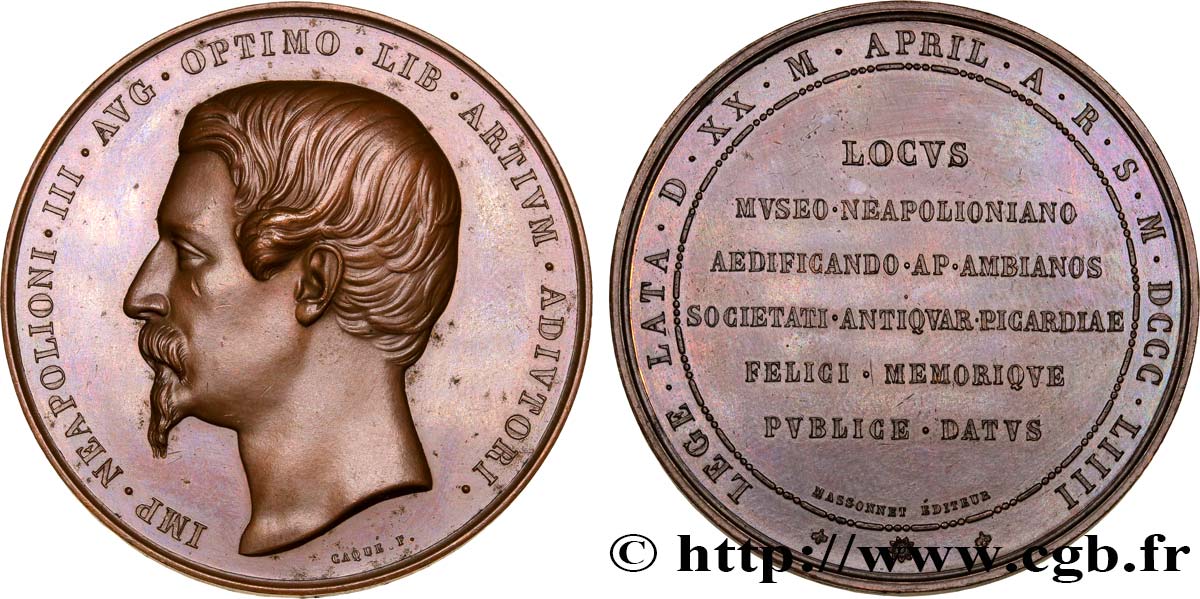
E-auction 411-323534 - fme_371446 - SECONDO IMPERO FRANCESE Médaille, Musée national de Picardie
Devi Sign-in ed essere un offerente approvato fare un'offerta, Login per fare offerte. Conti sono soggetti ad approvazione e di approvazione sono raggiunti entro 48 ore. Non aspettare fino al giorno di una vendita si chiude per registrarti.Confermando la tua offerta su questo oggetto ti impegni ad un contratto legalmente vincolante per l'acquisto di questo prodotto e fare clic su «offerta» costituisce accettazione dei termini di utilizzo de e-auctions cgb.fr.
Offerta deve essere collocato in euro gli importi interi vendita only.The si chiuderà al momento sulla descrizione dell'oggetto, eventuali offerte pervenute al sito dopo l'orario di chiusura non verranno eseguite. Volte transmition possono variare e le offerte potrebbero essere respinto se si attende per gli ultimi secondi. Per ulteriori informazioni ckeck le FAQ.
SENZA COSTI PER GLI ACQUIRENTI.
SENZA COSTI PER GLI ACQUIRENTI.
| Valutazione : | 160 € |
| Prezzo : | 72 € |
| Offerta maxima : | 138 € |
| Data di fine vendita : | 01 marzo 2021 18:35:30 |
| partecipanti : | 9 partecipanti |
Tipo : Médaille, Musée national de Picardie
Data: 1870
Nome della officina / città: 80 - Amiens
Metallo : rame
Diametro : 52 mm
Asse di coniazione : 12 h.
Incisore CAQUÉ Armand Auguste (1795-1881)
Peso : 70 g.
Orlo : lisse + main CUIVRE
Marchio : main indicatrice (1845-1860) et CUIVRE
Commenti sullo stato di conservazione:
Superbe médaille avec un très beau portrait au droit. Fine patine brune, bien homogène. Traces de manipulation
Diritto
Titolatura diritto : IMP. NAPOLIONI. III. AVG. OPTIMO. LIB. ARTIBVM. ADIVTORI..
Descrittivo diritto : Tête nue à gauche ; signé au-dessous CAQUE F..
Rovescio
Titolatura rovescio : LEGE. LATA D. XX. M. APRIL. A. R. S. M. DCCC. LIIII // LOCVS / MVSEO. NEAPOLIONIANO / AEDIFICANDO. AP. AMBIANOS / SOCIETATI. ANTIQVAR. PICARDIAE / FELICI. MEMOIQVE / PVBLICE. DATVS.
Descrittivo rovescio : Légende en six lignes, signé : MASSONET EDITEUR.
Commento
Le musée de Picardie est un musée d'art et d'archéologie situé à Amiens, en France. Il regroupe de riches collections qui vont de la Préhistoire au XXe siècle, notamment en archéologie et en peinture. Il a reçu le label « musée de France ».
Le musée fut créé en 1802 sous le nom « musée Napoléon », en référence à l'empereur Napoléon Ier, considéré comme le « fondateur » du musée, après qu'il eut envoyé une série de tableaux à l'occasion de la signature de la paix d'Amiens.
Le bâtiment actuel du musée fut construit entre 1855 et 1867 sur les plans des architectes Henri Parent et Arthur Diet qui prirent modèle sur l'agrandissement du Palais du Louvre de Napoléon III. Véritable palais, le bâtiment a été spécifiquement conçu - ce qui, à l'époque, était une véritable innovation - pour être un musée accueillant les collections régionales d'antiquités et des œuvres d'art. C'est aussi un bâtiment à la gloire de la Picardie et à ses hommes illustres. Sur les médaillons de la façade sont sculptés les portraits d'Antoine Parmentier, Jean de La Fontaine, Robert de Luzarches… Sur le plafond peint du grand salon on peut voir Jeanne Hachette, Pierre l'Ermite, Jean Racine…
Il est l'un des premiers établissements modernes de ce type bâti en France et servit de modèle pour d'autres villes. L'édifice a été créé grâce à l'action militante de la Société des antiquaires de Picardie, soucieuse de doter la cité d'un équipement propre à accueillir les objets récoltés depuis des décennies..
The Museum of Picardy is an art and archaeology museum located in Amiens, France.. It brings together rich collections ranging from prehistory to the 20th century, particularly in archaeology and painting.. It has received the “Musée de France” label..
The museum was founded in 1802 under the name \\\"Musée Napoléon\\\", in reference to Emperor Napoleon I, considered the \\\"founder\\\" of the museum, after he sent a series of paintings on the occasion of the signing of the Peace of Amiens..
The current museum building was built between 1855 and 1867 to the plans of architects Henri Parent and Arthur Diet, who modeled it on the expansion of the Louvre Palace by Napoleon III.. A true palace, the building was specifically designed - which, at the time, was a real innovation - to be a museum housing regional collections of antiquities and works of art.. It is also a building to the glory of Picardy and its illustrious men.. On the medallions of the facade are sculpted portraits of Antoine Parmentier, Jean de La Fontaine, Robert de Luzarches… On the painted ceiling of the great hall one can see Jeanne Hachette, Pierre l'Ermite, Jean Racine… It is one of the first modern establishments of this type built in France and served as a model for other towns. The building was created thanks to the militant action of the Société des antiquaires de Picardie, keen to provide the city with facilities capable of housing the objects collected over the decades..
Le musée fut créé en 1802 sous le nom « musée Napoléon », en référence à l'empereur Napoléon Ier, considéré comme le « fondateur » du musée, après qu'il eut envoyé une série de tableaux à l'occasion de la signature de la paix d'Amiens.
Le bâtiment actuel du musée fut construit entre 1855 et 1867 sur les plans des architectes Henri Parent et Arthur Diet qui prirent modèle sur l'agrandissement du Palais du Louvre de Napoléon III. Véritable palais, le bâtiment a été spécifiquement conçu - ce qui, à l'époque, était une véritable innovation - pour être un musée accueillant les collections régionales d'antiquités et des œuvres d'art. C'est aussi un bâtiment à la gloire de la Picardie et à ses hommes illustres. Sur les médaillons de la façade sont sculptés les portraits d'Antoine Parmentier, Jean de La Fontaine, Robert de Luzarches… Sur le plafond peint du grand salon on peut voir Jeanne Hachette, Pierre l'Ermite, Jean Racine…
Il est l'un des premiers établissements modernes de ce type bâti en France et servit de modèle pour d'autres villes. L'édifice a été créé grâce à l'action militante de la Société des antiquaires de Picardie, soucieuse de doter la cité d'un équipement propre à accueillir les objets récoltés depuis des décennies..
The Museum of Picardy is an art and archaeology museum located in Amiens, France.. It brings together rich collections ranging from prehistory to the 20th century, particularly in archaeology and painting.. It has received the “Musée de France” label..
The museum was founded in 1802 under the name \\\"Musée Napoléon\\\", in reference to Emperor Napoleon I, considered the \\\"founder\\\" of the museum, after he sent a series of paintings on the occasion of the signing of the Peace of Amiens..
The current museum building was built between 1855 and 1867 to the plans of architects Henri Parent and Arthur Diet, who modeled it on the expansion of the Louvre Palace by Napoleon III.. A true palace, the building was specifically designed - which, at the time, was a real innovation - to be a museum housing regional collections of antiquities and works of art.. It is also a building to the glory of Picardy and its illustrious men.. On the medallions of the facade are sculpted portraits of Antoine Parmentier, Jean de La Fontaine, Robert de Luzarches… On the painted ceiling of the great hall one can see Jeanne Hachette, Pierre l'Ermite, Jean Racine… It is one of the first modern establishments of this type built in France and served as a model for other towns. The building was created thanks to the militant action of the Société des antiquaires de Picardie, keen to provide the city with facilities capable of housing the objects collected over the decades..
Cronistoria
SECONDO IMPERO FRANCESE
(02/12/1852-04/09/1870)
Proclamato imperatore con il nome di Napoleone III, Luigi Napoleone fece il suo ingresso solenne a Parigi il 2 dicembre 1852.. Sposò Eugénie Marie de Montijo, un'aristocratica spagnola, nel gennaio 1853. Il suo regno può essere suddiviso in tre periodi: l'impero autoritario fino al 1860; l'Impero liberale dal 1860 al 1870 poi l'Impero parlamentare nel 1870. Durante l'impero autoritario, Napoleone III esercitava il suo potere senza condivisione, controllava la stampa mentre i giornali praticavano l'autocensura per evitare la loro soppressione.. I prefetti esercitano poteri illimitati nei dipartimenti, i sindaci, i funzionari sono nominati dal governo. Come sotto il Primo Impero, l'Istruzione e l'Università sono monitorate. Mantenendo i principi fondamentali della rivoluzione, la sovranità del popolo viene mantenuta grazie alla consultazione tramite plebiscito. Sul piano economico il boom è importante, si sviluppa l'industrializzazione così come gli istituti di credito ei grandi magazzini. Il prestigio militare è accresciuto dalla guerra di Crimea che consente alla Francia di svolgere un ruolo internazionale. L'attacco dell'Orsini (gennaio 1858) non impedisce alla Francia di intervenire in Italia per far trionfare il principio delle nazionalità e consente l'annessione di Nizza e Savoia con il trattato di Torino (marzo 1860). Dal 1860 l'Impero si mosse verso maggiori libertà: trattato di libero scambio con l'Inghilterra, comparsa di una debole opposizione nel Corpo Legislativo, concessione del diritto di sciopero (1864), liberalizzazione della stampa (1868). A livello internazionale la Francia acquisisce la Nuova Caledonia, la Cocincina e incoraggia lo scavo del Canale di Suez di Ferdinand de Lesseps. In Messico, invece, il sostegno a Massimiliano e all'Austria fu un fallimento. Le elezioni del 1869 furono molto negative per il regime e l'opposizione ottenne il 45% dei voti. Il regime si è poi evoluto verso un impero parlamentare chiamando al potere Émile Ollivier, leader del partito orléanista e liberale. Dopo Sadowa nel 1866 quando la Prussia schiacciò l'Austria, la vicenda del trono di Spagna e l'invio da Ems portarono alla guerra che fu dichiarata il 19 luglio 1870. Accumulando battute d'arresto, l'esercito francese fu circondato a Metz poi Napoleone III, malato, capitolò a Sedan il 2 settembre. Appena seppe la notizia, fu annunciata da Gambetta la decadenza dell'Impero, poi il 4 settembre fu proclamata la Repubblica.. Napoleone III fu poi portato prigioniero in Assia e poi partì per il Kent dove morì nel 1873..
 Segnalare un errore
 Stampate la pagina
 Condividi mia selezione
 Fai una domanda
 Consegnare / vendere
Articoli correlati

 Descrittivo


Articoli visualizzati di recente

5 Francs PASTEUR FRANCIA 1966 F.61.03 q.FDC
100.00 €

1000 Francs DRAPEAU FRANCIA 1944 VF.22.01 q.BB
500.00 €
Un centime Dupré 1798 Paris F.100/12 BB40
27.00 €

20 centimes Lindauer Zinc 1945 F.155/2 BB52
6.00 €
SECONDO IMPERO FRANCESE Médaille, Musée national de Picardie SPL
72.00 €

SVIZZERA - CANTON VAUD Médaille, Concours agricole SPL
100.00 €
cgbfr.it numismatica


