


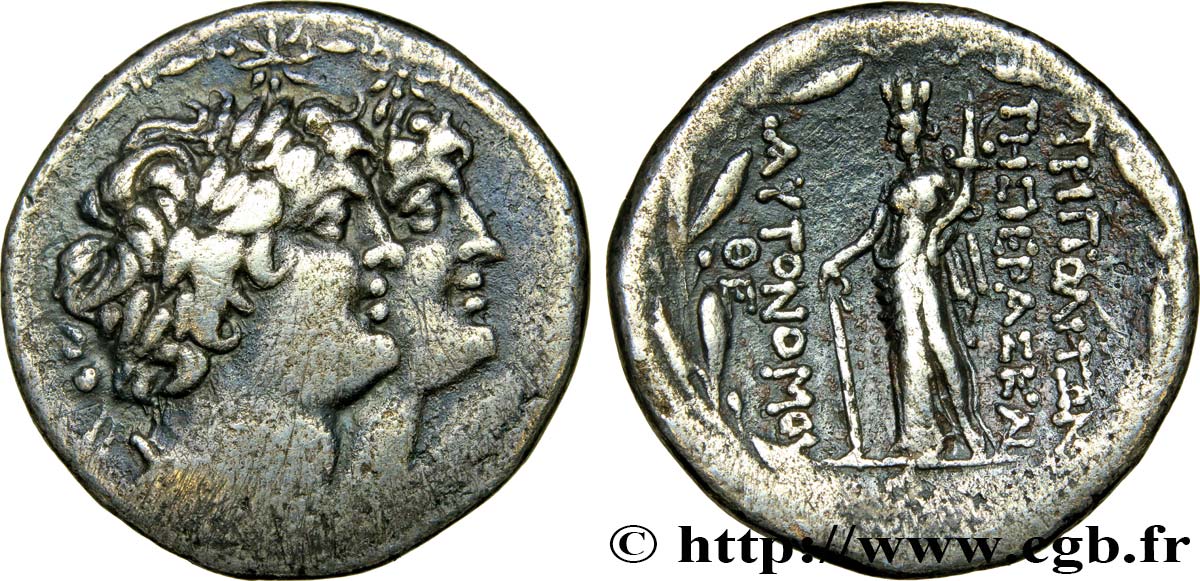
bgr_432050 - PHENICIA - TRIPOLIS Tétradrachme stéphanophore
non disponibile.
Articolo venduto sul nostro negozio (2020)
Prezzo : 750.00 €
Articolo venduto sul nostro negozio (2020)
Prezzo : 750.00 €
Tipo : Tétradrachme stéphanophore
Data: an 209
Nome della officina / città: Tripolis, Phénicie
Metallo : argento
Diametro : 27 mm
Asse di coniazione : 12 h.
Peso : 14,40 g.
Grado di rarità : R2
Commenti sullo stato di conservazione:
Exemplaire sur un flan ovale bien centré des deux côtés à l’usure importante lisible et identifiable. Beaux bustes des Dioscures. Usure plus importante au revers
N° nelle opere di riferimento :
Diritto
Titolatura diritto : ANÉPIGRAPHE.
Descrittivo diritto : Bustes accolés des Dioscures laurés et drapés à droite, surmontés chacun d’une étoile ; le tout entouré de la stemma.
Rovescio
Descrittivo rovescio : Tyché tourelée debout à gauche, vêtue du chiton, tenant un timon de la main droite et une corne d’abondance de la main gauche ; le tout dans une couronne de laurier.
Legenda rovescio : TRIPOLITWN/ THS IERAS KAI// AUTONOMOU/ QE
Traduzione rovescio : (de Tripoli la sainte et autonome).
Commento
Sur ce tétradrachme, la stemma n’est pratiquement pas visible. Mêmes coins que l’exemplaire reproduit dans l’ouvrage d’Edward Cohen, DCA., p. 385, n° 715. Sur cet exemplaire, nous avons une double datation en ère séleucide (an 209) à l’exergue et ère tripolitaine (an 3) dans le champ à gauche qui correspond à l’année 104-103 avant J.-C..
On this tetradrachm, the stemma is practically invisible. Same dies as the example reproduced in the work of Edward Cohen, DCA., p. 385, no. 715. On this example, we have a double dating in the Seleucid era (year 209) in the exergue and Tripolitan era (year 3) in the left field which corresponds to the year 104-103 BC.
On this tetradrachm, the stemma is practically invisible. Same dies as the example reproduced in the work of Edward Cohen, DCA., p. 385, no. 715. On this example, we have a double dating in the Seleucid era (year 209) in the exergue and Tripolitan era (year 3) in the left field which corresponds to the year 104-103 BC.
Cronistoria
PHENICIA - TRIPOLIS
(II-I secolo a.C.)
Tripoli del Libano, l'antica Tripoli fu fondata congiuntamente da tre delle principali città della Fenicia: Arados, Sidon e Tyr. Si trovava a metà strada sulla costa tra Arados e Byblos. La città ottenne la sua autonomia solo alla fine del II secolo a.C., nel 112-111 a.C., anche se si conoscono monete già dall'inizio del II secolo a.C.. La città sembra essere rimasta indipendente fino all'84-83 a.C. la città fu conquistata da Pompeo. Nel 50 a.C. fu sotto la lagida dominazione di Cleopatra VII Thea prima di cadere nelle mani di Marco Antonio nel 41-40 a.C.. Dopo aver adottato l'era pompeiana nel 64 a.C., prese l'era attiana dal 31 a.C..
 Segnalare un errore
 Stampate la pagina
 Condividi mia selezione
 Fai una domanda
 Consegnare / vendere
Articoli visualizzati di recente

1 Peseta SPAGNA 1951 P.139a AU+
9.00 €
5 Pesos CUBA 1896 P.048b SPL
13.72 €

TACITO Tétradrachme BB
26.00 €
CLAUDIO II IL GOTICO Antoninien BB/q.SPL
90.00 €
cgbfr.it numismatica


