


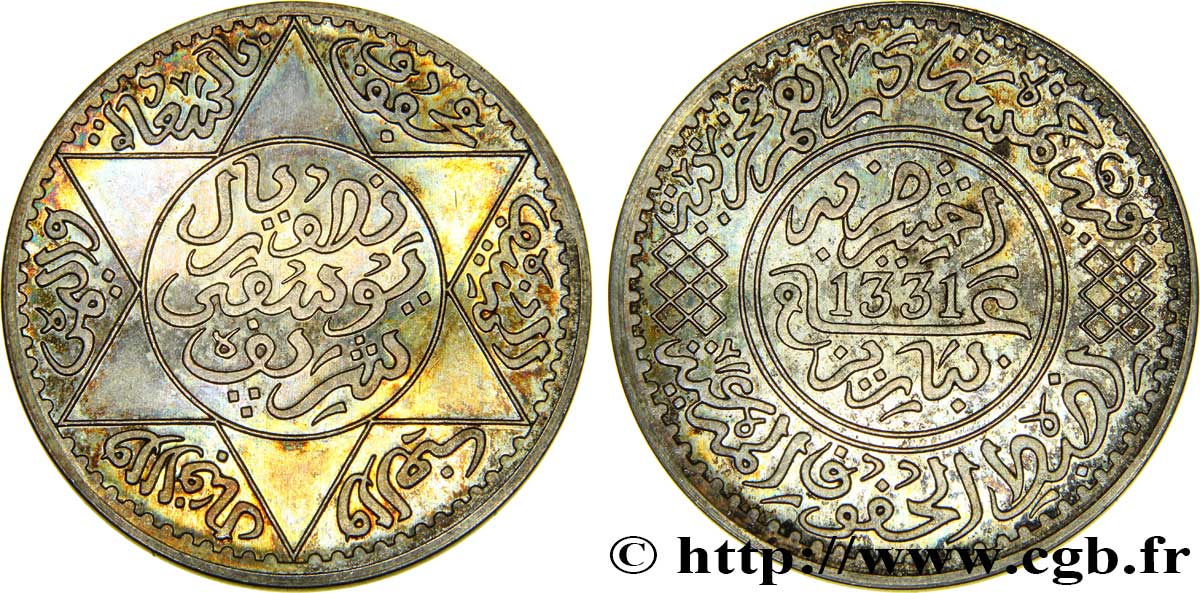
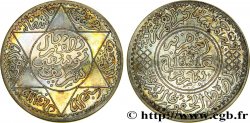
fco_320809 - MAROCCO - PROTETTORATO FRANCESE 5 Dirhams (frappe de présentation ?) Moulay Youssef I an 1331 1913 Paris
non disponibile.
Articolo venduto sul nostro negozio (2015)
Prezzo : 3 500.00 €
Articolo venduto sul nostro negozio (2015)
Prezzo : 3 500.00 €
Tipo : 5 Dirhams (frappe de présentation ?) Moulay Youssef I an 1331
Data: 1913
Nome della officina / città: Paris
Quantità coniata : -
Metallo : argento
Titolo in millesimi : 835 ‰
Diametro : 32,53 mm
Asse di coniazione : 6 h.
Peso : 18,05 g.
Orlo : étoiles sur tranche
Grado di rarità : INÉDIT
Commenti sullo stato di conservazione:
très bel exemplaire
N° nelle opere di riferimento :
Pedigree :
Cet exemplaire provient de la Collection Michel
Diritto
Titolatura diritto : EN ARABE, AU CENTRE : DEMI-RIAL DE MOULAY YUSSEF, LE NOBLE ; DANS LES CANTONS DE L’ÉTOILE : QU’IL SOIT ACCOMPAGNÉ PAR LA JOIE, LA CHANCE, L’AMOUR DE SON PEUPLE, LA GLOIRE, ET CE, POUR TOUJOURS.
Descrittivo diritto : Sceau de Salomon cerclé en son centre.
Rovescio
Titolatura rovescio : POUR VALOIR CE QUE DE DROIT POUR CINQ DIRHAMS COURANTS / FRAPPÉ EN L’ANNÉE 1331 À PARIS.
Descrittivo rovescio : Double cercle et arabesques.
Commento
Cette monnaie a une tranche lisse contrairement au type émis qui a une tranche étoilée. Le poids est aussi supérieur avec un poids de 18,05 grammes contre 12,50 grammes contre le type émis. Épreuve ou essai, cette monnaie suscite de nombreuses interrogations.
Nous avons souvent inversé les illustrations du livre de Jean Lecompte avers/revers car le Maroc étant un protectorat, la puissance émettrice, théoriquement placée à l’avers, est le roi du Maroc et non la République française.
Pour cette pièce, qui ne mentionne pas de statut politique particulier ni n’utilise le système inspiré de celui des Français (qui n’apparaît qu’en 1339 A.H., on devrait certainement placer à l’avers le nom et les titres du roi. On notera que dans ce cas l’avers porte également la valeur faciale, le revers une autre expression de la valeur faciale, le lieu et l’année de frappe.
Malheureusement, entre les intentions des responsables marocains, l’exécution par la Monnaie de Paris (nous avons vu que l’auteur des coins ne connaissait pas la langue arabe) et les traditions locales éventuellement différentes, il est très difficile de trancher.
This coin has a smooth edge, unlike the issued type, which has a star-shaped edge. Its weight is also higher, weighing 18.05 grams compared to 12.50 grams for the issued type. Whether proof or trial, this coin raises many questions. We have often reversed the illustrations in Jean Lecompte's book, obverse/reverse, because Morocco being a protectorate, the issuing power, theoretically placed on the obverse, is the King of Morocco and not the French Republic. For this coin, which does not mention any particular political status nor does it use the system inspired by the French (which only appears in 1339 AH), the name and titles of the king should certainly be placed on the obverse. It should be noted that in this case the obverse also bears the face value, the reverse another expression of the face value, the place and year of minting. Unfortunately, between the intentions of the Moroccan officials, the execution by the Paris Mint (we have seen that the author of the dies did not know the Arabic language) and the possibly different local traditions, it is very difficult to decide
Nous avons souvent inversé les illustrations du livre de Jean Lecompte avers/revers car le Maroc étant un protectorat, la puissance émettrice, théoriquement placée à l’avers, est le roi du Maroc et non la République française.
Pour cette pièce, qui ne mentionne pas de statut politique particulier ni n’utilise le système inspiré de celui des Français (qui n’apparaît qu’en 1339 A.H., on devrait certainement placer à l’avers le nom et les titres du roi. On notera que dans ce cas l’avers porte également la valeur faciale, le revers une autre expression de la valeur faciale, le lieu et l’année de frappe.
Malheureusement, entre les intentions des responsables marocains, l’exécution par la Monnaie de Paris (nous avons vu que l’auteur des coins ne connaissait pas la langue arabe) et les traditions locales éventuellement différentes, il est très difficile de trancher.
This coin has a smooth edge, unlike the issued type, which has a star-shaped edge. Its weight is also higher, weighing 18.05 grams compared to 12.50 grams for the issued type. Whether proof or trial, this coin raises many questions. We have often reversed the illustrations in Jean Lecompte's book, obverse/reverse, because Morocco being a protectorate, the issuing power, theoretically placed on the obverse, is the King of Morocco and not the French Republic. For this coin, which does not mention any particular political status nor does it use the system inspired by the French (which only appears in 1339 AH), the name and titles of the king should certainly be placed on the obverse. It should be noted that in this case the obverse also bears the face value, the reverse another expression of the face value, the place and year of minting. Unfortunately, between the intentions of the Moroccan officials, the execution by the Paris Mint (we have seen that the author of the dies did not know the Arabic language) and the possibly different local traditions, it is very difficult to decide
Cronistoria
MAROCCO - PROTETTORATO FRANCESE
1912-1956
Il Marocco si è aperto al commercio europeo alla fine del XVIII secolo. Il paese rimase diviso nel XIX secolo tra l'influenza francese (bombardamento di Tangeri e Mogador), britannica e spagnola e divenne una posta in gioco nella rivalità delle sue potenze, a cui la Germania si unì nel 1905. L'incidente di Agadir nel 1911 è regolato dal trattativa tra Francia e Germania che accetta il protettorato francese sul Marocco contro una fascia di territorio in Congo. Lyautey, generale residente, pacifica il paese mentre l'Alto Atlante resiste fino al 1934. In seguito a grandi lavori, il paese si trasforma rapidamente ma la Francia impone sempre più la sua amministrazione diretta senza tener conto del protettorato. Il nazionalismo ha poi continuato a guadagnare terreno e la sconfitta del 1940 ha portato a manifestazioni sempre più grandi..
 Segnalare un errore
 Stampate la pagina
 Condividi mia selezione
 Fai una domanda
 Consegnare / vendere
Articoli correlati
 Descrittivo


Articoli visualizzati di recente

GALLIA - ALTA E MEDIA SEINE Potin au sanglier et à la tête coupée MB
4.00 €
MAROCCO - PROTETTORATO FRANCESE 5 Dirhams (frappe de présentation ?) Moulay You
3500.00 €

50 francs or Napoléon III, tête nue 1857 Paris F.547/4 BB48
562.00 €

20 francs or Génie, Troisième République 1898 Paris F.533/23 BB45
210.00 €

SRI LANKA 5 Rupees (Roupies) Sommet des pays non alignés 1976 Llantrisant SPL
8.00 €

ITALIA - REGNO DE SARDINIA 5 Lire Victor Emmanuel I 1819 Turin MB
154.00 €
cgbfr.it numismatica


