


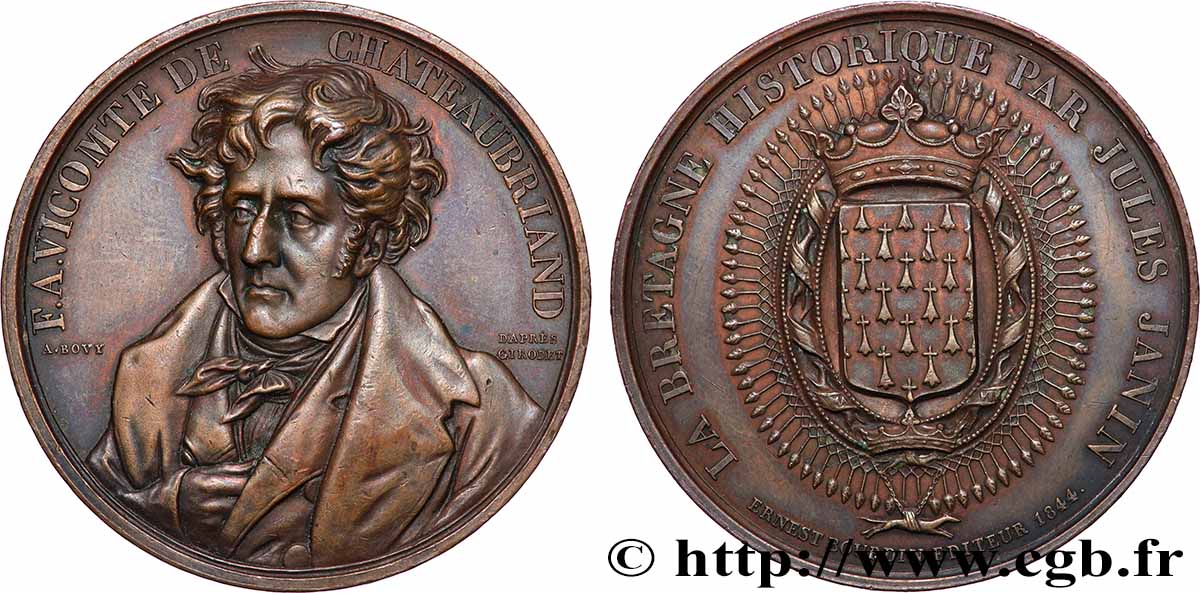
fme_1119170 - LUIGI FILIPPO I Médaille, Jules Janin, Vicomte de Chateaubriand, refrappe
60.00 €
Quantità
Aggiungi al carrello

Tipo : Médaille, Jules Janin, Vicomte de Chateaubriand, refrappe
Data: 1844
Metallo : rame
Diametro : 41 mm
Asse di coniazione : 12 h.
Incisore BOVY Antoine (1795-1877)
Peso : 39,72 g.
Orlo : lisse + proue CUIVRE
Marchio : Proue CUIVRE
Commenti sullo stato di conservazione:
Patine hétérogène, légèrement irisée, avec des traces d’usure, rayures et taches d’oxydation
N° nelle opere di riferimento :
Diritto
Titolatura diritto : F. A. VICOMTE DE - CHATEAUBRIAND.
Descrittivo diritto : Buste habillé de trois quarts face de Chateaubriand, signé : A. BOVY - D’APRES GIRODET.
Rovescio
Titolatura rovescio : LA BRETAGNE HISTORIQUE PAR JULES JANIN.
Descrittivo rovescio : Écu couronné de Bretagne, signé : ERNEST BOURDIN EDITEUR 1844..
Commento
Gabriel-Jules Janin, né à Saint-Étienne le 16 février 18041 est mort à Paris le 19 juin 1874, est un écrivain et critique dramatique français.
Fils d’un avocat, Janin reçoit une bonne éducation, d’abord dans sa ville natale puis au lycée Louis-le-Grand à Paris. Après un passage dans l’étude de l’avoué Jean-Baptiste Guillonnet-Merville, où il sera saute-ruisseau en même temps qu’Honoré de Balzac, il devient journaliste et travaille notamment à la Revue de Paris, à la Revue des deux Mondes, au Figaro et à la Quotidienne. Il fut parmi les fondateurs de la Revue de Paris et du Journal des Enfants. Il se fait connaître en 1827 avec le roman L’Âne mort et la femme guillotinée. La Confession en 1830, un peu moins profond, mais au style encore plus remarquable, et Barnave en 1831, où il attaque la famille d’Orléans, finissent d’asseoir sa réputation.
Entre-temps, il entre comme critique au Journal des Débats où il reste quarante ans. Son autorité le fait surnommer « le prince des critiques ».
Gabriel-Jules Janin, born in Saint-Étienne on February 16, 1804, died in Paris on June 19, 1874, was a French writer and drama critic. The son of a lawyer, Janin received a good education, first in his hometown and then at the Lycée Louis-le-Grand in Paris. After a stint in the office of the lawyer Jean-Baptiste Guillonnet-Merville, where he was a leaping brook at the same time as Honoré de Balzac, he became a journalist and worked notably for the Revue de Paris, the Revue des deux Mondes, Le Figaro and La Quotidienne. He was among the founders of the Revue de Paris and the Journal des Enfants. He became known in 1827 with the novel The Dead Donkey and the Guillotined Woman. The Confession in 1830, a little less profound, but with an even more remarkable style, and Barnave in 1831, in which he attacks the Orléans family, finally established his reputation. In the meantime, he joined the Journal des Débats as a critic, where he remained for forty years. His authority earned him the nickname \\\"the prince of critics.\\\"
Cronistoria
LUIGI FILIPPO I
(7/08/1830-24/02/1848)
Nato a Parigi nel 1773, Luigi Filippo è il primogenito di Luigi Filippo Giuseppe, duca d'Orléans (Philippe-Égalité), ghigliottinato nel 1793 per corruzione dopo aver votato per la morte del cugino Luigi XVI. Successivamente porta i titoli di duca di Valois, Chartres e Orleans dal 1793. Favorevole alla Rivoluzione, come suo padre, dovette tuttavia rifugiarsi in Svizzera, poi viaggiò in Scandinavia, negli Stati Uniti e infine si stabilì in Inghilterra nel 1801.. La Restaurazione gli permette di ritrovare gli immensi possedimenti della sua famiglia ma rimane considerato un potenziale rivale da Luigi XVIII che lo accoglie con freddezza. Profugo in Inghilterra durante i cento giorni, tornò in Francia nel 1817. Avido di guadagno, ha dato il suo appoggio all'opposizione rappresentata dal partito liberale facendo affidamento sull'alta borghesia possidente.. Le giornate del 1830 gli diedero la possibilità di salire al potere dopo aver aderito al tricolore e moltiplicato le promesse. Divenne il 31 luglio 1830 luogotenente generale del regno poi re dei francesi il 7 agosto. Il suo regno, sotto un'apparenza liberale, diventerà quello della borghesia e degli ambienti imprenditoriali mentre le opposizioni (legittimisti, bonapartisti, repubblicani e socialisti) saranno mantenute illegalmente.. La sua politica di pace e la sua autorità gli valsero poi un notevole prestigio presso le corti europee.. Il banchiere Laffitte è Primo Ministro. La Fayette è uno degli artefici di questa "rivoluzione borghese". Il 13 marzo 1831 Casimir Périer sostituì Laffitte. La Francia interviene in Belgio nell'agosto 1831 per contrastare gli olandesi. I legittimisti, con il complotto di rue des Prouvaires, cercano di stabilire Enrico V come re mentre sua madre cerca di sollevare la Vandea. Fu arrestata il 3 dicembre 1832 a Nantes.. L'epidemia di colera uccide più di diecimila persone a Parigi, tra cui Casimir Périer. I funerali del generale Lamarque furono l'occasione per un tentativo di insurrezione repubblicana, schiacciato nel sangue (cfr. miserabile). I francesi occupano Anversa il 23 dicembre 1832.. L'attacco di Fieschi del 28 luglio 1835 contro Luigi Filippo uccide diciotto persone tra cui il maresciallo Mortier. La prima linea ferroviaria Parigi-Orléans e la colonna di luglio furono inaugurate rispettivamente il 24 ottobre 1837 e il 28 luglio 1840.. L'anno 1840 segnò una svolta nel regime, con grande instabilità ministeriale prima di avere il ministero Guizot ("Arricchisci!").. Il principe Luigi Napoleone Bonaparte, dopo un secondo tentativo di putsch, fu condannato all'ergastolo e rinchiuso a Fort Ham da cui fuggì nel 1846. Le ceneri di Napoleone vengono portate da Sant'Elena e trasferite a Les Invalides. Dal 1841 Luigi Filippo impegnò la Francia sulla via della conquista totale dell'Algeria, già avviata sotto Carlo X, mentre nella Francia metropolitana si sviluppò un grande boom economico.. Una legge del 1841 limita il lavoro minorile a 12 ore. Il primo grave incidente ferroviario avvenne sulla linea Parigi-Versailles e causò 45 morti l'8 maggio 1842. Il 13 luglio morì accidentalmente il duca d'Orleans, il figlio maggiore del re. Il 16 maggio 1843 il duca di Aumale prese la smala di Abd-el-Kader che riuscì a fuggire. Bugeaud, governatore dell'Algeria, viene nominato maresciallo. Il 1843 segna anche l'inizio dell'Intesa Cordiale e la visita della regina Vittoria in Francia. I francesi hanno battuto i marocchini a Isly. Abd-el-Kader si arrende il 23 dicembre 1847. Il rifiuto delle riforme porta alla caduta del regime durante la campagna dei banchetti e Luigi Filippo, detronizzato il 24 febbraio 1848, si rifugia in Inghilterra dopo aver abdicato in favore del nipote..
 Segnalare un errore
 Stampate la pagina
 Condividi mia selezione
 Fai una domanda
 Consegnare / vendere
Articoli correlati

 Descrittivo


Articoli visualizzati di recente

LOTTE Lot de 5 monnaies lotto
150.00 €

10 francs Jimenez 1986 F.373/3 SPL62 PCGS
110.00 €

REGNO UNITO 1 Shilling Guillaume IV 1834 BB
75.00 €
cgbfr.it numismatica


