


v52_0408 - GIULIO CAESAR Denier

MONNAIES 52 (2012)
Prezzo di inizio : 750.00 €
Valutazione : 1 500.00 €
Prezzo realizzato : 830.00 €
Numero di offerte : 4
Offerta maxima : 850.00 €
Prezzo di inizio : 750.00 €
Valutazione : 1 500.00 €
Prezzo realizzato : 830.00 €
Numero di offerte : 4
Offerta maxima : 850.00 €
Tipo : Denier
Data: 49 AC.
Nome della officina / città: Gaule ou Italie
Metallo : argento
Titolo in millesimi : 950 ‰
Diametro : 19,5 mm
Asse di coniazione : 10 h.
Peso : 3,38 g.
Grado di rarità : R1
Commenti sullo stato di conservazione:
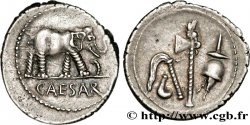
Exemplaire de qualité exceptionnelle pour ce type sur un flan large, ovale parfaitement centré des deux côtés avec les grènetis complets. Droit magnifique avec un éléphant de haut relief, bien venu à la frappe. Très joli revers de style fin. Patine grise épaisse avec des reflets mordorés. Conserve la plus grande partie de son brillant de frappe et de son coupant d’origine
N° nelle opere di riferimento :
Pedigree :
Cet exemplaire provient de la vente Burgan 23, 1990, n° 218 et de la collection D. J
Diritto
Titolatura diritto : CAESAR À L'EXERGUE.
Descrittivo diritto : Éléphant passant à droite ; à ses pieds, un serpent (ou carnyx, trompette gauloise).
Traduzione diritto : “Cæsar”, (César).
Rovescio
Titolatura rovescio : ANÉPIGRAPHE.
Descrittivo rovescio : Instruments pontificaux : simpulum, aspersoir, hache à sacrifice, chapeau à sacrifice.
Commento
Poids léger. Pour ce type, M. Crawford a relevé une estimation de 750 coins de droit et de 833 coins de revers, représentant une production qui pourrait avoisiner les deux à quatre millions de deniers. Les auteurs du CMDRR. ont isolé six variétés différentes pour ce denier. Pendant très longtemps, on pensa que ce denier avait été frappé par César pendant la Guerre des Gaules entre 58 et 52 avant J.-C., en Gaule même. En fait, il fut fabriqué au début des Guerres Civiles. Il a été imité servilement par les Trévires avec le bronze HIRTIVS (LT. 9235), fortement romanisé.
Lightweight. For this type, Mr. Crawford noted an estimate of 750 obverse dies and 833 reverse dies, representing a production that could be around two to four million denarii. The authors of the CMDRR. isolated six different varieties for this denarius. For a very long time, it was thought that this denarius had been struck by Caesar during the Gallic Wars between 58 and 52 BC, in Gaul itself. In fact, it was made at the beginning of the Civil Wars. It was slavishly imitated by the Treveri with the bronze HIRTIVS (LT. 9235), heavily Romanized
Lightweight. For this type, Mr. Crawford noted an estimate of 750 obverse dies and 833 reverse dies, representing a production that could be around two to four million denarii. The authors of the CMDRR. isolated six different varieties for this denarius. For a very long time, it was thought that this denarius had been struck by Caesar during the Gallic Wars between 58 and 52 BC, in Gaul itself. In fact, it was made at the beginning of the Civil Wars. It was slavishly imitated by the Treveri with the bronze HIRTIVS (LT. 9235), heavily Romanized
Cronistoria
GIULIO CAESAR
(13/07/100-15/03/44 a.C.)
Giulio Cesare, nato nel 100 a.C., appartiene al partito di Mario e si oppone giovanissimo a Silla. Fu pretore nel 62 a.C., prima di formare con Pompeo e Crasso il primo triumvirato nel 59 a.C., anno del suo consolato. Riceve quindi un impero proconsolare sulla Gallia, rinnovato nel 54. Combatte Vercingétorige a Gergovie poi ad Alesia. Assediato, il capo gallico deve arrendersi. Crasso essendo stato ucciso a Carre, in Mesopotamia, nel 53 aC, Cesare si arrabbiò con Pompeo e marciò su Roma nel 49 aC Nel 48 aC, a Farsalo, schiacciò Pompeo che fuggì in Egitto dove fu assassinato. Cesare deve quindi affrontare i figli di Pompeo e il partito pompeiano. Li sconfisse a Thapsus (Africa, morte di Catone di Utica) nel 46 aC ea Munda (Spagna, morte di Gneio Pompeo). Cesare fu assassinato alle Idi di marzo (15 marzo 44 a.C.) da Cassio e Bruto. Fu divinizzato dopo la sua morte nel 42 a.C..
 Segnalare un errore
 Stampate la pagina
 Condividi mia selezione
 Fai una domanda
 Consegnare / vendere
Articoli correlati
 Descrittivo
Articoli visualizzati di recente
TROAS - NEANDREIA Obole BB
175.00 €

COMMODO Unité BB
195.00 €
BRUTO Denier q.SPL
801.00 €
SETTIMIO SEVERO Denier q.SPL
150.00 €
PROBO Aurelianus MS
175.00 €
GIULIO CAESAR Denier MS
830.00 €
cgbfr.it numismatica


