


bpv_141600 - VESPASIANO Tétradrachme syro-phénicien
non disponibile.
Articolo venduto sul nostro negozio (2015)
Prezzo : 350.00 €
Articolo venduto sul nostro negozio (2015)
Prezzo : 350.00 €
Tipo : Tétradrachme syro-phénicien
Data: an 2
Nome della officina / città: Antioche, Syrie, Séleucie et Piérie
Metallo : argento
Diametro : 25,5 mm
Asse di coniazione : 12 h.
Peso : 13,11 g.
Commenti sullo stato di conservazione:
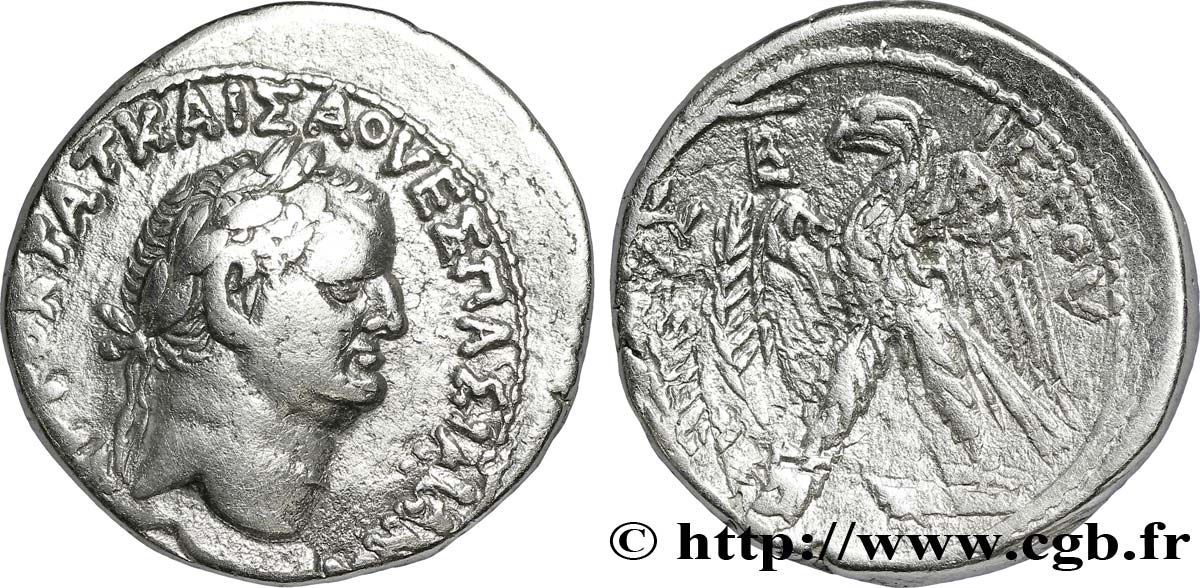
Flan très large, exceptionnel pour l’émission, le décentrement ne gêne donc pas la lecture, très faible usure de circulation, petites traces de tréflage au revers
N° nelle opere di riferimento :
Pedigree :
Cet exemplaire est le 0112_018, il provient de la trouvaille dite de Cisjordanie
Diritto
Descrittivo diritto : Tête laurée de Vespasien à droite (O*).
Legenda diritto : AUTOKRAT KAISA OUESPASIANOU, (Autokratoros Kaisaros ouespasianou)
Traduzione diritto : (L'empereur césar Vespasien).
Rovescio
Descrittivo rovescio : Aigle debout à gauche sur une massue, les ailes déployées.
Legenda rovescio : ETOUS B IE[ROU] (Etous b Ierou)
Traduzione rovescio : (deuxième année sainte).
Commento
Les monnaies du troisième groupe des frappes de Vespasien, caractérisées par un aigle à gauche sur une massue, sans couronne dans le bec, sont du style d’Alexandrie mais de la datation syrienne avec la lettre annuelle surmontée d’une barre. Les quantités frappées suivent les besoins : les frappes les plus massives sont celles de l’An 2, fin de la Guerre juive et elles se terminent en l’An 5 avec des quantités frappées décroissantes au fil des années.
Plusieurs graveurs participent à cette série où celui de notre exemplaire est très bien représenté. On doit remarquer que les pièces des groupes dits au style d’Alexandrie ont une caractéristique commune : l’aigle ne tient pas de couronne (groupes 1, 2 et 3) dans le bec. Ceci renforce l’idée que cette couronne était une distinction attribuée à la ville émettrice et que nous aurions affaire à un atelier militaire ou plus simplement à un atelier - quelque soit sa localisation - fourni en métal par le Trésor Militaire, sans lien organique avec une ville.
Dans la base TSP maintenue par Michel Prieur, cent seize exemplaires sont maintenant répertoriés, les musées sont bien pourvus : Paris, British Museum, Berne, ANS (3), Israel State Museum, Oxford (3), Hunterian Coin Collection et Blackburn Museum.
The coins of the third group of Vespasian's strikes, characterized by an eagle facing left on a club, without a crown in the beak, are of the Alexandrian style but of Syrian dating with the annual letter surmounted by a bar. The quantities minted follow the needs: the most massive mintings are those of Year 2, end of the Jewish War and they end in Year 5 with decreasing quantities minted over the years.
Several engravers participate in this series where that of our example is very well represented. It should be noted that the coins of the so-called Alexandrian style groups have a common characteristic: the eagle does not hold a crown (groups 1, 2 and 3) in its beak.. This reinforces the idea that this crown was a distinction awarded to the issuing city and that we would be dealing with a military workshop or more simply a workshop - whatever its location - supplied with metal by the Military Treasury, without an organic link with a city..
In the TSP database maintained by Michel Prieur, one hundred and sixteen examples are now listed, the museums are well supplied: Paris, British Museum, Bern, ANS (3), Israel State Museum, Oxford (3), Hunterian Coin Collection and Blackburn Museum
Plusieurs graveurs participent à cette série où celui de notre exemplaire est très bien représenté. On doit remarquer que les pièces des groupes dits au style d’Alexandrie ont une caractéristique commune : l’aigle ne tient pas de couronne (groupes 1, 2 et 3) dans le bec. Ceci renforce l’idée que cette couronne était une distinction attribuée à la ville émettrice et que nous aurions affaire à un atelier militaire ou plus simplement à un atelier - quelque soit sa localisation - fourni en métal par le Trésor Militaire, sans lien organique avec une ville.
Dans la base TSP maintenue par Michel Prieur, cent seize exemplaires sont maintenant répertoriés, les musées sont bien pourvus : Paris, British Museum, Berne, ANS (3), Israel State Museum, Oxford (3), Hunterian Coin Collection et Blackburn Museum.
The coins of the third group of Vespasian's strikes, characterized by an eagle facing left on a club, without a crown in the beak, are of the Alexandrian style but of Syrian dating with the annual letter surmounted by a bar. The quantities minted follow the needs: the most massive mintings are those of Year 2, end of the Jewish War and they end in Year 5 with decreasing quantities minted over the years.
Several engravers participate in this series where that of our example is very well represented. It should be noted that the coins of the so-called Alexandrian style groups have a common characteristic: the eagle does not hold a crown (groups 1, 2 and 3) in its beak.. This reinforces the idea that this crown was a distinction awarded to the issuing city and that we would be dealing with a military workshop or more simply a workshop - whatever its location - supplied with metal by the Military Treasury, without an organic link with a city..
In the TSP database maintained by Michel Prieur, one hundred and sixteen examples are now listed, the museums are well supplied: Paris, British Museum, Bern, ANS (3), Israel State Museum, Oxford (3), Hunterian Coin Collection and Blackburn Museum
Cronistoria
VESPASIANO
(1/07/69-24/06/79)
Vespasien nacque il 17 novembre 9 a Flacrines, presso Reate (nella terra sabina). Appartiene alla borghesia municipale italiana. Edile nel 38, prestatore nel 40, console nel 51, proconsole d'Africa nel 63, comandò con Claude la spedizione in Bretagna. Nerone gli affidò tre legioni e un impero proconsolare per reprimere la rivolta di Giudea nel 66. Fu proclamato augusto il 1 luglio 69 ad Alessandria e i suoi figli, Tito e Domiziano, furono promossi a Cesare. Vitellio fu eliminato il 20 dicembre 69. Tito fu direttamente associato al governo dal padre dal 71. Il suo regno fu dedicato alla restaurazione politica ed economica di Roma. Nel 73, ha assunto la censura. Morì a Reate il 24 giugno 79.
 Segnalare un errore
 Stampate la pagina
 Condividi mia selezione
 Fai una domanda
 Consegnare / vendere
Articoli correlati

 Descrittivo


cgbfr.it numismatica


