


E-auction 106-56289 - bpv_304956 - VESPASIANO Tétradrachme syro-phénicien
Devi Sign-in ed essere un offerente approvato fare un'offerta, Login per fare offerte. Conti sono soggetti ad approvazione e di approvazione sono raggiunti entro 48 ore. Non aspettare fino al giorno di una vendita si chiude per registrarti.Confermando la tua offerta su questo oggetto ti impegni ad un contratto legalmente vincolante per l'acquisto di questo prodotto e fare clic su «offerta» costituisce accettazione dei termini di utilizzo de e-auctions cgb.fr.
Offerta deve essere collocato in euro gli importi interi vendita only.The si chiuderà al momento sulla descrizione dell'oggetto, eventuali offerte pervenute al sito dopo l'orario di chiusura non verranno eseguite. Volte transmition possono variare e le offerte potrebbero essere respinto se si attende per gli ultimi secondi. Per ulteriori informazioni ckeck le FAQ.
SENZA COSTI PER GLI ACQUIRENTI.
SENZA COSTI PER GLI ACQUIRENTI.
| Valutazione : | 95 € |
| Prezzo : | 80 € |
| Offerta maxima : | 80 € |
| Data di fine vendita : | 27 aprile 2015 16:02:00 |
| partecipanti : | 7 partecipanti |
Tipo : Tétradrachme syro-phénicien
Data: an 4
Nome della officina / città: Antioche, Syrie, Séleucie et Piérie
Metallo : argento
Diametro : 27 mm
Asse di coniazione : 12 h.
Peso : 14,52 g.
Commenti sullo stato di conservazione:
Flan un peu court, usure de circulation, bons détails au revers
N° nelle opere di riferimento :
Pedigree :
Cet exemplaire est le 0137_039 de la base TSP, il provient de la trouvaille dite de Cisjordanie
Diritto
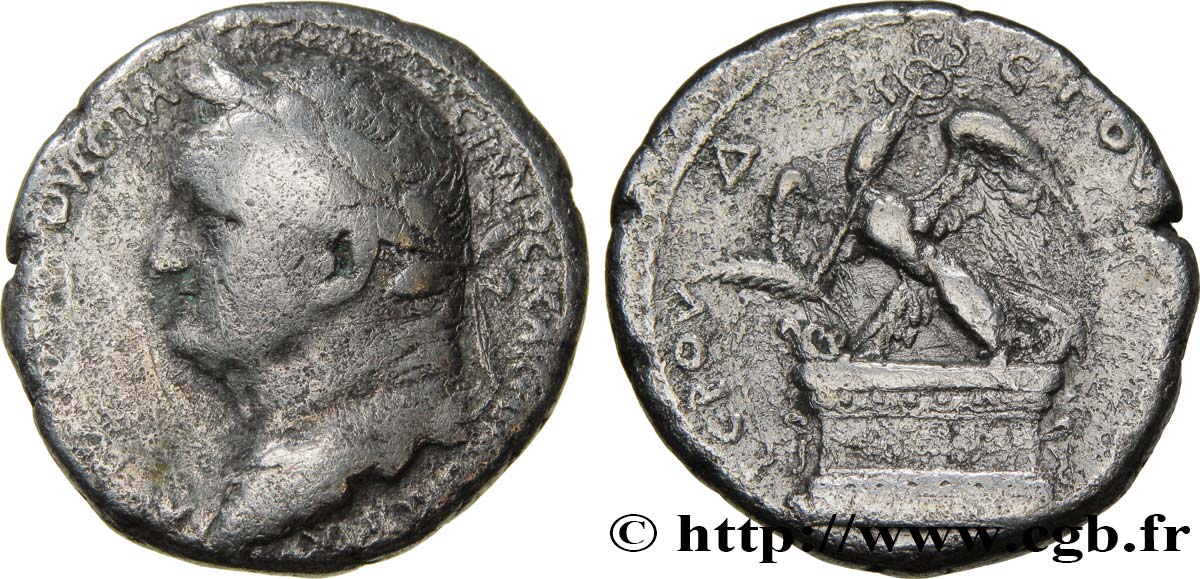
Descrittivo diritto : Tête laurée de Vespasien à gauche, traces de draperies sur l’épaule, légende commençant à la troncature du buste, grènetis en feuilles et points (O*3).
Legenda diritto : AUTOKRATWR OUESPASIANOS KAISAR SEBASTOS
Traduzione diritto : (L'empereur Vespasien césar auguste).
Rovescio
Descrittivo rovescio : Aigle debout à gauche, tête et queue à droite tenant un caducée dans son bec, une palme horizontale tournée à gauche à coté de lui, le tout posé sur un large autel enguirlandé et décoré, les bords relevés de petites sculptures.
Legenda rovescio : ETOUS NEOU IEROU D
Traduzione rovescio : (année sainte, quatrième du règne).
Commento
Nous suivons Richard McAlee dans sa distinction entre les gravures avec un grènetis au droit (RMACRA 359a) et celles avec des feuilles alternées de points (RMACRA 359b) et créons donc les références 137A et 137B. Malheureusement pour les pointages, les images des anciens catalogues ne sont pas toujours d’une parfaite netteté et il faudra attendre que ces exemplaires repassent en vente avec de meilleures photos pour terminer la répartition. Le problème des flans courts se pose aussi et ne peut être résolu que par des comparaisons de coins.
Le dixième groupe des frappes de Vespasien est une complète énigme, surtout pour son type de revers. En effet, celui-ci est sans équivalent sauf dans une rarissime émission de Caracalla pour Byblos (prieur 1307), certainement sans aucun rapport.
La frappe de se groupe se déroule dans les années 4 et 5 du règne, le graveur, d’une qualité exceptionnelle, n’est pas répertorié par ailleurs et sa technique de marque au compas le cercle de la légende, laissant une marque visible, n’est pas connue sur d’autres pièces de la période.
Il ne s’agit pas d’une émission commémorative sans contenu économique, puisque le nombre d’exemplaires connus n’est pas négligeable. Il vient concurrencer le groupe 3, seul à encore frapper dans ces années tardives, sans que l’on comprenne - sauf pour une question de qualité esthétique (rappelons que le groupe 3 est de l’école dite d’Alexandrie, donc d’une gravure médiocre) pourquoi il apparaît. Il y a certainement un motif à ce type si extraordinaire, qui ne sera pas repris ultérieurement, mais dont l’Histoire semble avoir - à notre connaissance - perdu le souvenir.
Le style du droit - extraordinaire - est tout à l’honneur de l’école hellénistique de gravure et on remarque, à la presque maigreur et au nez plus pincé de l’empereur, que celui-ci a bien vieilli depuis la prise de pouvoir : nous sommes loin des portraits stéréotypés de l’atelier de Rome !
Dans la base TSP maintenue par Michel Prieur, cent vingt et un exemplaires sont maintenant répertoriés (variantes et indéterminés compris) dont en musées Paris (3), Berlin (2), Glasgow Hunterian Coin Collection, Berne, ANS (2), Copenhague, Jérusalem, Oxford, Fitzwilliam Museum (2), Yale, Vienne(2), Oslo, Tel Aviv Kadman Museum, Jerusalem Hebrew University.
We follow Richard McAlee in his distinction between engravings with a grain on the right (RMACRA 359a) and those with alternating sheets of dots (RMACRA 359b) and therefore create the references 137A and 137B. Unfortunately for the scores, the images in the old catalogs are not always perfectly clear and we will have to wait until these examples come back on sale with better photos to complete the distribution.. The problem of short sides also arises and can only be solved by comparisons of corners.
The tenth group of Vespasian's strikes is a complete enigma, especially for its type of reverse. Indeed, this one has no equivalent except in a very rare issue of Caracalla for Byblos (prior 1307), certainly without any connection.
The striking of this group took place in years 4 and 5 of the reign, the engraver, of exceptional quality, is not listed elsewhere and his technique of marking the circle of the legend with a compass, leaving a visible mark, is not known on other coins of the period.
This is not a commemorative issue without economic content, since the number of known examples is not negligible.. It competes with group 3, the only one still striking in these late years, without anyone understanding - except for a question of aesthetic quality (remember that group 3 is from the so-called Alexandria school, therefore of mediocre engraving) why it appears. There is certainly a motive for this extraordinary type, which will not be taken up again later, but which History seems to have - to our knowledge - lost the memory of..
The style of the right - extraordinary - is a credit to the Hellenistic school of engraving and we notice, from the almost thinness and the more pinched nose of the emperor, that he has aged well since taking power: we are far from the stereotypical portraits of the workshop of Rome! In the TSP database maintained by Michel Prieur, one hundred and twenty-one examples are now listed (variants and undetermined included) including in museums Paris (3), Berlin (2), Glasgow Hunterian Coin Collection, Bern, ANS (2), Copenhagen, Jerusalem, Oxford, Fitzwilliam Museum (2), Yale, Vienna (2), Oslo, Tel Aviv Kadman Museum, Jerusalem Hebrew University
Le dixième groupe des frappes de Vespasien est une complète énigme, surtout pour son type de revers. En effet, celui-ci est sans équivalent sauf dans une rarissime émission de Caracalla pour Byblos (prieur 1307), certainement sans aucun rapport.
La frappe de se groupe se déroule dans les années 4 et 5 du règne, le graveur, d’une qualité exceptionnelle, n’est pas répertorié par ailleurs et sa technique de marque au compas le cercle de la légende, laissant une marque visible, n’est pas connue sur d’autres pièces de la période.
Il ne s’agit pas d’une émission commémorative sans contenu économique, puisque le nombre d’exemplaires connus n’est pas négligeable. Il vient concurrencer le groupe 3, seul à encore frapper dans ces années tardives, sans que l’on comprenne - sauf pour une question de qualité esthétique (rappelons que le groupe 3 est de l’école dite d’Alexandrie, donc d’une gravure médiocre) pourquoi il apparaît. Il y a certainement un motif à ce type si extraordinaire, qui ne sera pas repris ultérieurement, mais dont l’Histoire semble avoir - à notre connaissance - perdu le souvenir.
Le style du droit - extraordinaire - est tout à l’honneur de l’école hellénistique de gravure et on remarque, à la presque maigreur et au nez plus pincé de l’empereur, que celui-ci a bien vieilli depuis la prise de pouvoir : nous sommes loin des portraits stéréotypés de l’atelier de Rome !
Dans la base TSP maintenue par Michel Prieur, cent vingt et un exemplaires sont maintenant répertoriés (variantes et indéterminés compris) dont en musées Paris (3), Berlin (2), Glasgow Hunterian Coin Collection, Berne, ANS (2), Copenhague, Jérusalem, Oxford, Fitzwilliam Museum (2), Yale, Vienne(2), Oslo, Tel Aviv Kadman Museum, Jerusalem Hebrew University.
We follow Richard McAlee in his distinction between engravings with a grain on the right (RMACRA 359a) and those with alternating sheets of dots (RMACRA 359b) and therefore create the references 137A and 137B. Unfortunately for the scores, the images in the old catalogs are not always perfectly clear and we will have to wait until these examples come back on sale with better photos to complete the distribution.. The problem of short sides also arises and can only be solved by comparisons of corners.
The tenth group of Vespasian's strikes is a complete enigma, especially for its type of reverse. Indeed, this one has no equivalent except in a very rare issue of Caracalla for Byblos (prior 1307), certainly without any connection.
The striking of this group took place in years 4 and 5 of the reign, the engraver, of exceptional quality, is not listed elsewhere and his technique of marking the circle of the legend with a compass, leaving a visible mark, is not known on other coins of the period.
This is not a commemorative issue without economic content, since the number of known examples is not negligible.. It competes with group 3, the only one still striking in these late years, without anyone understanding - except for a question of aesthetic quality (remember that group 3 is from the so-called Alexandria school, therefore of mediocre engraving) why it appears. There is certainly a motive for this extraordinary type, which will not be taken up again later, but which History seems to have - to our knowledge - lost the memory of..
The style of the right - extraordinary - is a credit to the Hellenistic school of engraving and we notice, from the almost thinness and the more pinched nose of the emperor, that he has aged well since taking power: we are far from the stereotypical portraits of the workshop of Rome! In the TSP database maintained by Michel Prieur, one hundred and twenty-one examples are now listed (variants and undetermined included) including in museums Paris (3), Berlin (2), Glasgow Hunterian Coin Collection, Bern, ANS (2), Copenhagen, Jerusalem, Oxford, Fitzwilliam Museum (2), Yale, Vienna (2), Oslo, Tel Aviv Kadman Museum, Jerusalem Hebrew University
Cronistoria
VESPASIANO
(1/07/69-24/06/79)
Vespasien nacque il 17 novembre 9 a Flacrines, presso Reate (nella terra sabina). Appartiene alla borghesia municipale italiana. Edile nel 38, prestatore nel 40, console nel 51, proconsole d'Africa nel 63, comandò con Claude la spedizione in Bretagna. Nerone gli affidò tre legioni e un impero proconsolare per reprimere la rivolta di Giudea nel 66. Fu proclamato augusto il 1 luglio 69 ad Alessandria e i suoi figli, Tito e Domiziano, furono promossi a Cesare. Vitellio fu eliminato il 20 dicembre 69. Tito fu direttamente associato al governo dal padre dal 71. Il suo regno fu dedicato alla restaurazione politica ed economica di Roma. Nel 73, ha assunto la censura. Morì a Reate il 24 giugno 79.
 Segnalare un errore
 Stampate la pagina
 Condividi mia selezione
 Fai una domanda
 Consegnare / vendere
Articoli correlati

 Descrittivo


cgbfr.it numismatica


