


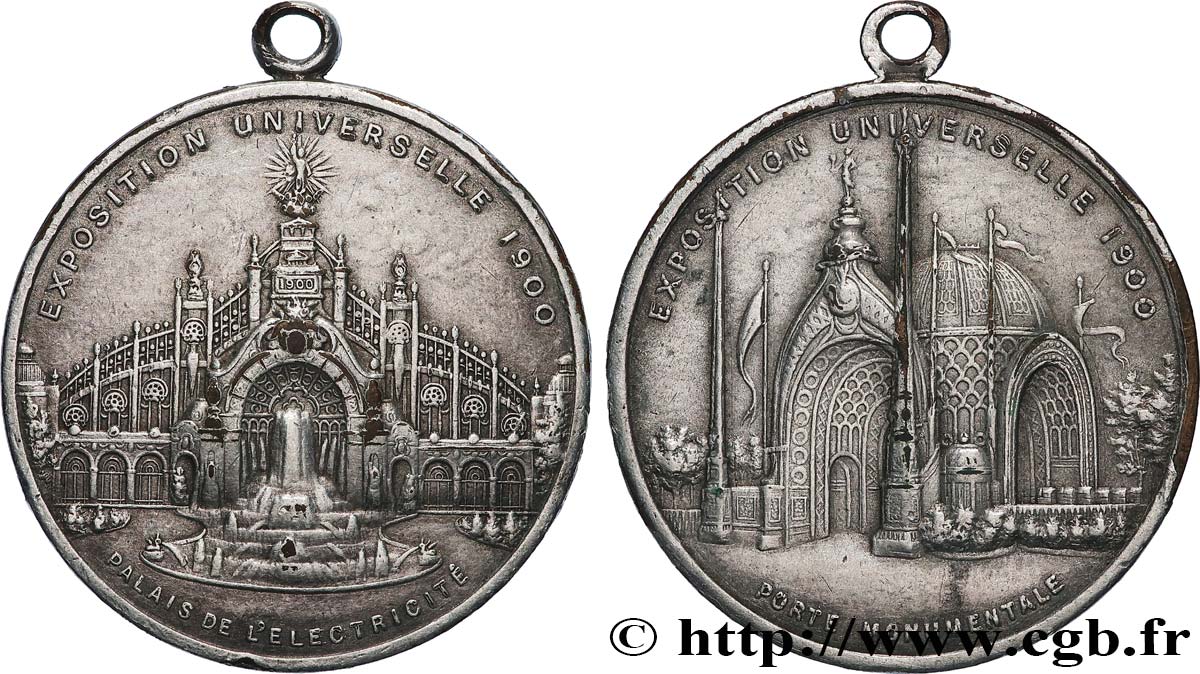
fme_1086679 - TERZA REPUBBLICA FRANCESE Médaille, Exposition Universelle
80.00 €
Quantità
Aggiungi al carrello

Tipo : Médaille, Exposition Universelle
Data: 1900
Nome della officina / città: Paris
Metallo : bronzo argentato
Diametro : 37 mm
Asse di coniazione : 12 h.
Peso : 14,37 g.
Orlo : lisse
Marchio : sans poinçon
Grado di rarità : R2
Commenti sullo stato di conservazione:
Patine hétérogène avec des traces d’usure et rayures. Taches d’oxydation. Argenture partie notamment sur la tranche
Diritto
Titolatura diritto : EXPOSITION UNIVERSELLE 1900 / PALAIS DE L’ELECTRICITE.
Descrittivo diritto : Le palais de l’électricité.
Rovescio
Titolatura rovescio : EXPOSITION UNIVERSELLE 1900 / PORTE MONUMENTALE.
Descrittivo rovescio : La porte du palais de l’électricité.
Commento
Médaille avec un diamètre sans bélière de 33 mm
Jeux et Exposition Universelle se superposèrent. L'Exposition Universelle s'est tenue du 14 avril au 12 novembre 1900 avec plus de 50 millions de visiteurs et 83.000 exposants.
Les expositions universelles ont été créées pour présenter les réalisations industrielles des différentes nations. Elles représentaient la vitrine technologique et industrielle des participants, témoignant du progrès au cours de la révolution industrielle. La première exposition universelle s'est déroulée à Londres en 1851.
À l'origine, chaque pays disposait d'un espace réservé dans un pavillon central. À partir de 1867, des pavillons nationaux firent leur apparition. En principe, ils étaient attribués seulement s'il y avait des choses à présenter que le pavillon central ne pouvait accueillir. Ils ne tardèrent pas à se généraliser, les nations exposantes construisant des pavillons typiques de l'architecture de leurs pays.
La compétition était omniprésente dans les expositions universelles, et des concours permettaient aux plus méritants d'obtenir des médailles bénéficiant d'un certain prestige.
De nombreuses réalisations architecturales construites à l'occasion d'expositions universelles sont devenues par la suite des symboles des villes qui les ont abritées : la tour Eiffel à Paris, l'Atomium à Bruxelles, le Space Needle à Seattle, la Biosphère à Montréal.
Enfin, la tenue des expositions universelles a toujours été l'occasion de mettre en place des projets d'urbanisme : construction du métro de Paris en 1900 ou celui de Montréal en 1967, extension du métro de Lisbonne en 1998…
Voir http://fr.wikipedia.org/wiki/Exposition_universelle .
Medal with a diameter of 33 mm without the bail. The Games and the Universal Exhibition overlapped.. The Universal Exhibition was held from April 14 to November 12, 1900, with over 50 million visitors and 83. 000 exhibitors.
World's fairs were created to showcase the industrial achievements of different nations.. They represented the technological and industrial showcase of the participants, bearing witness to the progress made during the industrial revolution.. The first World's Fair took place in London in 1851..
Originally, each country had its own reserved space in a central pavilion.. From 1867 onwards, national pavilions began to appear.. In principle, they were only allocated if there were things to display that the central pavilion could not accommodate.. They soon became widespread, with exhibiting nations building pavilions typical of their countries' architecture..
Competition was omnipresent at world's fairs, and contests allowed the most deserving to obtain medals that carried a certain prestige..
Many architectural achievements built for world's fairs have subsequently become symbols of the cities that hosted them: the Eiffel Tower in Paris, the Atomium in Brussels, the Space Needle in Seattle, the Biosphere in Montreal.
Finally, the holding of world's fairs has always been an opportunity to implement urban planning projects: the construction of the Paris metro in 1900 or that of Montreal in 1967, the extension of the Lisbon metro in 1998… See http://fr. Wikipedia. org/wiki/Exposition_universelle
Jeux et Exposition Universelle se superposèrent. L'Exposition Universelle s'est tenue du 14 avril au 12 novembre 1900 avec plus de 50 millions de visiteurs et 83.000 exposants.
Les expositions universelles ont été créées pour présenter les réalisations industrielles des différentes nations. Elles représentaient la vitrine technologique et industrielle des participants, témoignant du progrès au cours de la révolution industrielle. La première exposition universelle s'est déroulée à Londres en 1851.
À l'origine, chaque pays disposait d'un espace réservé dans un pavillon central. À partir de 1867, des pavillons nationaux firent leur apparition. En principe, ils étaient attribués seulement s'il y avait des choses à présenter que le pavillon central ne pouvait accueillir. Ils ne tardèrent pas à se généraliser, les nations exposantes construisant des pavillons typiques de l'architecture de leurs pays.
La compétition était omniprésente dans les expositions universelles, et des concours permettaient aux plus méritants d'obtenir des médailles bénéficiant d'un certain prestige.
De nombreuses réalisations architecturales construites à l'occasion d'expositions universelles sont devenues par la suite des symboles des villes qui les ont abritées : la tour Eiffel à Paris, l'Atomium à Bruxelles, le Space Needle à Seattle, la Biosphère à Montréal.
Enfin, la tenue des expositions universelles a toujours été l'occasion de mettre en place des projets d'urbanisme : construction du métro de Paris en 1900 ou celui de Montréal en 1967, extension du métro de Lisbonne en 1998…
Voir http://fr.wikipedia.org/wiki/Exposition_universelle .
Medal with a diameter of 33 mm without the bail. The Games and the Universal Exhibition overlapped.. The Universal Exhibition was held from April 14 to November 12, 1900, with over 50 million visitors and 83. 000 exhibitors.
World's fairs were created to showcase the industrial achievements of different nations.. They represented the technological and industrial showcase of the participants, bearing witness to the progress made during the industrial revolution.. The first World's Fair took place in London in 1851..
Originally, each country had its own reserved space in a central pavilion.. From 1867 onwards, national pavilions began to appear.. In principle, they were only allocated if there were things to display that the central pavilion could not accommodate.. They soon became widespread, with exhibiting nations building pavilions typical of their countries' architecture..
Competition was omnipresent at world's fairs, and contests allowed the most deserving to obtain medals that carried a certain prestige..
Many architectural achievements built for world's fairs have subsequently become symbols of the cities that hosted them: the Eiffel Tower in Paris, the Atomium in Brussels, the Space Needle in Seattle, the Biosphere in Montreal.
Finally, the holding of world's fairs has always been an opportunity to implement urban planning projects: the construction of the Paris metro in 1900 or that of Montreal in 1967, the extension of the Lisbon metro in 1998… See http://fr. Wikipedia. org/wiki/Exposition_universelle
Cronistoria
TERZA REPUBBLICA FRANCESE
(4/09/1870-10/07/1940)
La notizia della capitolazione di Sedan provoca la rivoluzione del 4 settembre 1870 a Parigi. Proclamata all'Hôtel de Ville, la Repubblica è dotata di un governo provvisorio chiamato Governo di Difesa Nazionale. Minacciato a sinistra dall'insurrezione del Comune ea destra dai monarchici, il nuovo regime ebbe un inizio difficile.. Inizialmente capo del potere esecutivo (febbraio 1871), Thiers si occupò di riorganizzare il paese prima di scegliere la sua forma di governo.. Divenne presidente della Repubblica nell'agosto 1871 e, nonostante la sua azione per liberare il territorio, dovette lasciare il suo incarico nel marzo 1873 di fronte all'opposizione monarchica.. Viene poi sostituito da Mac-Mahon favorevole alla restaurazione della monarchia ma questo non viene ripristinato in seguito alla questione della bandiera. La legge del settennato fu poi varata nel novembre 1873 e poi, nel 1875, furono approvate le leggi fondamentali che servirono da Costituzione della Terza Repubblica.. Sistema parlamentare, si caratterizza in particolare per la netta preponderanza del potere legislativo su quello esecutivo. Anticlericale, la Terza Repubblica rende la scuola gratuita, laica e obbligatoria ma continua la politica coloniale per le sue ambizioni economiche, strategiche e morali. La separazione tra Chiesa e Stato fu approvata nel 1905.. L'idea di vendetta sulla Germania e il nazionalismo significativo sono al centro della crisi boulangista, dello scandalo di Panama o dell'affare Dreyfus degli anni 1886-1899, mentre la politica estera è molto attiva, in particolare in Marocco e che si sviluppa la corsa agli armamenti. La prima guerra mondiale fu costosa per la Francia, che si riprese solo dal 1920 o addirittura dal 1928 per la moneta con il franco "Poincaré".. La crisi del 1929 si fa sentire solo dal 1932 ma dura fino al 1939, periodo durante il quale l'instabilità ministeriale è molto importante. Vacillando nel 1934, la Terza Repubblica trovò un nuovo cemento unitario con l'antifascismo che permise al Fronte Popolare di salire al potere nel 1936.. Ma, paralizzata contro la Germania, la Francia fu poi impantanata in una "guerra fasulla" e poi subì una delle più grandi sconfitte della sua storia nel giugno 1940.. Riunite nell'Assemblea nazionale di Vichy il 10 luglio 1940, le Camere, benché elette nel 1936, votarono pieni poteri a Pétain in una sorta di suicidio collettivo con 569 voti favorevoli, 80 contrari e 18 astenuti..
 Segnalare un errore
 Stampate la pagina
 Condividi mia selezione
 Fai una domanda
 Consegnare / vendere
Articoli correlati

 Descrittivo


Articoli visualizzati di recente
COSTANZO II Maiorina réduite, (PB, Æ 3) q.SPL/BB
13.00 €

ISOLA RIUNIONE 2 Francs 1948 Paris SPL
4.00 €
5 francs Hercule 1870 Paris F.334/1 BB
200.00 €

1 centime Cérès 1894 Paris F.104/21 MS63
24.00 €

MALTA - EMMANUEL DE ROHAN 2 Scudi 1796 La Valette q.SPL
150.00 €

AUSTRALIA 1 Shilling Georges V 1918 Melbourne q.BB
15.00 €
cgbfr.it numismatica


