


fjt_743174 - SÉRIE MÉTALLIQUE DES ROIS DE FRANCE Règne de CLODION - 2 - Émission LOUIS XVIII n.d.
non disponibile.
Articolo venduto sul nostro negozio (2022)
Prezzo : 35.00 €
Articolo venduto sul nostro negozio (2022)
Prezzo : 35.00 €
Tipo : Règne de CLODION - 2 - Émission LOUIS XVIII
Data: n.d.
Metallo : ottone
Diametro : 32 mm
Asse di coniazione : 12 h.
Peso : 15,55 g.
Orlo : cannelée
Grado di rarità : R1
Commenti sullo stato di conservazione:
Légère usure sur l’avers
Pedigree :
Exemplaire provenant de la Collection MARINECHE
Diritto
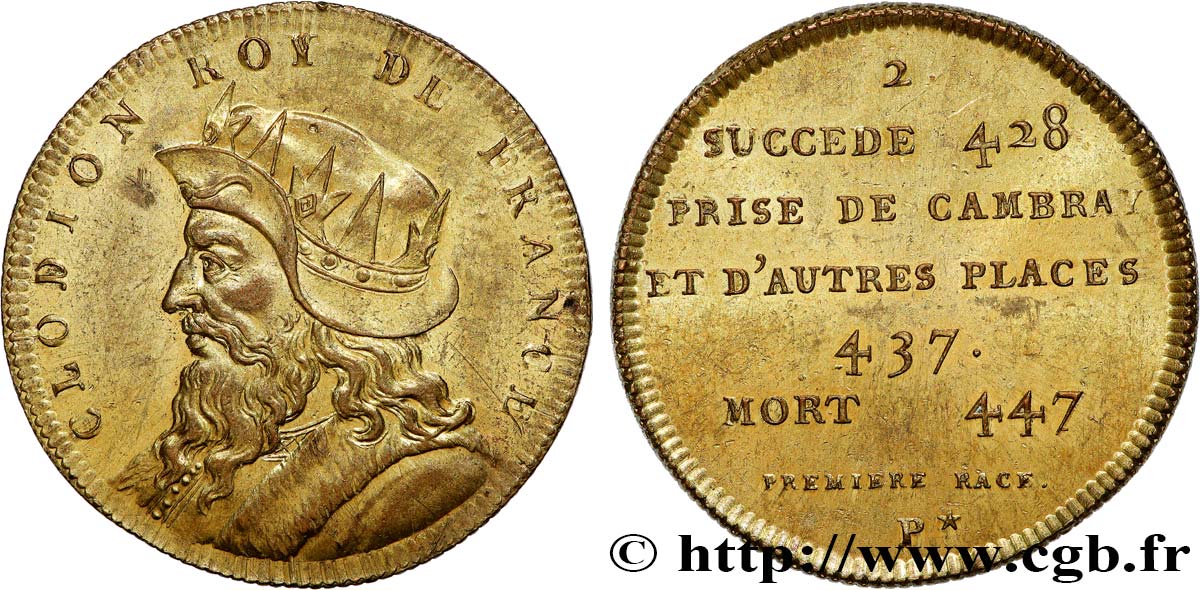
Titolatura diritto : CLODION ROY DE FRANCE.
Descrittivo diritto : Buste imaginaire drapé et radié à droite à la manière des antoniniens de Postume où la couronne radiée est gravée sur le casque.
Rovescio
Titolatura rovescio : 2 - SUCCEDE 428 - PRISE DE CAMBRAY ET D’AUTRES PLACES 437 - MORT 447 - PREMIERE RACE / P*..
Descrittivo rovescio : en huit lignes.
Commento
Clodion dit le Chevelu (vers 390 - vers 450) était le chef des Francs saliens et le plus ancien roi de la dynastie des Mérovingiens dont on soit certain.
Selon Grégoire de Tours, il succède au roi Théodomir, sans que l'on sache s'il y a plusieurs années d'interrègne entre les deux rois.
En 428, Clodion apprend que les villes de la Belgique Seconde sont sans défense. En effet, le général romain Aetius a prélevé beaucoup de soldats de ces territoires pour combattre ses ennemis les Wisigoths. Surprises, les troupes romaines qui gardaient les passages sont défaites, Clodion bat facilement les garnisons restantes et s'empare de Tournai, emporte Cambrai du premier assaut et réduit tout le pays des environs jusqu'à la Somme. En fait, plus que des pillages faciles, il cherche à conférer à son autorité de roi guerrier une assise territoriale, qu'il veut voir s'étendre sur le riche territoire entre le Rhin, la Somme, la Meuse et la mer du Nord
En 431, Clodion qui célébrait les noces d'un grand seigneur de son armée près du bourg d'Helena — sans doute près d'Arras — est attaqué par le général Aetius et son lieutenant Majorien. Le général voulait reprendre les territoires annexés par les Francs. Clodion, qui n'était pas préparé à l'affrontement, est contraint de fuir et perd tout ce qu'il avait conquis sur l'Empire romain en deçà du Rhin. Cependant, conscient qu'il n'avait pas les moyens militaires pour occuper à nouveau le territoire, Aetius préfère négocier la paix et conclut avec Clodion un traité (fœdus) qui fait des Francs, des « fédérés » combattant pour Rome, et les autorise à s'installer dans l'Empire, en l'occurrence près du fisc impérial de Tournai. Il s'agit là des origines du futur royaume franc de Clovis Ier.
Pour le reste de son histoire voir http://fr.wikipedia.org/wiki/Clodion_le_Chevelu . On notera avec intérêt que l’illustration de cette fiche est réalisée, et pour cause, avec notre jeton.
Clodion the Hairy (circa 390 - circa 450) was the leader of the Salian Franks and the oldest known king of the Merovingian dynasty..
According to Gregory of Tours, he succeeded King Theodomir, although it is not known whether there were several years of interregnum between the two kings..
In 428, Clodion learned that the cities of Belgium II were undefended.. In fact, the Roman general Aetius took many soldiers from these territories to fight his enemies the Visigoths.. Surprised, the Roman troops guarding the passes are defeated, Clodion easily defeats the remaining garrisons and captures Tournai, takes Cambrai in the first assault and reduces the entire surrounding country to the Somme. In fact, more than easy pillaging, he sought to confer on his authority as a warrior king a territorial base, which he wanted to see extend over the rich territory between the Rhine, the Somme, the Meuse and the North Sea. In 431, Clodion, who was celebrating the wedding of a great lord of his army near the town of Helena - probably near Arras - was attacked by General Aetius and his lieutenant Majorian.. The general wanted to retake the territories annexed by the Franks. Clodion, who was not prepared for the confrontation, was forced to flee and lost everything he had conquered from the Roman Empire on this side of the Rhine.. However, aware that he did not have the military means to occupy the territory again, Aetius preferred to negotiate peace and concluded a treaty (fœdus) with Clodion which made the Franks \\\"federates\\\" fighting for Rome, and authorized them to settle in the Empire, in this case near the imperial tax office of Tournai.. These are the origins of the future Frankish kingdom of Clovis I..
For the rest of his story see http://fr. Wikipedia. org/wiki/Clodion_le_Chevelu . It is worth noting that the illustration on this sheet is made, and for good reason, with our token
Selon Grégoire de Tours, il succède au roi Théodomir, sans que l'on sache s'il y a plusieurs années d'interrègne entre les deux rois.
En 428, Clodion apprend que les villes de la Belgique Seconde sont sans défense. En effet, le général romain Aetius a prélevé beaucoup de soldats de ces territoires pour combattre ses ennemis les Wisigoths. Surprises, les troupes romaines qui gardaient les passages sont défaites, Clodion bat facilement les garnisons restantes et s'empare de Tournai, emporte Cambrai du premier assaut et réduit tout le pays des environs jusqu'à la Somme. En fait, plus que des pillages faciles, il cherche à conférer à son autorité de roi guerrier une assise territoriale, qu'il veut voir s'étendre sur le riche territoire entre le Rhin, la Somme, la Meuse et la mer du Nord
En 431, Clodion qui célébrait les noces d'un grand seigneur de son armée près du bourg d'Helena — sans doute près d'Arras — est attaqué par le général Aetius et son lieutenant Majorien. Le général voulait reprendre les territoires annexés par les Francs. Clodion, qui n'était pas préparé à l'affrontement, est contraint de fuir et perd tout ce qu'il avait conquis sur l'Empire romain en deçà du Rhin. Cependant, conscient qu'il n'avait pas les moyens militaires pour occuper à nouveau le territoire, Aetius préfère négocier la paix et conclut avec Clodion un traité (fœdus) qui fait des Francs, des « fédérés » combattant pour Rome, et les autorise à s'installer dans l'Empire, en l'occurrence près du fisc impérial de Tournai. Il s'agit là des origines du futur royaume franc de Clovis Ier.
Pour le reste de son histoire voir http://fr.wikipedia.org/wiki/Clodion_le_Chevelu . On notera avec intérêt que l’illustration de cette fiche est réalisée, et pour cause, avec notre jeton.
Clodion the Hairy (circa 390 - circa 450) was the leader of the Salian Franks and the oldest known king of the Merovingian dynasty..
According to Gregory of Tours, he succeeded King Theodomir, although it is not known whether there were several years of interregnum between the two kings..
In 428, Clodion learned that the cities of Belgium II were undefended.. In fact, the Roman general Aetius took many soldiers from these territories to fight his enemies the Visigoths.. Surprised, the Roman troops guarding the passes are defeated, Clodion easily defeats the remaining garrisons and captures Tournai, takes Cambrai in the first assault and reduces the entire surrounding country to the Somme. In fact, more than easy pillaging, he sought to confer on his authority as a warrior king a territorial base, which he wanted to see extend over the rich territory between the Rhine, the Somme, the Meuse and the North Sea. In 431, Clodion, who was celebrating the wedding of a great lord of his army near the town of Helena - probably near Arras - was attacked by General Aetius and his lieutenant Majorian.. The general wanted to retake the territories annexed by the Franks. Clodion, who was not prepared for the confrontation, was forced to flee and lost everything he had conquered from the Roman Empire on this side of the Rhine.. However, aware that he did not have the military means to occupy the territory again, Aetius preferred to negotiate peace and concluded a treaty (fœdus) with Clodion which made the Franks \\\"federates\\\" fighting for Rome, and authorized them to settle in the Empire, in this case near the imperial tax office of Tournai.. These are the origins of the future Frankish kingdom of Clovis I..
For the rest of his story see http://fr. Wikipedia. org/wiki/Clodion_le_Chevelu . It is worth noting that the illustration on this sheet is made, and for good reason, with our token
Cronistoria
SÉRIE MÉTALLIQUE DES ROIS DE FRANCE
Questa serie è stata incisa da Thomas Bernard ed è interrotta, per questo autore, dal segno di Luigi XIV. I seguenti gettoni sono incisi da Nicolas Gatteaux per Luigi XV, Duvivier per Luigi XVI, Puymaurin e Gayrard per Luigi XVII, Puymaurin e Depaulis per Luigi XVIII. La serie è spesso attribuita a Jean Dassier sulla fede di Forrer ma corregge la sua affermazione nel suo volume VIII e conferma gli archivi della Monnaie de Paris che specificano che la serie è stata commissionata da Monsieur de Launay. Esistono diverse emissioni, in rame o ottone, di peso variabile ma coerenti per serie, le matrici di rovescio a volte sono varie. La classificazione dei re avviene secondo l'uso antico, in tre razze successive. Notiamo l'esistenza di un token molto raro che spiega le sigle che abbiamo visto solo in una serie in ottone. La confezione di questa serie era in un tubo di legno. Ovviamente è molto difficile ricostruirlo e va notato che i diversi gettoni hanno rarità molto diverse, essendo stati probabilmente acquistati a pezzi dal pubblico, favorendo i buoni re. Esiste almeno una serie in argento, forse apocrifa, completata fino a Napoleone III con gettoni per tutti i regimi successivi, compresa la Rivoluzione e Napoleone I, vedi MONNAIES 28, n° 1395. Questa serie è documentata in un piccolo libro di Philippe Marinèche da chi può acquistarlo, contattare phmarineche@aol. com.
 Segnalare un errore
 Stampate la pagina
 Condividi mia selezione
 Fai una domanda
 Consegnare / vendere
Articoli correlati
 Descrittivo



cgbfr.it numismatica


