


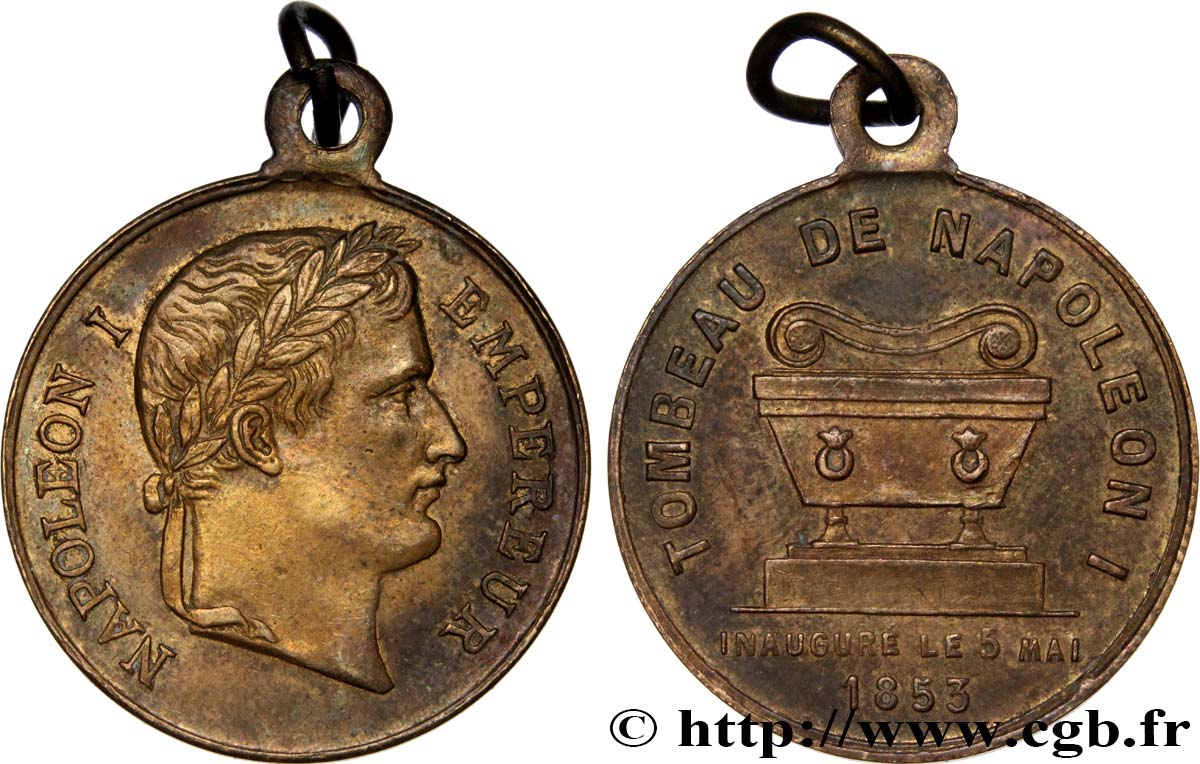
fme_486080 - SECONDO IMPERO FRANCESE Médaillette, Inauguration du tombeau de Napoléon Ier
non disponibile.
Articolo venduto sul nostro negozio (2018)
Prezzo : 15.00 €
Articolo venduto sul nostro negozio (2018)
Prezzo : 15.00 €
Tipo : Médaillette, Inauguration du tombeau de Napoléon Ier
Data: 1853
Nome della officina / città: 75 - Paris
Metallo : ottone
Diametro : 27,5 mm
Asse di coniazione : 12 h.
Incisore C. T.
Peso : 5,1 g.
Orlo : Lisse
Marchio : sans poinçon
Commenti sullo stato di conservazione:
Patine hétérogène
N° nelle opere di riferimento :
Diritto
Titolatura diritto : NAPOLÉON I - EMPEREUR.
Descrittivo diritto : Tête laurée de Napoléon à droite.
Rovescio
Titolatura rovescio : TOMBEAU DE NAPOLEON I // INAUGURÉ LE 5 MAI / 1853.
Commento
Médaille sans graveur et sans poinçon. Il faut noter que cette médaillette a eu un gros succès puisque l’on compte au moins quatre versions de buste, deux sans signature, avec signature C.T. et avec signature VIEUXMAIRE. À noter qu’il existe plusieurs coins de revers dont l’un avec I et l’autre avec Ier.
Si le tombeau fut inauguré durant le Second empire, il avait été décidé sous Louis-Philippe, avec le retour des cendres.
L’hôtel des Invalides est un monument parisien dont la construction fut ordonnée par Louis XIV par l'édit royal du 24 février 1670, pour abriter les invalides de ses armées. Aujourd'hui, il accueille toujours des invalides, mais également la cathédrale Saint-Louis des Invalides, plusieurs musées et une nécropole militaire avec notamment le tombeau de Napoléon Ier. Cet immense complexe architectural, conçu par Libéral Bruand et Jules Hardouin-Mansart, est un des chef-d’œuvres les plus importants de l'architecture classique française.
Medal without engraver and without hallmark. It should be noted that this medallion was very successful since there are at least four versions of the bust, two without signature, with CT signature and with VIEUXMAIRE signature. Note that there are several reverse dies, one with I and the other with Ier. If the tomb was inaugurated during the Second Empire, it had been decided under Louis-Philippe, with the return of the ashes. The Hôtel des Invalides is a Parisian monument whose construction was ordered by Louis XIV by the royal edict of February 24, 1670, to house the invalids of his armies. Today, it still houses invalids, but also the Saint-Louis des Invalides Cathedral, several museums and a military necropolis including the tomb of Napoleon I. This immense architectural complex, designed by Libéral Bruand and Jules Hardouin-Mansart, is one of the most important masterpieces of French classical architecture
Si le tombeau fut inauguré durant le Second empire, il avait été décidé sous Louis-Philippe, avec le retour des cendres.
L’hôtel des Invalides est un monument parisien dont la construction fut ordonnée par Louis XIV par l'édit royal du 24 février 1670, pour abriter les invalides de ses armées. Aujourd'hui, il accueille toujours des invalides, mais également la cathédrale Saint-Louis des Invalides, plusieurs musées et une nécropole militaire avec notamment le tombeau de Napoléon Ier. Cet immense complexe architectural, conçu par Libéral Bruand et Jules Hardouin-Mansart, est un des chef-d’œuvres les plus importants de l'architecture classique française.
Medal without engraver and without hallmark. It should be noted that this medallion was very successful since there are at least four versions of the bust, two without signature, with CT signature and with VIEUXMAIRE signature. Note that there are several reverse dies, one with I and the other with Ier. If the tomb was inaugurated during the Second Empire, it had been decided under Louis-Philippe, with the return of the ashes. The Hôtel des Invalides is a Parisian monument whose construction was ordered by Louis XIV by the royal edict of February 24, 1670, to house the invalids of his armies. Today, it still houses invalids, but also the Saint-Louis des Invalides Cathedral, several museums and a military necropolis including the tomb of Napoleon I. This immense architectural complex, designed by Libéral Bruand and Jules Hardouin-Mansart, is one of the most important masterpieces of French classical architecture
Cronistoria
SECONDO IMPERO FRANCESE
(02/12/1852-04/09/1870)
Proclamato imperatore con il nome di Napoleone III, Luigi Napoleone fece il suo ingresso solenne a Parigi il 2 dicembre 1852.. Sposò Eugénie Marie de Montijo, un'aristocratica spagnola, nel gennaio 1853. Il suo regno può essere suddiviso in tre periodi: l'impero autoritario fino al 1860; l'Impero liberale dal 1860 al 1870 poi l'Impero parlamentare nel 1870. Durante l'impero autoritario, Napoleone III esercitava il suo potere senza condivisione, controllava la stampa mentre i giornali praticavano l'autocensura per evitare la loro soppressione.. I prefetti esercitano poteri illimitati nei dipartimenti, i sindaci, i funzionari sono nominati dal governo. Come sotto il Primo Impero, l'Istruzione e l'Università sono monitorate. Mantenendo i principi fondamentali della rivoluzione, la sovranità del popolo viene mantenuta grazie alla consultazione tramite plebiscito. Sul piano economico il boom è importante, si sviluppa l'industrializzazione così come gli istituti di credito ei grandi magazzini. Il prestigio militare è accresciuto dalla guerra di Crimea che consente alla Francia di svolgere un ruolo internazionale. L'attacco dell'Orsini (gennaio 1858) non impedisce alla Francia di intervenire in Italia per far trionfare il principio delle nazionalità e consente l'annessione di Nizza e Savoia con il trattato di Torino (marzo 1860). Dal 1860 l'Impero si mosse verso maggiori libertà: trattato di libero scambio con l'Inghilterra, comparsa di una debole opposizione nel Corpo Legislativo, concessione del diritto di sciopero (1864), liberalizzazione della stampa (1868). A livello internazionale la Francia acquisisce la Nuova Caledonia, la Cocincina e incoraggia lo scavo del Canale di Suez di Ferdinand de Lesseps. In Messico, invece, il sostegno a Massimiliano e all'Austria fu un fallimento. Le elezioni del 1869 furono molto negative per il regime e l'opposizione ottenne il 45% dei voti. Il regime si è poi evoluto verso un impero parlamentare chiamando al potere Émile Ollivier, leader del partito orléanista e liberale. Dopo Sadowa nel 1866 quando la Prussia schiacciò l'Austria, la vicenda del trono di Spagna e l'invio da Ems portarono alla guerra che fu dichiarata il 19 luglio 1870. Accumulando battute d'arresto, l'esercito francese fu circondato a Metz poi Napoleone III, malato, capitolò a Sedan il 2 settembre. Appena seppe la notizia, fu annunciata da Gambetta la decadenza dell'Impero, poi il 4 settembre fu proclamata la Repubblica.. Napoleone III fu poi portato prigioniero in Assia e poi partì per il Kent dove morì nel 1873..
 Segnalare un errore
 Stampate la pagina
 Condividi mia selezione
 Fai una domanda
 Consegnare / vendere
Articoli correlati

 Descrittivo



Articoli visualizzati di recente

VALENTE Nummus q.BB
20.00 €

SECONDO IMPERO FRANCESE Médaille, Inauguration du tombeau de Napoléon Ier q.SP
4.00 €
cgbfr.it numismatica


