


E-auction 165-101749 - bpv_154025 - FILIPPO I PADRE Tétradrachme syro-phénicien

Devi Sign-in ed essere un offerente approvato fare un'offerta, Login per fare offerte. Conti sono soggetti ad approvazione e di approvazione sono raggiunti entro 48 ore. Non aspettare fino al giorno di una vendita si chiude per registrarti.Confermando la tua offerta su questo oggetto ti impegni ad un contratto legalmente vincolante per l'acquisto di questo prodotto e fare clic su «offerta» costituisce accettazione dei termini di utilizzo de e-auctions cgb.fr.
Offerta deve essere collocato in euro gli importi interi vendita only.The si chiuderà al momento sulla descrizione dell'oggetto, eventuali offerte pervenute al sito dopo l'orario di chiusura non verranno eseguite. Volte transmition possono variare e le offerte potrebbero essere respinto se si attende per gli ultimi secondi. Per ulteriori informazioni ckeck le FAQ.
SENZA COSTI PER GLI ACQUIRENTI.
SENZA COSTI PER GLI ACQUIRENTI.
| Valutazione : | 180 € |
| Prezzo : | 65 € |
| Offerta maxima : | 71 € |
| Data di fine vendita : | 13 giugno 2016 15:15:00 |
| partecipanti : | 11 partecipanti |
Tipo : Tétradrachme syro-phénicien
Data: 248
Nome della officina / città: Antioche, Syrie, Séleucie et Piérie
Metallo : billone
Diametro : 28,00 mm
Asse di coniazione : 12 h.
Peso : 11,84 g.
Grado di rarità : R2
Commenti sullo stato di conservazione:
Frappe bien centrée sur un flan oblong et légèrement éclaté. Traces de surfrappe sur les légendes, très beau portrait réaliste
N° nelle opere di riferimento :
Pedigree :
Cet exemplaire, qui provient de la trouvaille dite de Turquie 1930, est le 0370_005 de la base TSP
Diritto
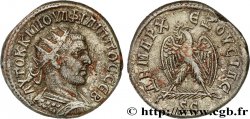
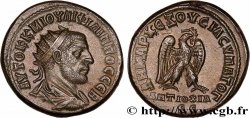
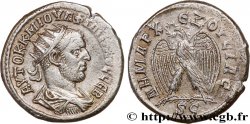
Descrittivo diritto : Buste lauré, drapé et cuirassé de Philippe Ier à droite, vu de trois quarts en arrière (A*2).
Legenda diritto : AUTOK K M IOUL FILIPPOS SEB, (Autokratoros Kaisaros Markos Ioulios Filippos Sebastos)
Traduzione diritto : (L’empereur césar Marc Jules Philippe auguste).
Rovescio
Titolatura rovescio : ANTIOXIA / S|C À L’EXERGUE.
Descrittivo rovescio : Aigle debout à gauche, les ailes écartées, l’aile droite passant derrière la patte droite, tête et queue à droite, tenant une couronne feuillée dans son bec.
Legenda rovescio : DHMARC - EX OUSIAS UPATOG
Traduzione rovescio : (Revêtu de la puissance tribunitienne / Consul pour la troisième fois / avec l’accord du Sénat d’Antioche).
Commento
Ce type de buste, en proportion, est de loin le plus courant de toutes ces émissions. Symboliquement, il traduit les différents pouvoirs de l’empereur, militaires (laurier, cuirasse dont on voit une ptéryge) et civils par le drapé qui peut rappeler la toge pour le citoyen. On pourrait le considérer comme un vœu pieux, celui de la paix juste et durable, mais armée...
En abordant les frappes du 3e consulat, on remarque l’absence complète de frappes datées du deuxième consulat, bien que le deuxième consulat de Philippe existe indubitablement à Rome, y compris sur les émissions monétaires. Interruption des frappes ou comput différent à Antioche qu’à Rome ? Nous penchons pour la deuxième solution, pour deux raisons.
Tout d’abord la continuité stylistique : tant pour les revers que pour les droits, il n’y a pas de rupture, alors que l’on aurait pu présumer une certaine normalisation après une interruption des frappes. De plus, celle-ci se produira effectivement pour les frappes datées du quatrième consulat avec un style d’aigle unique, suivie à la fin par une nouveauté encore plus marquante, l’introduction d’officines indiquées sur les monnaies.
Ensuite, il existe à Antioche de très nombreuses frappes datées d’un quatrième consulat de Philippe l’Arabe dont nous ne trouvons pas trace à Rome. Il est extrêmement regrettable que les quelques informations dont nous disposons sur le Sénat d’Antioche soient largement plus tardives (4e et 5e siècle) car les émissions de tétradrachmes laissent à penser que non seulement le Sénat d’Antioche manifestait son indépendance envers Rome en frappant de l’argent avec la titulature “SC / ANTIOXIA” mais encore qu’il avait son propre comput impérial sous Philippe.
L’apparition de cette exergue et la disparition de la palme sont caractéristiques des 3e et 4e consulat mais les styles des aigles ne se normaliseront qu’au 4e.
On note que les sigma sont gravés en C.
Dans la base TSP maintenue par Michel Prieur, treize exemplaires sont maintenant répertoriés pour ce type, aucun en musée.
This type of bust, in proportion, is by far the most common of all these shows. Symbolically, it translates the different powers of the emperor, military (laurel, breastplate of which we see a pteryge) and civil by the drapery which can recall the toga for the citizen. It could be considered a pious wish, that of a just and lasting peace, but armed. . .
When approaching the strikes of the 3rd consulate, we notice the complete absence of strikes dated from the second consulate, although Philip's second consulate undoubtedly existed in Rome, including on monetary issues.. Was the minting interrupted or was the calculation different in Antioch than in Rome? We are inclined to choose the second solution, for two reasons..
First of all, stylistic continuity: for both the backhands and the forehands, there is no break, whereas one might have assumed a certain standardization after an interruption in the strokes. Furthermore, this will actually occur for the strikes dated from the fourth consulate with a unique eagle style, followed at the end by an even more striking novelty, the introduction of offices indicated on the coins..
Then, in Antioch there are many strikes dated to a fourth consulate of Philip the Arab, of which we find no trace in Rome.. It is extremely regrettable that the little information we have on the Senate of Antioch is much later (4th and 5th century) because the issues of tetradrachms suggest that not only did the Senate of Antioch demonstrate its independence from Rome by minting money with the title “SC / ANTIOXIA” but also that it had its own imperial computus under Philip.
The appearance of this exergue and the disappearance of the palm are characteristic of the 3rd and 4th consulate but the styles of the eagles will not become standardized until the 4th.
Note that the sigmas are engraved in C.
In the TSP database maintained by Michel Prieur, thirteen examples are now listed for this type, none in museums
En abordant les frappes du 3e consulat, on remarque l’absence complète de frappes datées du deuxième consulat, bien que le deuxième consulat de Philippe existe indubitablement à Rome, y compris sur les émissions monétaires. Interruption des frappes ou comput différent à Antioche qu’à Rome ? Nous penchons pour la deuxième solution, pour deux raisons.
Tout d’abord la continuité stylistique : tant pour les revers que pour les droits, il n’y a pas de rupture, alors que l’on aurait pu présumer une certaine normalisation après une interruption des frappes. De plus, celle-ci se produira effectivement pour les frappes datées du quatrième consulat avec un style d’aigle unique, suivie à la fin par une nouveauté encore plus marquante, l’introduction d’officines indiquées sur les monnaies.
Ensuite, il existe à Antioche de très nombreuses frappes datées d’un quatrième consulat de Philippe l’Arabe dont nous ne trouvons pas trace à Rome. Il est extrêmement regrettable que les quelques informations dont nous disposons sur le Sénat d’Antioche soient largement plus tardives (4e et 5e siècle) car les émissions de tétradrachmes laissent à penser que non seulement le Sénat d’Antioche manifestait son indépendance envers Rome en frappant de l’argent avec la titulature “SC / ANTIOXIA” mais encore qu’il avait son propre comput impérial sous Philippe.
L’apparition de cette exergue et la disparition de la palme sont caractéristiques des 3e et 4e consulat mais les styles des aigles ne se normaliseront qu’au 4e.
On note que les sigma sont gravés en C.
Dans la base TSP maintenue par Michel Prieur, treize exemplaires sont maintenant répertoriés pour ce type, aucun en musée.
This type of bust, in proportion, is by far the most common of all these shows. Symbolically, it translates the different powers of the emperor, military (laurel, breastplate of which we see a pteryge) and civil by the drapery which can recall the toga for the citizen. It could be considered a pious wish, that of a just and lasting peace, but armed. . .
When approaching the strikes of the 3rd consulate, we notice the complete absence of strikes dated from the second consulate, although Philip's second consulate undoubtedly existed in Rome, including on monetary issues.. Was the minting interrupted or was the calculation different in Antioch than in Rome? We are inclined to choose the second solution, for two reasons..
First of all, stylistic continuity: for both the backhands and the forehands, there is no break, whereas one might have assumed a certain standardization after an interruption in the strokes. Furthermore, this will actually occur for the strikes dated from the fourth consulate with a unique eagle style, followed at the end by an even more striking novelty, the introduction of offices indicated on the coins..
Then, in Antioch there are many strikes dated to a fourth consulate of Philip the Arab, of which we find no trace in Rome.. It is extremely regrettable that the little information we have on the Senate of Antioch is much later (4th and 5th century) because the issues of tetradrachms suggest that not only did the Senate of Antioch demonstrate its independence from Rome by minting money with the title “SC / ANTIOXIA” but also that it had its own imperial computus under Philip.
The appearance of this exergue and the disappearance of the palm are characteristic of the 3rd and 4th consulate but the styles of the eagles will not become standardized until the 4th.
Note that the sigmas are engraved in C.
In the TSP database maintained by Michel Prieur, thirteen examples are now listed for this type, none in museums
Cronistoria
FILIPPO I PADRE
(03/244-09/249)
Philippe nacque a Bostra in Trachonitis, una provincia dell'Arabia, da cui il soprannome dell'Imperatore. Fu nominato Prefetto del Pretorio dopo la scomparsa di Timésithée, suocero di Gordiano III, nel 243. Filippo fece assassinare o fece assassinare Gordiano all'inizio del 244, poi si affrettò a concludere un'infame pace con i Sassanidi . Paga loro un tributo di 500.000 denari. Chiamò suo figlio Filippo Cesare nel 244 e sua moglie Otacilia Sévéra augusta. Nel 247, Filippo eleva suo figlio ad agosto. Condusse una brillante campagna contro i Quadi ei Carpi che avevano invaso la Dacia. Il grande evento del regno di Filippo è la commemorazione del millennio di Roma che inizia il 21 aprile 247. Diversi usurpatori, tra cui Jotapien e Pacatian, si proclamano augusti alla fine del regno. Philippe incarica Decio, comandante delle legioni della Pannonia, di ristabilire l'ordine sul Danubio. Le truppe, contro la sua volontà, proclamano Decio augusto nel giugno o luglio 249. Filippo muore combattendo le truppe di Decio nel settembre 249.
 Segnalare un errore
 Stampate la pagina
 Condividi mia selezione
 Fai una domanda
 Consegnare / vendere
Articoli correlati

 Descrittivo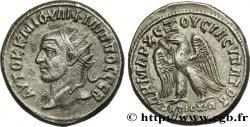

cgbfr.it numismatica


