


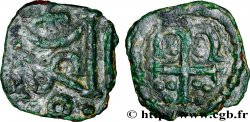
v32_0977 - PARIS (PARISIVS) Obole (ou demi-denier) à la croix ancrée

MONNAIES 32 (2007)
Prezzo di inizio : 280.00 €
Valutazione : 750.00 €
Prezzo realizzato : 310.00 €
Numero di offerte : 2
Offerta maxima : 310.00 €
Prezzo di inizio : 280.00 €
Valutazione : 750.00 €
Prezzo realizzato : 310.00 €
Numero di offerte : 2
Offerta maxima : 310.00 €
Tipo : Obole (ou demi-denier) à la croix ancrée
Data: Début VIIIe siècle
Data: Début VIIIe siècle
Nome della officina / città: Paris
Metallo : argento
Diametro : 11 mm
Asse di coniazione : 11 h.
Peso : 0,58 g.
Grado di rarità : R3
Commenti sullo stato di conservazione:
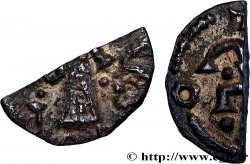
Monnaie coupée en deux, mais totalement identifiable. Bon centrage de la monnaie avec les types complets et bien centrés. Métal finement patiné peut-être un peu granuleux
N° nelle opere di riferimento :
Diritto
Titolatura diritto : [PARISI]VS.
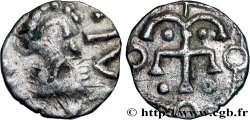
Descrittivo diritto : Buste diadémé à droite, une sorte de croisette sur le front ; légende autour.
Rovescio
Titolatura rovescio : ANÉPIGRAPHE.
Descrittivo rovescio : Croix ancrée, les bras munis d’un pendant à leur extrémité ; grènetis entre des annelets à 3, 6 et 9 heures et une croisette à midi.
Commento
Si les monnaies coupées sont bien attestées à l'époque romaine et à l'époque gauloises, tout le monde pensera aux as de Nîmes ou aux potins, ce phénomène est peu ou pas attesté à l'époque mérovingienne. Le monnayage est pourtant restreint et principalement connu par des triens en ou or des deniers en argent. Le monnayage de bronze est excessivement rare et l'étude des oboles semble n'être un phénomène que très récent. Dans ce contexte et face à la rareté des monnaies divisionnaires, il est presque logique que la population ou les marchands aient eu recours à la découpe des monnaies comme celle proposée ici.
Cette obole a été obtenue en découpant un denier de Paris, vraisemblablement au burin, en ayant soin que la découpe soit exactement sur le bras verticale de la croix ancrée du revers. Le poids de 0,58 grammes correspond à un denier de 1,16 gramme ce qui coïncide avec le poids habituellement observé pour les deniers de ce type.
If cut coins are well attested in the Roman and Gallic periods, everyone will think of the aces of Nîmes or the potins, this phenomenon is little or not attested in the Merovingian period. Coinage is however limited and mainly known by triens in gold or silver deniers. Bronze coinage is excessively rare and the study of obols seems to be a very recent phenomenon. In this context and given the rarity of fractional coins, it is almost logical that the population or the merchants resorted to cutting coins like the one proposed here. This obol was obtained by cutting a denier of Paris, probably with a burin, taking care that the cut is exactly on the vertical arm of the anchored cross on the reverse. The weight of 0.58 grams corresponds to a denier of 1.16 grams which coincides with the weight usually observed for deniers of this type
Cette obole a été obtenue en découpant un denier de Paris, vraisemblablement au burin, en ayant soin que la découpe soit exactement sur le bras verticale de la croix ancrée du revers. Le poids de 0,58 grammes correspond à un denier de 1,16 gramme ce qui coïncide avec le poids habituellement observé pour les deniers de ce type.
If cut coins are well attested in the Roman and Gallic periods, everyone will think of the aces of Nîmes or the potins, this phenomenon is little or not attested in the Merovingian period. Coinage is however limited and mainly known by triens in gold or silver deniers. Bronze coinage is excessively rare and the study of obols seems to be a very recent phenomenon. In this context and given the rarity of fractional coins, it is almost logical that the population or the merchants resorted to cutting coins like the one proposed here. This obol was obtained by cutting a denier of Paris, probably with a burin, taking care that the cut is exactly on the vertical arm of the anchored cross on the reverse. The weight of 0.58 grams corresponds to a denier of 1.16 grams which coincides with the weight usually observed for deniers of this type
Cronistoria
PARIS (PARISIVS)
(VII-VIII secolo)
Le valute merovingie di Parigi sono suddivise in monete d'oro reali, palatine, scuola palatina, fiscali, monetarie e denari. I denarii sono di diversi tipi; Vescovado (a nome di Agilbertus, Sigofredus, Turnoaldus, Adulfus, Berneharius, Hugo, Merfridus, Fedolius, Ratbertus, Ragnecapdus o Madalbertus), della Scuola, del Palazzo e della regione di Parigi. I rovesci sono per lo più decorati con una svastica o una croce ancorata.
 Segnalare un errore
 Stampate la pagina
 Condividi mia selezione
 Fai una domanda
 Consegnare / vendere
Articoli correlati
 Descrittivo

Articoli visualizzati di recente
10 Cents AAFES STATI UNITI D'AMERICA 2006 P.M344 FDC
0.80 €
IONIA - MILETUS Vingt-quatrième de statère ou hemiobole q.SPL
250.00 €

SAN MARINO SÉRIE Euro BRILLANT UNIVERSEL 2003 BU
90.00 €
2 francs Louis-Philippe 1834 Lille F.260/41 B12
29.00 €

SCIENCES & SCIENTIFIQUES Médaille, La jeunesse française à Michel-Eugène Che
150.00 €
cgbfr.it numismatica


