


fjt_713683 - ORLÉANAIS - Noblesse et villes Léonor d'Orléans, duc de Longueville n.d.
non disponibile.
Articolo venduto sul nostro negozio (2024)
Prezzo : 140.00 €
Articolo venduto sul nostro negozio (2024)
Prezzo : 140.00 €
Tipo : Léonor d'Orléans, duc de Longueville
Data: n.d.
Metallo : ottone
Diametro : 28,5 mm
Asse di coniazione : 7 h.
Peso : 4,95 g.
Orlo : lisse
Grado di rarità : R2
N° nelle opere di riferimento :
Pedigree :
Exemplaire provenant de la Collection MARINECHE
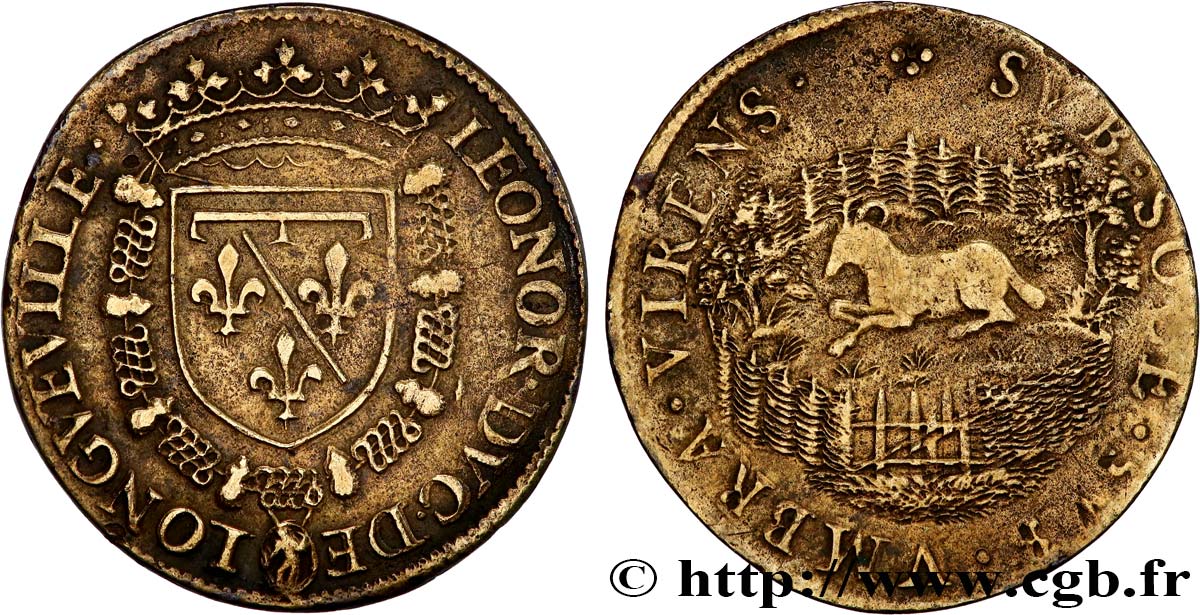
Diritto
Titolatura diritto : LEONOR. DUC. DE. LONGUEVILLE.
Descrittivo diritto : Armes de Leonor de Longueville avec le collier de l’Ordre de Saint Michel et de Saint Georges.
Rovescio
Titolatura rovescio : SUB. SOLE. SUB. UMBRA. VIRENS.
Descrittivo rovescio : Une chèvre dans un enclos palissadé.
Traduzione rovescio : Sous le soleil ou à l'ombre, elle reste vigoureuse.
Commento
Léonor d'Orléans (1540 - à Blois le 7 août 1573), duc de Longueville, prince de Châtellaillon, marquis de Rothelin, comte de Montgommery et de Tancarville, vicomte d'Abberville, de Melun, comte de Neufchâtel et de Valangin, fut gouverneur de Picardie et Normandie, et l’un des chefs militaires des guerres de religion. Fils de François d'Orléans-Longueville (v. 1513 - v. 1548) et de Jacqueline de Rohan-Gyé (v. 1520 - v. 1587), il combattit dans les dernières guerres d'Italie, et fut fait prisonnier par les Impériaux lors de la sanglante bataille de Saint-Quentin (1557). Il obtint de Charles IX le titre de prince du sang. De son union en 1563 avec la duchesse d’Estouteville Marie de Bourbon (1533-1601), il eut
* Henri d'Orléans, duc de Longueville ;
* François III d'Orléans, comte de Saint-Pol ;
* trois filles, dont Antoinette d’Orléans (née à Trie-Château en 1572, morte à Poitiers le 24 avril 1618)
Il mourut à Blois et fut inhumé à Châteaudun.
Voir sa biographie à http://fr.wikipedia.org/wiki/L%C3%A9onor_d%27Orl%C3%A9ans
Notons que Corre décrit le revers avec une licorne, sur notre exemplaire, c’est manifestement une chèvre avec deux cornes parfaitement nettes. Ce jeton a été frappé après que le Duc ait été promu chevalier de l’Ordre de Saint Michel et de Saint Georges.
Léonor d'Orléans (1540 - in Blois on August 7, 1573), Duke of Longueville, Prince of Châtellaillon, Marquis of Rothelin, Count of Montgomery and Tancarville, Viscount of Abberville, of Melun, Count of Neufchâtel and of Valangin, was governor of Picardy and Normandy, and one of the military leaders of the Wars of Religion. Son of François d'Orléans-Longueville (v. 1513 - v. 1548) and Jacqueline de Rohan-Gyé (v. 1520 - v. 1587), he fought in the last Italian wars, and was taken prisoner by the Imperials during the bloody battle of Saint-Quentin (1557). He obtained from Charles IX the title of prince of the blood. From his union in 1563 with the Duchess of Estouteville Marie de Bourbon (1533-1601), he had * Henri d'Orléans, Duke of Longueville; * François III d'Orléans, Count of Saint-Pol; * three daughters, including Antoinette d'Orléans (born in Trie-Château in 1572, died in Poitiers on April 24, 1618) He died in Blois and was buried in Châteaudun.
See his biography at http://fr. Wikipedia. org/wiki/L%C3%A9onor_d%27Orl%C3%A9ans Note that Corre describes the reverse with a unicorn, on our example, it is clearly a goat with two perfectly clear horns. This token was struck after the Duke was promoted to Knight of the Order of St. Michael and St. George
* Henri d'Orléans, duc de Longueville ;
* François III d'Orléans, comte de Saint-Pol ;
* trois filles, dont Antoinette d’Orléans (née à Trie-Château en 1572, morte à Poitiers le 24 avril 1618)
Il mourut à Blois et fut inhumé à Châteaudun.
Voir sa biographie à http://fr.wikipedia.org/wiki/L%C3%A9onor_d%27Orl%C3%A9ans
Notons que Corre décrit le revers avec une licorne, sur notre exemplaire, c’est manifestement une chèvre avec deux cornes parfaitement nettes. Ce jeton a été frappé après que le Duc ait été promu chevalier de l’Ordre de Saint Michel et de Saint Georges.
Léonor d'Orléans (1540 - in Blois on August 7, 1573), Duke of Longueville, Prince of Châtellaillon, Marquis of Rothelin, Count of Montgomery and Tancarville, Viscount of Abberville, of Melun, Count of Neufchâtel and of Valangin, was governor of Picardy and Normandy, and one of the military leaders of the Wars of Religion. Son of François d'Orléans-Longueville (v. 1513 - v. 1548) and Jacqueline de Rohan-Gyé (v. 1520 - v. 1587), he fought in the last Italian wars, and was taken prisoner by the Imperials during the bloody battle of Saint-Quentin (1557). He obtained from Charles IX the title of prince of the blood. From his union in 1563 with the Duchess of Estouteville Marie de Bourbon (1533-1601), he had * Henri d'Orléans, Duke of Longueville; * François III d'Orléans, Count of Saint-Pol; * three daughters, including Antoinette d'Orléans (born in Trie-Château in 1572, died in Poitiers on April 24, 1618) He died in Blois and was buried in Châteaudun.
See his biography at http://fr. Wikipedia. org/wiki/L%C3%A9onor_d%27Orl%C3%A9ans Note that Corre describes the reverse with a unicorn, on our example, it is clearly a goat with two perfectly clear horns. This token was struck after the Duke was promoted to Knight of the Order of St. Michael and St. George
Cronistoria
ORLÉANAIS - Noblesse et villes
Fondata sulle rovine della città gallica di Cenabum, la città prende il nome dall'imperatore Aurélien, Aurelianum. La città fu sede vescovile dal IV secolo, poi capitale di un regno franco nel VI secolo. Formando una contea sotto i Carolingi, la regione di Orleans divenne poi la base territoriale del potere dei Capetingi. Dotata di un'università dal 1309, fu poi assediata dagli inglesi ma consegnata da Giovanna d'Arco nel maggio 1429. La città entrò poi più volte nella storia durante le Guerre di Religione, la Fronda o nel 1870 quando fu occupata da von der Tann.
 Segnalare un errore
 Stampate la pagina
 Condividi mia selezione
 Fai una domanda
 Consegnare / vendere
Articoli correlati
 Descrittivo
Articoli visualizzati di recente
20 Francs DEBUSSY Modifié Fauté FRANCIA 1997 F.66ter.02 FDC
100.00 €

SPAGNA - REGNO DI SPAGNA - FILIPO IV Lot de quatre Contremarque de Maravedis mil
120.00 €
FIDEM - Organe de la Fédération Internationale de la Médaille, 17ème n° 1 -
10.00 €
ÉGYPTE - ROYAUME D'ÉGYPTE - FOUAD Ier 100 piastres, or jaune AH 1340 = 1922 S
130.00 €
cgbfr.it numismatica


