


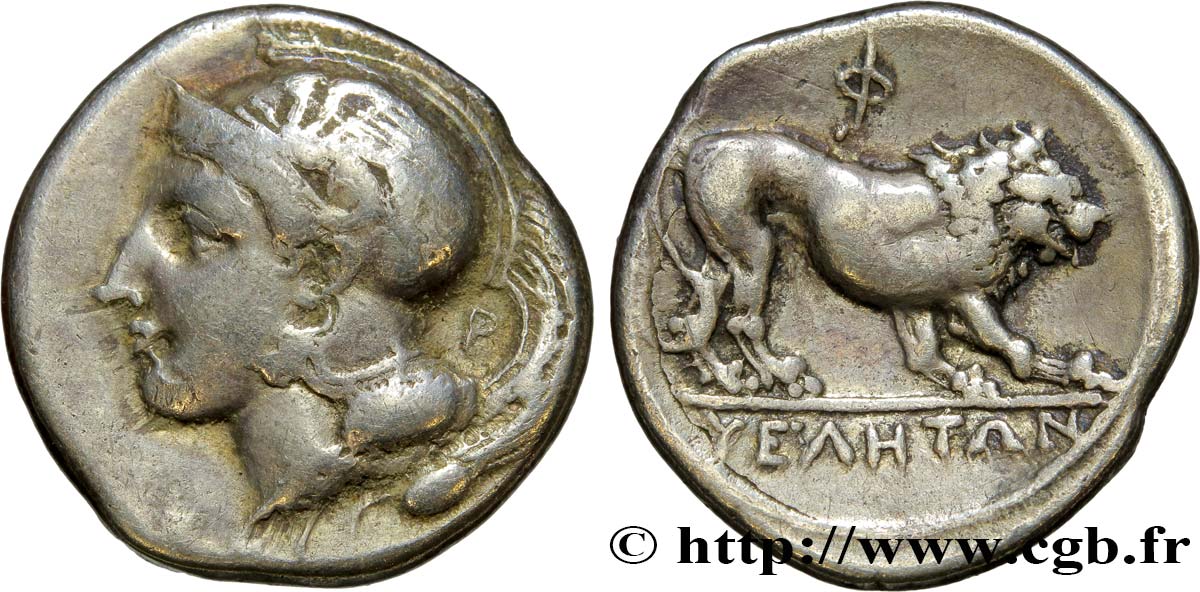
bgr_396300 - LUCANIA - VELIA Nomos, statère ou didrachme
non disponibile.
Articolo venduto sul nostro negozio (2016)
Prezzo : 280.00 €
Articolo venduto sul nostro negozio (2016)
Prezzo : 280.00 €
Tipo : Nomos, statère ou didrachme
Data: c. 365-350/340 AC
Nome della officina / città: Luncanie, Vélia
Metallo : argento
Diametro : 22 mm
Asse di coniazione : 6 h.
Peso : 7,57 g.
Grado di rarità : R1
Commenti sullo stato di conservazione:
Exemplaire sur un flan irrégulier bien centré des deux côtés. Beau portrait d’Athéna. Revers bien à la frappe, mais un peu mou. Patine grise superficielle avec des reflets dorés
N° nelle opere di riferimento :
Diritto
Descrittivo diritto : Tête d'Athéna à gauche, coiffée du casque attique à cimier avec triple aigrette, orné d’un griffon.
Legenda diritto : (RQ)
Rovescio
Descrittivo rovescio : Lion passant à droite .
Legenda rovescio : UELHTWN/ F
Traduzione rovescio : (de Vélia).
Commento
R. Williams a étudié la dégradation du coin de droit (A/152) et du coin de revers (R/ 203) et a déterminé six phases différentes. Très tôt, le monnayage de Vélia a été décrit comme ayant inspiré la drachme lourde de Marseille (LT. 785-791). Certains l’ont même décrit comme un monnayage symmachique : un lion de Vélia étant l’équivalent de deux lions de Marseille. Aujourd’hui, cette théorie est remise en cause, par G. Depeyrot, non sans arguments, mais avec une certaine acrimonie. Le lion de Vélia a pu servir de modèle à celui de Marseille, mais à quelle date ? La frappe à Vélia commence dans la seconde moitié du Ve siècle avant J.-C. pour se poursuivre jusqu’en 281 avant J.-C. À quel moment les Massaliotes auraient-ils emprunté le lion de Vélia ?.
R. Williams studied the degradation of the obverse die (A/152) and the reverse die (R/203) and identified six different phases. Very early on, the coinage of Velia was described as having inspired the heavy drachma of Marseille (LT. 785-791). Some have even described it as a symmachic coinage: one lion of Velia being the equivalent of two lions of Marseille. Today, this theory is challenged, not without argument, but with a certain acrimony, by G. Depeyrot. The lion of Velia could have served as a model for that of Marseille, but at what date? Minting at Velia began in the second half of the 5th century BC and continued until 281 BC. At what point could the Massaliotes have borrowed the lion of Velia?
R. Williams studied the degradation of the obverse die (A/152) and the reverse die (R/203) and identified six different phases. Very early on, the coinage of Velia was described as having inspired the heavy drachma of Marseille (LT. 785-791). Some have even described it as a symmachic coinage: one lion of Velia being the equivalent of two lions of Marseille. Today, this theory is challenged, not without argument, but with a certain acrimony, by G. Depeyrot. The lion of Velia could have served as a model for that of Marseille, but at what date? Minting at Velia began in the second half of the 5th century BC and continued until 281 BC. At what point could the Massaliotes have borrowed the lion of Velia?
Cronistoria
LUCANIA - VELIA
(350-281 a.C.)
Velia, Elea per i Greci, fu fondata intorno al 540 a.C. dai Focesi che avevano lasciato l'Asia Minore dopo la caduta di Sardi nel 546 a.C.. Velia divenne alleata dei Romani dal 275 a.C. la monetazione di Marsiglia perché la metropoli marsigliese aveva stretti legami con Velia.
 Segnalare un errore
 Stampate la pagina
 Condividi mia selezione
 Fai una domanda
 Consegnare / vendere
Articoli correlati

 Descrittivo


Articoli visualizzati di recente
TIBERIO II CONSTANTINO Follis BB/q.SPL
95.00 €

CHURCHES Méreau de Notre-Dame de Paris SPL
37.00 €

2 centimes Daniel-Dupuis 1914 Paris F.110/17 BB
5.00 €
CANADA 50 Cents Elisabeth II 1962 MS
10.00 €

SVIZZERA 20 Francs "Vreneli" 1902 Berne SPL
300.00 €

BELGIO 5 Francs Léopold II 1870 q.BB
17.00 €
cgbfr.it numismatica


