


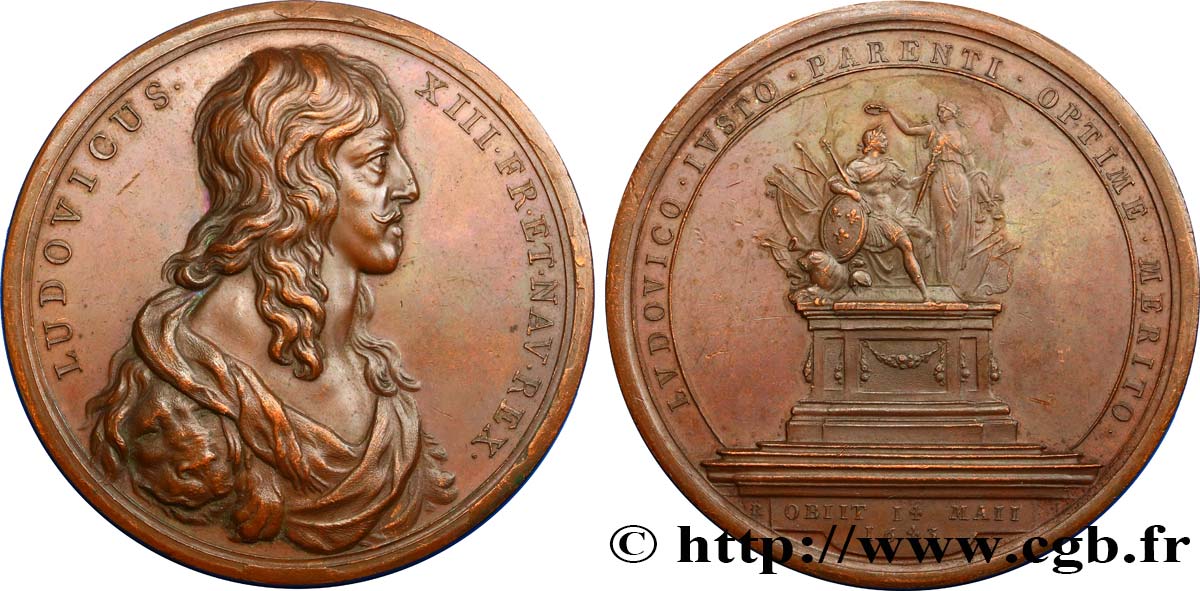
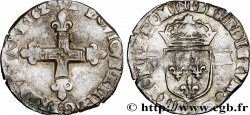
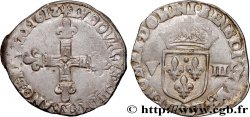
fme_412301 - LOUIS XIII Médaille pour la mort de Louis XIII le Juste
non disponibile.
Articolo venduto sul nostro negozio (2021)
Prezzo : 600.00 €
Articolo venduto sul nostro negozio (2021)
Prezzo : 600.00 €
Tipo : Médaille pour la mort de Louis XIII le Juste
Data: 1643
Nome della officina / città: 75 - Paris
Metallo : bronzo
Diametro : 70 mm
Asse di coniazione : 12 h.
Incisore MOLART Michel (1641-1713)
Peso : 155 g.
Orlo : lisse
Commenti sullo stato di conservazione:
Magnifique portrait avec un revers un peu plus usé avec quelques traces de manipulation. Sinon agréable patine brune
Diritto
Titolatura diritto : LVDOVICUS. XIII. FR. ET. NAV. REX..
Descrittivo diritto : Buste à l’antique de Louis XIII avec la léonté sur l’épaule.
Rovescio
Titolatura rovescio : LVDOVICO IVSTO PARENTI OPTIME MERITO // ORBIIT 14 MAII / 1643.
Descrittivo rovescio : Louis XIII assis, vêtue à l'antique, tenant un bouclier fleurdelisé et un sceptre, couronné par la Justice.
Commento
Médaille avec le même portrait et probablement de la même série que la médaille fme_412168 avec le Val de Grace au revers (signé MOLART Michel - 1641-1713). Cet exemplaire n’est signé que d’un R à gauche de l’exergue.
Après la mort du cardinal, en décembre 1642, le roi décide de se réconcilier avec certains des anciens conspirateurs comme son demi-frère, César de Vendôme et ses fils, le duc de Mercœur et le duc de Beaufort. Toutefois, il poursuit la même politique. Il fait entrer au conseil d'État un des proches collaborateurs de Richelieu, le Cardinal Mazarin qui devient vite premier ministre de fait, (le Roi n'a pas nommé de premier ministre, mais au bout de quelques mois, lorsque le secrétaire d'État à la guerre, Sublet de Noyers démissionne, le roi nomme pour le remplacer un des protégés de Mazarin, Michel Le Tellier).
Après six semaines de terribles coliques et vomissements, Louis XIII meurt le 14 mai 1643, soit 33 ans jour pour jour après son père Henri IV (assassiné le 14 mai 1610), à 41 ans, des conséquences d'un mal aujourd'hui identifié comme la maladie de Crohn. Il est toutefois probable que cette maladie chronique n'ait fait que l'affaiblir et que le coup de grâce lui ait été donné par son médecin, Bouvard, qui laisse le bilan de trente-quatre saignées, mille deux cents lavements et deux cent cinquante purges pratiqués sur le roi dans les deux dernières années de sa vie. Son corps est porté à la basilique Saint-Denis sans aucune cérémonie, selon son propre désir pour ne pas accabler son peuple d'une dépense excessive et inutile. Juste avant de mourir, Louis XIII rédige un testament visant à limiter les prérogatives de sa femme, la nouvelle Régente. Anne d'Autriche n'en tient pas compte et le fait casser dès qu'elle en a connaissance.
Medal with the same portrait and probably from the same series as the medal fme_412168 with the Val de Grace on the reverse (signed MOLART Michel - 1641-1713). This example is signed only with an R to the left of the exergue.
After the cardinal's death in December 1642, the king decided to reconcile with some of the former conspirators such as his half-brother, César de Vendôme and his sons, the Duke of Mercœur and the Duke of Beaufort.. However, it continues the same policy. He brought one of Richelieu's close collaborators, Cardinal Mazarin, into the Council of State, who quickly became de facto Prime Minister (the King had not appointed a Prime Minister, but after a few months, when the Secretary of State for War, Sublet de Noyers, resigned, the King appointed one of Mazarin's protégés, Michel Le Tellier, to replace him)..
After six weeks of terrible colic and vomiting, Louis XIII died on May 14, 1643, 33 years to the day after his father Henri IV (assassinated on May 14, 1610), at the age of 41, from the consequences of an illness now identified as Crohn's disease.. It is likely, however, that this chronic illness only weakened him and that the final blow was given by his doctor, Bouvard, who left a record of thirty-four bloodlettings, one thousand two hundred enemas and two hundred and fifty purges carried out on the king in the last two years of his life.. His body was taken to the Basilica of Saint-Denis without any ceremony, according to his own wish so as not to burden his people with excessive and unnecessary expense.. Just before his death, Louis XIII drew up a will aimed at limiting the prerogatives of his wife, the new Regent. Anne of Austria ignored this and had it broken as soon as she became aware of it.
Après la mort du cardinal, en décembre 1642, le roi décide de se réconcilier avec certains des anciens conspirateurs comme son demi-frère, César de Vendôme et ses fils, le duc de Mercœur et le duc de Beaufort. Toutefois, il poursuit la même politique. Il fait entrer au conseil d'État un des proches collaborateurs de Richelieu, le Cardinal Mazarin qui devient vite premier ministre de fait, (le Roi n'a pas nommé de premier ministre, mais au bout de quelques mois, lorsque le secrétaire d'État à la guerre, Sublet de Noyers démissionne, le roi nomme pour le remplacer un des protégés de Mazarin, Michel Le Tellier).
Après six semaines de terribles coliques et vomissements, Louis XIII meurt le 14 mai 1643, soit 33 ans jour pour jour après son père Henri IV (assassiné le 14 mai 1610), à 41 ans, des conséquences d'un mal aujourd'hui identifié comme la maladie de Crohn. Il est toutefois probable que cette maladie chronique n'ait fait que l'affaiblir et que le coup de grâce lui ait été donné par son médecin, Bouvard, qui laisse le bilan de trente-quatre saignées, mille deux cents lavements et deux cent cinquante purges pratiqués sur le roi dans les deux dernières années de sa vie. Son corps est porté à la basilique Saint-Denis sans aucune cérémonie, selon son propre désir pour ne pas accabler son peuple d'une dépense excessive et inutile. Juste avant de mourir, Louis XIII rédige un testament visant à limiter les prérogatives de sa femme, la nouvelle Régente. Anne d'Autriche n'en tient pas compte et le fait casser dès qu'elle en a connaissance.
Medal with the same portrait and probably from the same series as the medal fme_412168 with the Val de Grace on the reverse (signed MOLART Michel - 1641-1713). This example is signed only with an R to the left of the exergue.
After the cardinal's death in December 1642, the king decided to reconcile with some of the former conspirators such as his half-brother, César de Vendôme and his sons, the Duke of Mercœur and the Duke of Beaufort.. However, it continues the same policy. He brought one of Richelieu's close collaborators, Cardinal Mazarin, into the Council of State, who quickly became de facto Prime Minister (the King had not appointed a Prime Minister, but after a few months, when the Secretary of State for War, Sublet de Noyers, resigned, the King appointed one of Mazarin's protégés, Michel Le Tellier, to replace him)..
After six weeks of terrible colic and vomiting, Louis XIII died on May 14, 1643, 33 years to the day after his father Henri IV (assassinated on May 14, 1610), at the age of 41, from the consequences of an illness now identified as Crohn's disease.. It is likely, however, that this chronic illness only weakened him and that the final blow was given by his doctor, Bouvard, who left a record of thirty-four bloodlettings, one thousand two hundred enemas and two hundred and fifty purges carried out on the king in the last two years of his life.. His body was taken to the Basilica of Saint-Denis without any ceremony, according to his own wish so as not to burden his people with excessive and unnecessary expense.. Just before his death, Louis XIII drew up a will aimed at limiting the prerogatives of his wife, the new Regent. Anne of Austria ignored this and had it broken as soon as she became aware of it.
Cronistoria
LOUIS XIII
(14/05/1610-14/05/1643)
Figlio di Enrico IV e di Maria de' Medici, Luigi XIII nacque a Fontainebleau nel 1601. Re nel 1610, regnò prima sotto la reggenza di sua madre, che seguì una politica di conciliazione con la Spagna e inondò i Grandi di favori per assicurare loro la pace.. Gli Stati Generali, riuniti nel 1614-1615, mostrarono la disunione degli Ordini e l'impossibilità di riforme finanziarie. Il favorito del reggente, Concino Concini, marchese di Ancre, fu a capo degli affari fino al 1617, data del suo assassinio per ordine del re.. Il nuovo favorito, Albert de Luynes, ricevette la dignità di conestabile e governò fino alla sua morte prima di Montauban nel 1621, continuando una politica estera favorevole agli Asburgo.. Tornata al potere, la regina-madre portò nel Concilio una delle sue creature, Richelieu, già vescovo di Luçon.. Dal 1626 e fino alla fine del regno, Richelieu fu, come Primo Ministro, il padrone assoluto dello Stato.. Le successive trame di Maria de' Medici, Gaston d'Orléans, Anna d'Austria e Cinq-Mars non riuscirono a vincere il favore del cardinale. Sottomise il partito protestante (presa di La Rochelle, 1628, editto di grazia di Alès, 1629) e portò la Francia nella Guerra dei Trent'anni, guerra prima coperta (1630) poi aperta (1635). Questa lunga impresa di "abbassamento della Casa d'Austria" durò fino al 1659.. Richelieu non ne vide la fine, ma poté assistere alla conquista dell'Artois, dell'Alsazia e del Rossiglione. Con gli anni Trenta del Seicento si verificò una "rivoluzione nell'arte di governare" corrispondente al ministero di Richelieu e all'entrata della Francia nella Guerra dei Trent'anni.. Nel contesto della "rivoluzione militare" del XVII secolo (decuplicazione numerica, preponderanza di fanteria e armi da fuoco, fortificazione bastionata), lo sforzo bellico senza precedenti imponeva e giustificava uno Stato onnipotente, mosso dalla sola ragion di Stato. "Gigante del grande secolo", studiato dagli anglosassoni più che dagli storici di Francia, l'esercito francese divenne un Leviatano armato; la tassa che la nutre pesava come non mai. L'esercizio del potere guadagnò in efficienza, con l'organizzazione del Consiglio di Stato e l'istituzione degli intendenti. Viene messo in atto un primo controllo dell'opinione e del linguaggio (istituzione dell'Accademia di Francia, creazione della Gazette de France). Il potere tendeva anche alla brutalità: evocando i primi anni Trenta del Seicento, Omer Talon scrive che "volevamo le cose per autorità e non per concerto". La Fronda appare come una reazione fallita a questi cambiamenti troppo rapidi. Re guerriero, re impregnato dei suoi doveri, Luigi XIII lasciò fare tutto al Gran Cardinale pur mantenendo la direzione degli eserciti, che guidò con coraggio (assedio di La Rochelle, 1628, affare del Passo di Susa, 1629, conquista del Rossiglione, 1642). Ha usato Richelieu senza piacergli, ma dopo la sua morte nel 1642 ha mantenuto i suoi ministri e ha continuato la sua politica fino alla sua morte l'anno successivo.. Da Anna d'Austria sposata nel 1614, ebbe due figli, Luigi XIV e Filippo d'Orléans.
 Segnalare un errore
 Stampate la pagina
 Condividi mia selezione
 Fai una domanda
 Consegnare / vendere
Articoli correlati
 Descrittivo
cgbfr.it numismatica


