


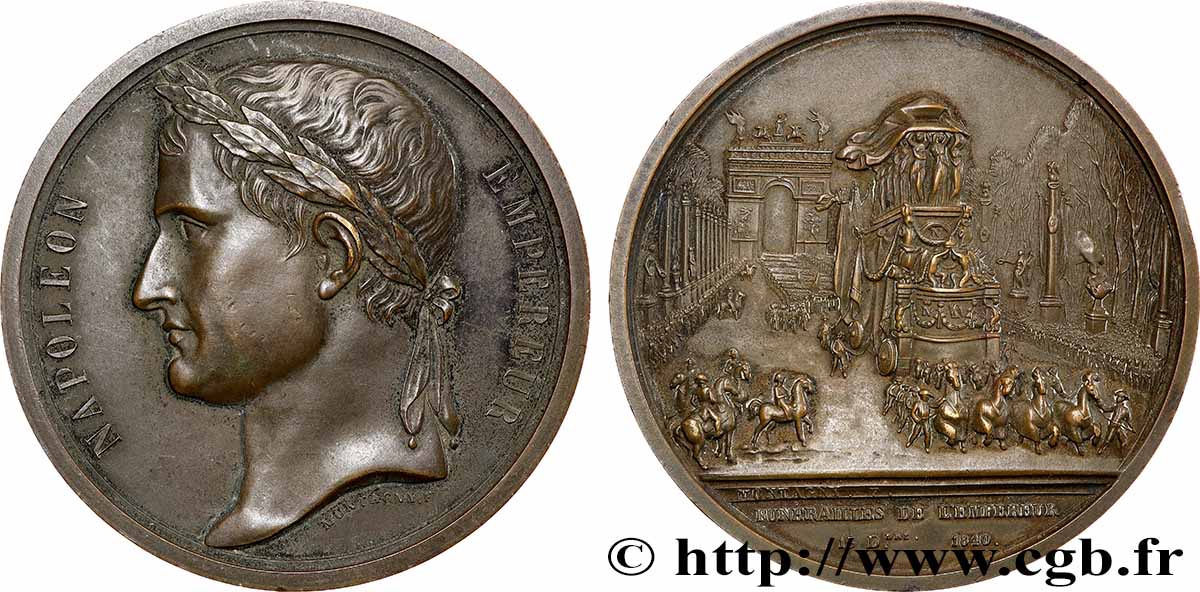
fme_1102425 - LUIGI FILIPPO I Médaille, Retour des cendres - funérailles de l’Empereur, refrappe
70.00 €
Quantità
Aggiungi al carrello

Tipo : Médaille, Retour des cendres - funérailles de l’Empereur, refrappe
Data: n.d.
Nome della officina / città: Monnaie de Paris
Metallo : bronzo
Diametro : 58,5 mm
Asse di coniazione : 12 h.
Incisore MONTAGNY Jean-Pierre (1789-1862)
Peso : 105,98 g.
Orlo : lisse + corne BRONZE
Marchio : corne BRONZE
Commenti sullo stato di conservazione:
Patine marron hétérogène, avec quelques taches d’oxydation. Légère usure
Diritto
Titolatura diritto : NAPOLÉON - EMPEREUR.
Descrittivo diritto : Tête laurée de Napoléon Ier à gauche. Signé : MONTAGNY F..
Rovescio
Titolatura rovescio : FUNÉRAILLES DE L’EMPEREUR / 15 D.BRE 1840..
Descrittivo rovescio : Vue du cortège funèbre, avec l’Arc de Triomphe en arrière plan. Signé : MONTAGNY F..
Commento
En 1840, le président du Conseil Adolphe Thiers négocie avec le gouvernement anglais le retour des cendres de Napoléon 1er à Paris. Il veut, par cette initiative, redresser le prestige du roi Louis-Philippe 1er. Les Anglais acceptent le transfert, désireux qu'ils sont de se concilier la France avec laquelle ils sont en conflit sur la question d'Orient.
Le 15 décembre 1840, au cours d'une cérémonie populaire et grandiose, le char funèbre entre à Paris et se dirige vers les Invalides où il est accueilli par le roi en personne. Le sarcophage est exposé dans une chapelle du Dôme des Invalides en attendant son transfert dans la crypte monumentale, en 1861.
Sur le trajet, un million de Parisiens devenus bonapartistes pour l'occasion n'hésitent pas à crier « Vive l'Empereur ! ».
Le principal bénéficiaire de l'opération est le courant bonapartiste. Il reprend vie et il ne lui faudra que huit ans pour amener au pouvoir Louis-Napoléon Bonaparte, neveu du regretté empereur.
Napoléon 1er repose depuis lors en l'église Saint-Louis-des-Invalides, selon le voeu qu'il avait exprimé sur son île : « Je désire que mes cendres reposent sur les bords de la Seine, au milieu de ce peuple français que j'ai tant aimé » (Mémorial de Sainte-Hélène).
In 1840, the President of the Council, Adolphe Thiers, negotiated with the English government the return of Napoleon I's ashes to Paris.. With this initiative, he wants to restore the prestige of King Louis-Philippe I.. The English accepted the transfer, eager as they were to reconcile France with which they were in conflict over the Eastern question..
On December 15, 1840, during a popular and grandiose ceremony, the funeral carriage entered Paris and headed towards the Invalides where it was welcomed by the king himself.. The sarcophagus is displayed in a chapel of the Dôme des Invalides while awaiting its transfer to the monumental crypt in 1861..
Along the way, a million Parisians who had become Bonapartists for the occasion did not hesitate to shout \\\"Long live the Emperor!\\\".
The main beneficiary of the operation is the Bonapartist movement. He came back to life and it took him only eight years to bring Louis-Napoléon Bonaparte, nephew of the late emperor, to power..
Napoleon I has since rested in the church of Saint-Louis-des-Invalides, according to the wish he expressed on his island: \\\"I wish my ashes to rest on the banks of the Seine, among the French people whom I loved so much\\\" (Saint Helena Memorial)
Le 15 décembre 1840, au cours d'une cérémonie populaire et grandiose, le char funèbre entre à Paris et se dirige vers les Invalides où il est accueilli par le roi en personne. Le sarcophage est exposé dans une chapelle du Dôme des Invalides en attendant son transfert dans la crypte monumentale, en 1861.
Sur le trajet, un million de Parisiens devenus bonapartistes pour l'occasion n'hésitent pas à crier « Vive l'Empereur ! ».
Le principal bénéficiaire de l'opération est le courant bonapartiste. Il reprend vie et il ne lui faudra que huit ans pour amener au pouvoir Louis-Napoléon Bonaparte, neveu du regretté empereur.
Napoléon 1er repose depuis lors en l'église Saint-Louis-des-Invalides, selon le voeu qu'il avait exprimé sur son île : « Je désire que mes cendres reposent sur les bords de la Seine, au milieu de ce peuple français que j'ai tant aimé » (Mémorial de Sainte-Hélène).
In 1840, the President of the Council, Adolphe Thiers, negotiated with the English government the return of Napoleon I's ashes to Paris.. With this initiative, he wants to restore the prestige of King Louis-Philippe I.. The English accepted the transfer, eager as they were to reconcile France with which they were in conflict over the Eastern question..
On December 15, 1840, during a popular and grandiose ceremony, the funeral carriage entered Paris and headed towards the Invalides where it was welcomed by the king himself.. The sarcophagus is displayed in a chapel of the Dôme des Invalides while awaiting its transfer to the monumental crypt in 1861..
Along the way, a million Parisians who had become Bonapartists for the occasion did not hesitate to shout \\\"Long live the Emperor!\\\".
The main beneficiary of the operation is the Bonapartist movement. He came back to life and it took him only eight years to bring Louis-Napoléon Bonaparte, nephew of the late emperor, to power..
Napoleon I has since rested in the church of Saint-Louis-des-Invalides, according to the wish he expressed on his island: \\\"I wish my ashes to rest on the banks of the Seine, among the French people whom I loved so much\\\" (Saint Helena Memorial)
Cronistoria
LUIGI FILIPPO I
(7/08/1830-24/02/1848)
Nato a Parigi nel 1773, Luigi Filippo è il primogenito di Luigi Filippo Giuseppe, duca d'Orléans (Philippe-Égalité), ghigliottinato nel 1793 per corruzione dopo aver votato per la morte del cugino Luigi XVI. Successivamente porta i titoli di duca di Valois, Chartres e Orleans dal 1793. Favorevole alla Rivoluzione, come suo padre, dovette tuttavia rifugiarsi in Svizzera, poi viaggiò in Scandinavia, negli Stati Uniti e infine si stabilì in Inghilterra nel 1801.. La Restaurazione gli permette di ritrovare gli immensi possedimenti della sua famiglia ma rimane considerato un potenziale rivale da Luigi XVIII che lo accoglie con freddezza. Profugo in Inghilterra durante i cento giorni, tornò in Francia nel 1817. Avido di guadagno, ha dato il suo appoggio all'opposizione rappresentata dal partito liberale facendo affidamento sull'alta borghesia possidente.. Le giornate del 1830 gli diedero la possibilità di salire al potere dopo aver aderito al tricolore e moltiplicato le promesse. Divenne il 31 luglio 1830 luogotenente generale del regno poi re dei francesi il 7 agosto. Il suo regno, sotto un'apparenza liberale, diventerà quello della borghesia e degli ambienti imprenditoriali mentre le opposizioni (legittimisti, bonapartisti, repubblicani e socialisti) saranno mantenute illegalmente.. La sua politica di pace e la sua autorità gli valsero poi un notevole prestigio presso le corti europee.. Il banchiere Laffitte è Primo Ministro. La Fayette è uno degli artefici di questa "rivoluzione borghese". Il 13 marzo 1831 Casimir Périer sostituì Laffitte. La Francia interviene in Belgio nell'agosto 1831 per contrastare gli olandesi. I legittimisti, con il complotto di rue des Prouvaires, cercano di stabilire Enrico V come re mentre sua madre cerca di sollevare la Vandea. Fu arrestata il 3 dicembre 1832 a Nantes.. L'epidemia di colera uccide più di diecimila persone a Parigi, tra cui Casimir Périer. I funerali del generale Lamarque furono l'occasione per un tentativo di insurrezione repubblicana, schiacciato nel sangue (cfr. miserabile). I francesi occupano Anversa il 23 dicembre 1832.. L'attacco di Fieschi del 28 luglio 1835 contro Luigi Filippo uccide diciotto persone tra cui il maresciallo Mortier. La prima linea ferroviaria Parigi-Orléans e la colonna di luglio furono inaugurate rispettivamente il 24 ottobre 1837 e il 28 luglio 1840.. L'anno 1840 segnò una svolta nel regime, con grande instabilità ministeriale prima di avere il ministero Guizot ("Arricchisci!").. Il principe Luigi Napoleone Bonaparte, dopo un secondo tentativo di putsch, fu condannato all'ergastolo e rinchiuso a Fort Ham da cui fuggì nel 1846. Le ceneri di Napoleone vengono portate da Sant'Elena e trasferite a Les Invalides. Dal 1841 Luigi Filippo impegnò la Francia sulla via della conquista totale dell'Algeria, già avviata sotto Carlo X, mentre nella Francia metropolitana si sviluppò un grande boom economico.. Una legge del 1841 limita il lavoro minorile a 12 ore. Il primo grave incidente ferroviario avvenne sulla linea Parigi-Versailles e causò 45 morti l'8 maggio 1842. Il 13 luglio morì accidentalmente il duca d'Orleans, il figlio maggiore del re. Il 16 maggio 1843 il duca di Aumale prese la smala di Abd-el-Kader che riuscì a fuggire. Bugeaud, governatore dell'Algeria, viene nominato maresciallo. Il 1843 segna anche l'inizio dell'Intesa Cordiale e la visita della regina Vittoria in Francia. I francesi hanno battuto i marocchini a Isly. Abd-el-Kader si arrende il 23 dicembre 1847. Il rifiuto delle riforme porta alla caduta del regime durante la campagna dei banchetti e Luigi Filippo, detronizzato il 24 febbraio 1848, si rifugia in Inghilterra dopo aver abdicato in favore del nipote..
 Segnalare un errore
 Stampate la pagina
 Condividi mia selezione
 Fai una domanda
 Consegnare / vendere
Articoli correlati

 Descrittivo


cgbfr.it numismatica


