


E-auction 412-324337 - fme_423632 - LUIGI FILIPPO I Médaille, Avènement de Louis-Philippe
Devi Sign-in ed essere un offerente approvato fare un'offerta, Login per fare offerte. Conti sono soggetti ad approvazione e di approvazione sono raggiunti entro 48 ore. Non aspettare fino al giorno di una vendita si chiude per registrarti.Confermando la tua offerta su questo oggetto ti impegni ad un contratto legalmente vincolante per l'acquisto di questo prodotto e fare clic su «offerta» costituisce accettazione dei termini di utilizzo de e-auctions cgb.fr.
Offerta deve essere collocato in euro gli importi interi vendita only.The si chiuderà al momento sulla descrizione dell'oggetto, eventuali offerte pervenute al sito dopo l'orario di chiusura non verranno eseguite. Volte transmition possono variare e le offerte potrebbero essere respinto se si attende per gli ultimi secondi. Per ulteriori informazioni ckeck le FAQ.
SENZA COSTI PER GLI ACQUIRENTI.
SENZA COSTI PER GLI ACQUIRENTI.
| Valutazione : | 180 € |
| Prezzo : | 77 € |
| Offerta maxima : | 300 € |
| Data di fine vendita : | 08 marzo 2021 18:46:30 |
| partecipanti : | 9 partecipanti |
Tipo : Médaille, Avènement de Louis-Philippe
Data: 1830
Nome della officina / città: 75 - Paris
Metallo : rame
Diametro : 75 mm
Asse di coniazione : 12 h.
Incisore DEPAULIS Alexis-Joseph (1790-1867)
Peso : 215 g.
Orlo : lisse
Marchio : sans poinçon
Commenti sullo stato di conservazione:
Belle et large médaille avec une patine marron. La médaille présente plusieurs coups et rayures, ainsi qu’une légère usure sur les reliefs
N° nelle opere di riferimento :
Diritto
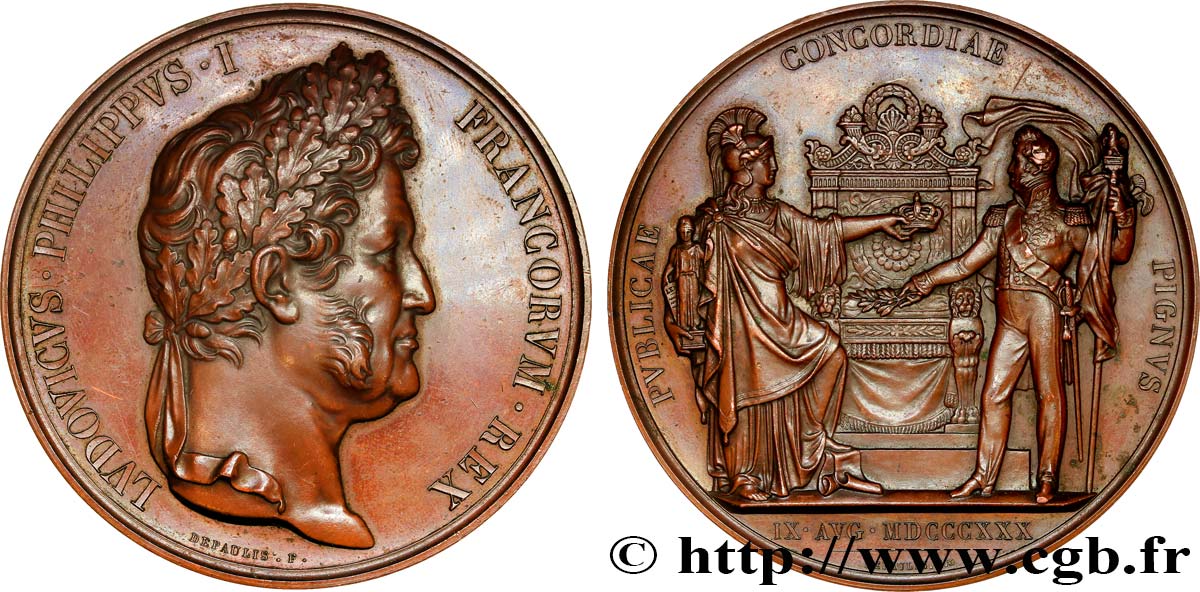
Titolatura diritto : LVDOVICVS. PHILIPPVS. I - FRANCORVM. REX.
Descrittivo diritto : Tête laurée à droite de Louis-Philippe Ier. Signé : DEPAULIS. F. .
Rovescio
Titolatura rovescio : PVBLICAE - CONCORDIAE - PIGNVS // MDCCCXXX.
Descrittivo rovescio : Dans le champ à gauche du trône royal, la France casquée debout, vêtue à l’antique, tenant à droite une statuette de la République timbrée LEX offre de la gauche la couronne à Louis-Philippe, situé à droite du trône, debout en uniforme. Il tend de la droite un rameau de laurier et retient de la gauche le drapeau tricolore. Signé : DEPAULIS. F. .
Commento
Médaille avec une tranche lisse, probablement d’époque, le système des poincons ayant été adopté en 1832.
En 1830, la révolution des « Trois Glorieuses » renverse Charles X, qui abdique (avec le contre-seing de son fils le dauphin Louis de France) en faveur de son petit-fils le duc de Bordeaux. Cependant les députés instituent le duc d’Orléans comme lieutenant-général du Royaume le 30 juillet 18306 et Charles X prend finalement le chemin de l'exil.
Louis-Philippe se fait proclamer roi des Français par la Chambre des députés le 9 août 1830, par la grâce d'une charte valant constitution. Ce nouveau titre, déjà porté par Louis XVI de 1789 à 1792, est une innovation constitutionnelle liant la nouvelle monarchie populaire au peuple, et non plus au pays, au territoire. Il s'agit donc d'une monarchie contractuelle fondée sur un Pacte entre le roi et les représentants de la nation. Un autre symbole fort de la nouvelle monarchie, appelée « monarchie de Juillet », est l’usage du drapeau tricolore pour remplacer le drapeau blanc de la Restauration. Cette arrivée au pouvoir à la faveur d’un soulèvement populaire vaut à Louis-Philippe l’hostilité des cours européennes et le surnom de « roi des barricades » ou encore « roi bourgeois »..
Medal with a smooth edge, probably from the period, the hallmark system having been adopted in 1832.
In 1830, the revolution of the \\\"Three Glorious Days\\\" overthrew Charles X, who abdicated (with the countersignature of his son, the Dauphin Louis of France) in favor of his grandson, the Duke of Bordeaux.. However, the deputies established the Duke of Orleans as Lieutenant-General of the Kingdom on July 30, 18306 and Charles X finally took the path of exile..
Louis-Philippe had himself proclaimed King of the French by the Chamber of Deputies on August 9, 1830, by virtue of a charter serving as a constitution.. This new title, already held by Louis XVI from 1789 to 1792, is a constitutional innovation linking the new popular monarchy to the people, and no longer to the country, to the territory. It is therefore a contractual monarchy based on a Pact between the king and the representatives of the nation. Another strong symbol of the new monarchy, called the \\\"July Monarchy\\\", is the use of the tricolor flag to replace the white flag of the Restoration. This rise to power thanks to a popular uprising earned Louis-Philippe the hostility of the European courts and the nickname \\\"king of the barricades\\\" or \\\"bourgeois king\\\"..
En 1830, la révolution des « Trois Glorieuses » renverse Charles X, qui abdique (avec le contre-seing de son fils le dauphin Louis de France) en faveur de son petit-fils le duc de Bordeaux. Cependant les députés instituent le duc d’Orléans comme lieutenant-général du Royaume le 30 juillet 18306 et Charles X prend finalement le chemin de l'exil.
Louis-Philippe se fait proclamer roi des Français par la Chambre des députés le 9 août 1830, par la grâce d'une charte valant constitution. Ce nouveau titre, déjà porté par Louis XVI de 1789 à 1792, est une innovation constitutionnelle liant la nouvelle monarchie populaire au peuple, et non plus au pays, au territoire. Il s'agit donc d'une monarchie contractuelle fondée sur un Pacte entre le roi et les représentants de la nation. Un autre symbole fort de la nouvelle monarchie, appelée « monarchie de Juillet », est l’usage du drapeau tricolore pour remplacer le drapeau blanc de la Restauration. Cette arrivée au pouvoir à la faveur d’un soulèvement populaire vaut à Louis-Philippe l’hostilité des cours européennes et le surnom de « roi des barricades » ou encore « roi bourgeois »..
Medal with a smooth edge, probably from the period, the hallmark system having been adopted in 1832.
In 1830, the revolution of the \\\"Three Glorious Days\\\" overthrew Charles X, who abdicated (with the countersignature of his son, the Dauphin Louis of France) in favor of his grandson, the Duke of Bordeaux.. However, the deputies established the Duke of Orleans as Lieutenant-General of the Kingdom on July 30, 18306 and Charles X finally took the path of exile..
Louis-Philippe had himself proclaimed King of the French by the Chamber of Deputies on August 9, 1830, by virtue of a charter serving as a constitution.. This new title, already held by Louis XVI from 1789 to 1792, is a constitutional innovation linking the new popular monarchy to the people, and no longer to the country, to the territory. It is therefore a contractual monarchy based on a Pact between the king and the representatives of the nation. Another strong symbol of the new monarchy, called the \\\"July Monarchy\\\", is the use of the tricolor flag to replace the white flag of the Restoration. This rise to power thanks to a popular uprising earned Louis-Philippe the hostility of the European courts and the nickname \\\"king of the barricades\\\" or \\\"bourgeois king\\\"..
Cronistoria
LUIGI FILIPPO I
(7/08/1830-24/02/1848)
Nato a Parigi nel 1773, Luigi Filippo è il primogenito di Luigi Filippo Giuseppe, duca d'Orléans (Philippe-Égalité), ghigliottinato nel 1793 per corruzione dopo aver votato per la morte del cugino Luigi XVI. Successivamente porta i titoli di duca di Valois, Chartres e Orleans dal 1793. Favorevole alla Rivoluzione, come suo padre, dovette tuttavia rifugiarsi in Svizzera, poi viaggiò in Scandinavia, negli Stati Uniti e infine si stabilì in Inghilterra nel 1801.. La Restaurazione gli permette di ritrovare gli immensi possedimenti della sua famiglia ma rimane considerato un potenziale rivale da Luigi XVIII che lo accoglie con freddezza. Profugo in Inghilterra durante i cento giorni, tornò in Francia nel 1817. Avido di guadagno, ha dato il suo appoggio all'opposizione rappresentata dal partito liberale facendo affidamento sull'alta borghesia possidente.. Le giornate del 1830 gli diedero la possibilità di salire al potere dopo aver aderito al tricolore e moltiplicato le promesse. Divenne il 31 luglio 1830 luogotenente generale del regno poi re dei francesi il 7 agosto. Il suo regno, sotto un'apparenza liberale, diventerà quello della borghesia e degli ambienti imprenditoriali mentre le opposizioni (legittimisti, bonapartisti, repubblicani e socialisti) saranno mantenute illegalmente.. La sua politica di pace e la sua autorità gli valsero poi un notevole prestigio presso le corti europee.. Il banchiere Laffitte è Primo Ministro. La Fayette è uno degli artefici di questa "rivoluzione borghese". Il 13 marzo 1831 Casimir Périer sostituì Laffitte. La Francia interviene in Belgio nell'agosto 1831 per contrastare gli olandesi. I legittimisti, con il complotto di rue des Prouvaires, cercano di stabilire Enrico V come re mentre sua madre cerca di sollevare la Vandea. Fu arrestata il 3 dicembre 1832 a Nantes.. L'epidemia di colera uccide più di diecimila persone a Parigi, tra cui Casimir Périer. I funerali del generale Lamarque furono l'occasione per un tentativo di insurrezione repubblicana, schiacciato nel sangue (cfr. miserabile). I francesi occupano Anversa il 23 dicembre 1832.. L'attacco di Fieschi del 28 luglio 1835 contro Luigi Filippo uccide diciotto persone tra cui il maresciallo Mortier. La prima linea ferroviaria Parigi-Orléans e la colonna di luglio furono inaugurate rispettivamente il 24 ottobre 1837 e il 28 luglio 1840.. L'anno 1840 segnò una svolta nel regime, con grande instabilità ministeriale prima di avere il ministero Guizot ("Arricchisci!").. Il principe Luigi Napoleone Bonaparte, dopo un secondo tentativo di putsch, fu condannato all'ergastolo e rinchiuso a Fort Ham da cui fuggì nel 1846. Le ceneri di Napoleone vengono portate da Sant'Elena e trasferite a Les Invalides. Dal 1841 Luigi Filippo impegnò la Francia sulla via della conquista totale dell'Algeria, già avviata sotto Carlo X, mentre nella Francia metropolitana si sviluppò un grande boom economico.. Una legge del 1841 limita il lavoro minorile a 12 ore. Il primo grave incidente ferroviario avvenne sulla linea Parigi-Versailles e causò 45 morti l'8 maggio 1842. Il 13 luglio morì accidentalmente il duca d'Orleans, il figlio maggiore del re. Il 16 maggio 1843 il duca di Aumale prese la smala di Abd-el-Kader che riuscì a fuggire. Bugeaud, governatore dell'Algeria, viene nominato maresciallo. Il 1843 segna anche l'inizio dell'Intesa Cordiale e la visita della regina Vittoria in Francia. I francesi hanno battuto i marocchini a Isly. Abd-el-Kader si arrende il 23 dicembre 1847. Il rifiuto delle riforme porta alla caduta del regime durante la campagna dei banchetti e Luigi Filippo, detronizzato il 24 febbraio 1848, si rifugia in Inghilterra dopo aver abdicato in favore del nipote..
 Segnalare un errore
 Stampate la pagina
 Condividi mia selezione
 Fai una domanda
 Consegnare / vendere
Articoli correlati
 Descrittivo



cgbfr.it numismatica


