


E-auction 77-38377 - fjt_014803 - LANGUEDOC TOWNS AND GENTRY Charles de Montchal, archevêque de Toulouse 1630
Devi Sign-in ed essere un offerente approvato fare un'offerta, Login per fare offerte. Conti sono soggetti ad approvazione e di approvazione sono raggiunti entro 48 ore. Non aspettare fino al giorno di una vendita si chiude per registrarti.Confermando la tua offerta su questo oggetto ti impegni ad un contratto legalmente vincolante per l'acquisto di questo prodotto e fare clic su «offerta» costituisce accettazione dei termini di utilizzo de e-auctions cgb.fr.
Offerta deve essere collocato in euro gli importi interi vendita only.The si chiuderà al momento sulla descrizione dell'oggetto, eventuali offerte pervenute al sito dopo l'orario di chiusura non verranno eseguite. Volte transmition possono variare e le offerte potrebbero essere respinto se si attende per gli ultimi secondi. Per ulteriori informazioni ckeck le FAQ.
SENZA COSTI PER GLI ACQUIRENTI.
SENZA COSTI PER GLI ACQUIRENTI.
| Valutazione : | 140 € |
| Prezzo : | 54 € |
| Offerta maxima : | 101 € |
| Data di fine vendita : | 06 ottobre 2014 18:39:00 |
| partecipanti : | 7 partecipanti |
Tipo : Charles de Montchal, archevêque de Toulouse
Data: 1630
Metallo : ottone
Diametro : 30 mm
Asse di coniazione : 6 h.
Orlo : lisse
Grado di rarità : R2
N° nelle opere di riferimento :
Diritto
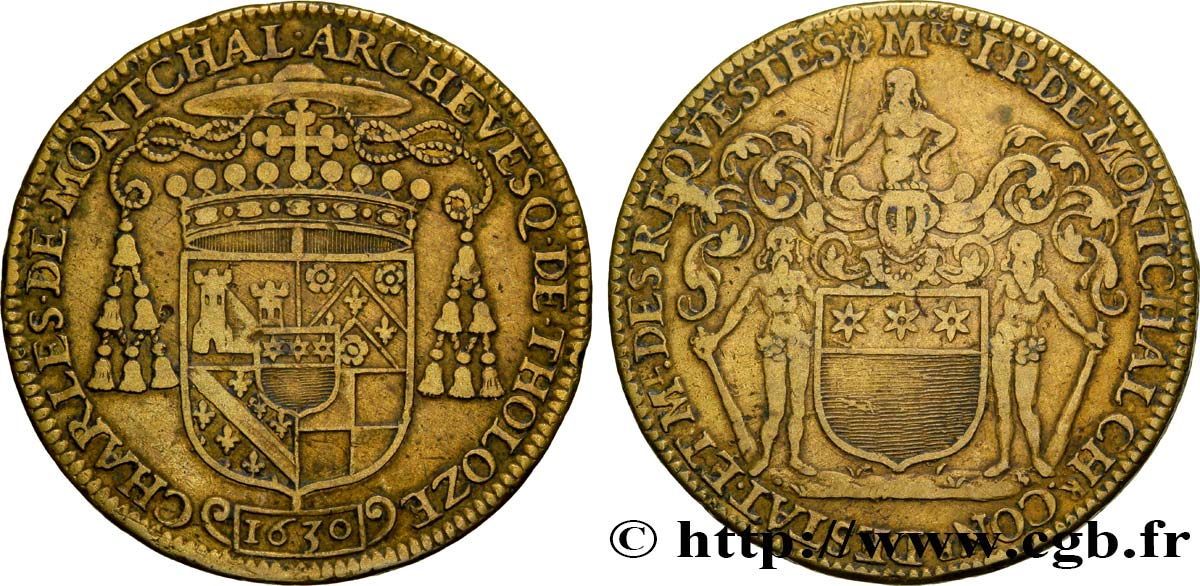
Titolatura diritto : CHARLES DE MONTCHAL ARCHEVESQ DE THOLOZE 1630.
Descrittivo diritto : Armes de Charles de Montchal, sur quatre écus, avec ses attributs.
Rovescio
Titolatura rovescio : MRE I P DE MONTCHAL CHR CONR DESTAT ET MR RES REQVESTES.
Descrittivo rovescio : Armes de Montchal.
Commento
Charles de Montchal, né en 1589 à Annonay et décédé le 22 août 1651 à Carcassonne, archevêque de Toulouse, est l'un des plus savants prélats qui aient occupé ce siège épiscopal français.
Né en 1589 à Annonay, d'un apothicaire de cette ville, il obtint une bourse à Paris au collège d'Autun, dont il devint dans la suite le principal, et y fit ses études avec une rare distinction. Ayant embrassé l'état ecclésiastique, il fut pourvu d'un canonicat du chapitre d'Angoulême, et succéda en 1628 sur le siège de Toulouse au cardinal de la Valette, qui donna sa démission en faveur de son ancien maître. Il s'appliqua avec zèle à l'administration de son diocèse, plaça des pasteurs instruits à la tète des paroisses, et distribua souvent lui-même au peuple le pain de la parole.
Député aux assemblées générales du clergé, il fut exclu en 1641 de celle de Mantes, pour s'être opposé aux volontés du cardinal de Richelieu : cette disgrâce lui mérita l'honneur d'être élu président de l'assemblée de 1645 où il prit encore la défense des immunités ecclésiastiques. Il fonda dans sa ville épiscopale un séminaire pour les jeunes clercs et une maison de secours pour les pauvres valides, et contribua à former divers autres établissements pieux.
Ce prélat avait la réputation d'un des bons hellénistes de son temps : il s'était attaché particulièrement à l'étude des historiens ecclésiastiques, et ses confrères l'avaient engagé à s'occuper d'une nouvelle édition de l'Histoire d'Eusèbe, dont il avait rétabli le texte et corrigé la version latine dans une infinité d'endroits. Il possédait une riche bibliothèque, remarquable surtout par le nombre de manuscrits grecs, arabes et hébreux qu'il avait recueillis à grands frais dans toute l'Europe : il se faisait un plaisir de les communiquer aux savants, dont il était l'un des plus zélés protecteurs ; et il y en eut quelques-uns de publiés par ses soins.
Sa biographie complète à http://fr.wikipedia.org/wiki/Charles_de_Montchal .
Charles de Montchal, born in 1589 in Annonay and died on August 22, 1651 in Carcassonne, Archbishop of Toulouse, is one of the most learned prelates who occupied this French episcopal seat..
Born in 1589 in Annonay, to an apothecary of this town, he obtained a scholarship to Paris at the college of Autun, of which he later became the principal, and studied there with rare distinction.. Having embraced the ecclesiastical state, he was provided with a canonry of the chapter of Angoulême, and succeeded in 1628 on the seat of Toulouse to Cardinal de la Valette, who resigned in favor of his former master.. He applied himself with zeal to the administration of his diocese, placed educated pastors at the head of the parishes, and often distributed the bread of the word to the people himself..
A deputy to the general assemblies of the clergy, he was excluded in 1641 from that of Mantes, for having opposed the wishes of Cardinal Richelieu: this disgrace earned him the honor of being elected president of the assembly of 1645 where he again took up the defense of ecclesiastical immunities.. He founded in his episcopal city a seminary for young clerics and a relief house for the able-bodied poor, and contributed to the formation of various other pious establishments..
This prelate had the reputation of one of the best Hellenists of his time: he had devoted himself particularly to the study of ecclesiastical historians, and his colleagues had engaged him to take care of a new edition of the History of Eusebius, of which he had restored the text and corrected the Latin version in an infinite number of places.. He possessed a rich library, remarkable above all for the number of Greek, Arabic and Hebrew manuscripts that he had collected at great expense throughout Europe: he took pleasure in communicating them to scholars, of whom he was one of the most zealous protectors; and some of them were published by him.
His full biography at http://fr. Wikipedia. org/wiki/Charles_de_Montchal
Né en 1589 à Annonay, d'un apothicaire de cette ville, il obtint une bourse à Paris au collège d'Autun, dont il devint dans la suite le principal, et y fit ses études avec une rare distinction. Ayant embrassé l'état ecclésiastique, il fut pourvu d'un canonicat du chapitre d'Angoulême, et succéda en 1628 sur le siège de Toulouse au cardinal de la Valette, qui donna sa démission en faveur de son ancien maître. Il s'appliqua avec zèle à l'administration de son diocèse, plaça des pasteurs instruits à la tète des paroisses, et distribua souvent lui-même au peuple le pain de la parole.
Député aux assemblées générales du clergé, il fut exclu en 1641 de celle de Mantes, pour s'être opposé aux volontés du cardinal de Richelieu : cette disgrâce lui mérita l'honneur d'être élu président de l'assemblée de 1645 où il prit encore la défense des immunités ecclésiastiques. Il fonda dans sa ville épiscopale un séminaire pour les jeunes clercs et une maison de secours pour les pauvres valides, et contribua à former divers autres établissements pieux.
Ce prélat avait la réputation d'un des bons hellénistes de son temps : il s'était attaché particulièrement à l'étude des historiens ecclésiastiques, et ses confrères l'avaient engagé à s'occuper d'une nouvelle édition de l'Histoire d'Eusèbe, dont il avait rétabli le texte et corrigé la version latine dans une infinité d'endroits. Il possédait une riche bibliothèque, remarquable surtout par le nombre de manuscrits grecs, arabes et hébreux qu'il avait recueillis à grands frais dans toute l'Europe : il se faisait un plaisir de les communiquer aux savants, dont il était l'un des plus zélés protecteurs ; et il y en eut quelques-uns de publiés par ses soins.
Sa biographie complète à http://fr.wikipedia.org/wiki/Charles_de_Montchal .
Charles de Montchal, born in 1589 in Annonay and died on August 22, 1651 in Carcassonne, Archbishop of Toulouse, is one of the most learned prelates who occupied this French episcopal seat..
Born in 1589 in Annonay, to an apothecary of this town, he obtained a scholarship to Paris at the college of Autun, of which he later became the principal, and studied there with rare distinction.. Having embraced the ecclesiastical state, he was provided with a canonry of the chapter of Angoulême, and succeeded in 1628 on the seat of Toulouse to Cardinal de la Valette, who resigned in favor of his former master.. He applied himself with zeal to the administration of his diocese, placed educated pastors at the head of the parishes, and often distributed the bread of the word to the people himself..
A deputy to the general assemblies of the clergy, he was excluded in 1641 from that of Mantes, for having opposed the wishes of Cardinal Richelieu: this disgrace earned him the honor of being elected president of the assembly of 1645 where he again took up the defense of ecclesiastical immunities.. He founded in his episcopal city a seminary for young clerics and a relief house for the able-bodied poor, and contributed to the formation of various other pious establishments..
This prelate had the reputation of one of the best Hellenists of his time: he had devoted himself particularly to the study of ecclesiastical historians, and his colleagues had engaged him to take care of a new edition of the History of Eusebius, of which he had restored the text and corrected the Latin version in an infinite number of places.. He possessed a rich library, remarkable above all for the number of Greek, Arabic and Hebrew manuscripts that he had collected at great expense throughout Europe: he took pleasure in communicating them to scholars, of whom he was one of the most zealous protectors; and some of them were published by him.
His full biography at http://fr. Wikipedia. org/wiki/Charles_de_Montchal
Cronistoria
LANGUEDOC TOWNS AND GENTRY
 Segnalare un errore
 Stampate la pagina
 Condividi mia selezione
 Fai una domanda
 Consegnare / vendere
Articoli correlati
 Descrittivo
Articoli visualizzati di recente

20 Francs DEBUSSY Modifié FRANCIA 1995 F.66ter.01 FDC
16.00 €

LOUIS XIV "THE SUN KING" Écu aux insignes 1702 La Rochelle MB/q.BB
180.00 €

LETTONIA Série 8 médailles, Essai Euros fantaisies 2004 MS
19.00 €

QUARTA REPUBBLICA FRANCESE Médaille pour la ligne SNCF Rouen - Le Havre SPL
100.00 €

STATI UNITI D'AMERICA - Tribù Indiane 1 Cent Proof Nation of La Posta 2013 FDC
2.00 €
LOUIS XV "THE WELL-BELOVED" Seize deniers des mines de Béarn 1727 Pau q.BB/BB
190.00 €
cgbfr.it numismatica


