


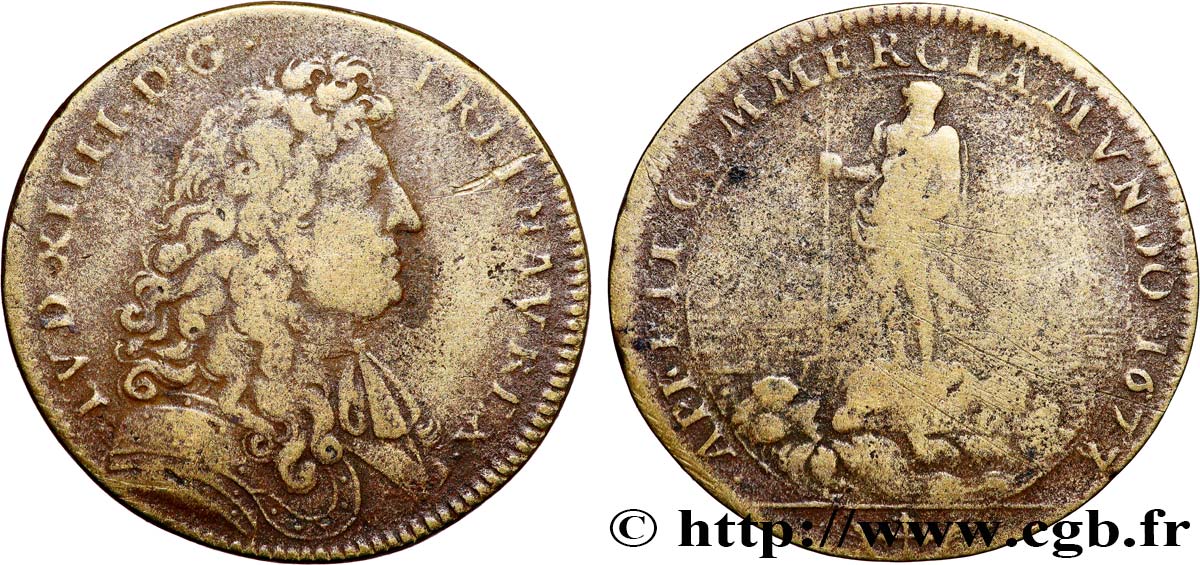
fjt_771766 - LANGUEDOC (ÉTATS DE ...) Creusement du canal des deux mers 1677
non disponibile.
Articolo venduto sul nostro negozio (2022)
Prezzo : 35.00 €
Articolo venduto sul nostro negozio (2022)
Prezzo : 35.00 €
Tipo : Creusement du canal des deux mers
Data: 1677
Metallo : ottone
Diametro : 25,5 mm
Asse di coniazione : 6 h.
Peso : 7,39 g.
Orlo : Lisse
Grado di rarità : R2
Commenti sullo stato di conservazione:
Importantes faiblesses de frappe. Patine hétérogène
N° nelle opere di riferimento :
Pedigree :
Jeton provenant de la Collection MARINECHE
Diritto
Titolatura diritto : .LVD. XIIII. D. G. - FR. ET. NAV. REX..
Descrittivo diritto : Buste cuirassé de Louis XIV à droite.
Traduzione diritto : Louis XIV, par la grâce de Dieu, roi de France et de Navarre.
Rovescio
Titolatura rovescio : .APERIT. COMMERCIA. MVNDO. 1677..
Descrittivo rovescio : Neptune debout de face sur un rocher. Il frappe de son trident la pierre qui s'entrouvre et laisse un passage aux flots de la mer. À l’exergue, la croix de Toulouse entre deux rameaux.
Traduzione rovescio : (Il ouvre au monde de nouvelles voies commerciales).
Commento
Le revers de ce jeton fait référence à la construction du Canal du Midi autrement connu sous le nom de Canal du Languedoc ou de Canal des Deux-Mers. L'idée de sa création remonte à François Ier. le 15 novembre 1662, Pierre-Paul de Riquet, seigneur de Bonrepos, présenta un projet pour le creusement de ce canal. Un édit du 14 octobre 1666 ordonna le début des travaux qui employèrent environ 12.000 hommes. Les travaux furent achevés le 15 mars 1681 après quinze années de dur labeur ayant nécessité la construction de 126 ponts, 55 aqueducs, 6 barrages, 7 pont-canaux et 1 tunnel. Ce canal qui relie la Garonne à la Méditerranée fait actuellement 240 kilomètres.
The reverse of this token refers to the construction of the Canal du Midi, otherwise known as the Canal du Languedoc or the Canal des Deux-Mers. The idea for its creation dates back to François I. On November 15, 1662, Pierre-Paul de Riquet, Lord of Bonrepos, presented a project for the digging of this canal. An edict of October 14, 1666 ordered the start of work, which employed approximately 12,000 men. The work was completed on March 15, 1681, after fifteen years of hard work requiring the construction of 126 bridges, 55 aqueducts, 6 dams, 7 canal bridges, and 1 tunnel. This canal, which connects the Garonne to the Mediterranean, is currently 240 kilometers long.
The reverse of this token refers to the construction of the Canal du Midi, otherwise known as the Canal du Languedoc or the Canal des Deux-Mers. The idea for its creation dates back to François I. On November 15, 1662, Pierre-Paul de Riquet, Lord of Bonrepos, presented a project for the digging of this canal. An edict of October 14, 1666 ordered the start of work, which employed approximately 12,000 men. The work was completed on March 15, 1681, after fifteen years of hard work requiring the construction of 126 bridges, 55 aqueducts, 6 dams, 7 canal bridges, and 1 tunnel. This canal, which connects the Garonne to the Mediterranean, is currently 240 kilometers long.
Cronistoria
LANGUEDOC (ÉTATS DE ...)
Gli Stati della Linguadoca erano costituiti dagli arcivescovi e vescovi della provincia, nobili e delegati del Terzo Stato nominati dagli organi municipali. Costituiti in commissioni di lavoro, gli Stati avevano il ruolo particolare di gestire i conti e di distribuire le imposte regie dirette anticipate sotto forma di sottoscrizione da questo Paese di Stati.. Hanno anche organizzato i mezzi di comunicazione attraverso appalti di lavori pubblici. I gettoni degli Stati originariamente erano destinati ad essere distribuiti ai membri dell'ufficio del conto poi, questa distribuzione fu estesa ai membri dell'ufficio delle reclute, al presidente degli Stati, ai sindaci generali dei siniscalci , all'impiegato del re, al tesoriere di borsa, ecc.. Potrebbero anche essere donati come omaggio o come omaggio a personalità esterne.. Realizzati a Parigi con annate comprese tra il 1634 e il 1790, questi gettoni venivano distribuiti sotto forma di portamonete di un centinaio di gettoni. Il più recente "Elenco dei gettoni e delle medaglie degli Stati Generali della Linguadoca" è stato scritto da M. Gérard Pinto, Quaderni dell'accordo bibliofilo di Montpellier, 1993.
 Segnalare un errore
 Stampate la pagina
 Condividi mia selezione
 Fai una domanda
 Consegnare / vendere
Articoli correlati

 Descrittivo


cgbfr.it numismatica


