


fjt_310790 - CONVENZIONE NAZIONALE Médaille de Palloy, prise de la Bastille n.d.

non disponibile.
Articolo venduto sul nostro negozio (2016)
Prezzo : 480.00 €
Articolo venduto sul nostro negozio (2016)
Prezzo : 480.00 €
Tipo : Médaille de Palloy, prise de la Bastille
Data: (1791-1792)
Data: n.d.
Metallo : rame rosso
Diametro : 37 mm
Asse di coniazione : 12 h.
Peso : 21,24 g.
Orlo : lisse
Grado di rarità : R2
Commenti sullo stato di conservazione:
Remarquable qualité de détails
N° nelle opere di riferimento :
Diritto
Titolatura diritto : A LA GLOIRE DE LA NATION FRANCAI. / .EPOQUE DE LA LIBERTE..
Descrittivo diritto : Ville de Paris assise, reposant sur des trophées militaires, tenant de la main droite un étendard portant un cop sur un champ semé de lis ; son bras gauche est appuyé sur un bouclier aux armes de Paris. En arrière-plan, des tentes et la Bastille sous un soleil rayonnant.
Rovescio
Titolatura rovescio : * / LEGISLATEURS / CE METAL PROVIENT / DES CHAINES DE NOTRE / SERVITUDE QUE VOTRE / SERMENT DU 20 JUIN 1789 / A FAIT BRISER LE 14 / JUILLET SUIVANT / + PAR PALLOY + / PATRIOTE / *.
Descrittivo rovescio : en onze lignes dans le champ.
Commento
Le listel donne l’impression que cet exemplaire a pu être enserré dans un cerclage. Le métal semble être deux couches de cuivre enserrant un métal plus sombre, peut-être du fer.
Ceci ne correspond pas à la description qu’en donne Gilles Michaud dans son livre et il considère ces médailles en cuivre comme postérieures sans pouvoir ni les dater si en donner l’origine. L’hypothèse d’essais semble devoir être rejetée, car ils seraient plus nombreux que les définitifs ; en revanche on peut se demander si des exemplaires ne furent pas frappés dans différents métaux puisque le texte du revers ne précise pas la nature du métal provenant de la Bastille.
The rim gives the impression that this specimen may have been enclosed in a ring. The metal appears to be two layers of copper enclosing a darker metal, perhaps iron. This does not correspond to the description given by Gilles Michaud in his book and he considers these copper medals to be later without being able to date them or give their origin. The hypothesis of tests seems to have to be rejected, because they would be more numerous than the definitive ones; on the other hand, one can wonder if specimens were not struck in different metals since the text on the reverse does not specify the nature of the metal coming from the Bastille
Cronistoria
CONVENZIONE NAZIONALE
(21/09/1792-26/10/1795)
La Repubblica fu proclamata il 22 settembre 1792 dalla Convenzione. La Francia dichiara guerra all'Inghilterra, all'Olanda e alla Spagna nel febbraio e marzo 1793. La prima coalizione contro la Francia è composta da Inghilterra, Olanda, Austria, Russia, Spagna, Prussia, Austria e Savoia. I francesi annettono la Renania e Basilea. Dumouriez, battuto a Neerwinden il 18 marzo, decretato dell'accusa, passa al nemico. Il 10 marzo 1793 fu istituito il Tribunale Rivoluzionario, poi il Comitato di Pubblica Sicurezza il 6 aprile. Marat fu assassinato da Charlotte Corday il 13 luglio 1793. La fine del governo dei Girondini il 31 maggio e il 2 giugno portò il processo e l'esecuzione il 31 ottobre. Questo è l'inizio del movimento federalista nelle province. Marsiglia viene presa il 25 agosto e Lione il 17 ottobre. I vandeani, che avevano preso Saumur il 9 giugno, furono schiacciati a Cholet il 17 ottobre. Il prelievo di massa è stato decretato il 23 agosto. Il 5 settembre la Convenzione istituisce il Terrore.
 Segnalare un errore
 Stampate la pagina
 Condividi mia selezione
 Fai una domanda
 Consegnare / vendere
Articoli correlati

 Descrittivo
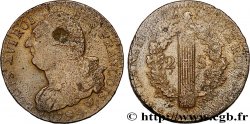

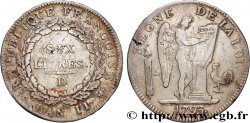

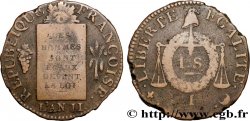
Articoli visualizzati di recente

GALLO-BELGIAN - CELTICA Lot de 5 potins lotto
43.00 €

HENRY II Douzain aux croissants 1552 La Rochelle q.BB
40.00 €

MALTA 2 Euro 10 ANS DES PIÈCES ET BILLETS EN EUROS 2012 MS
8.00 €

JETONS PUBLICITAIRES Signe du taureau SPL
25.00 €
Essai de fabrication de monnaie à 12 pans 1938 Paris VG.5489 G SPL+
115.00 €

LUIGI FILIPPO I Médaille, Tribunal de commerce de la Seine, Juge q.SPL
145.00 €
cgbfr.it numismatica


