


E-auction 496-406984 - fme_779068 - INDONESIA Médaille, UNESCO, Temple de Borobudur
Devi Sign-in ed essere un offerente approvato fare un'offerta, Login per fare offerte. Conti sono soggetti ad approvazione e di approvazione sono raggiunti entro 48 ore. Non aspettare fino al giorno di una vendita si chiude per registrarti.Confermando la tua offerta su questo oggetto ti impegni ad un contratto legalmente vincolante per l'acquisto di questo prodotto e fare clic su «offerta» costituisce accettazione dei termini di utilizzo de e-auctions cgb.fr.
Offerta deve essere collocato in euro gli importi interi vendita only.The si chiuderà al momento sulla descrizione dell'oggetto, eventuali offerte pervenute al sito dopo l'orario di chiusura non verranno eseguite. Volte transmition possono variare e le offerte potrebbero essere respinto se si attende per gli ultimi secondi. Per ulteriori informazioni ckeck le FAQ.
SENZA COSTI PER GLI ACQUIRENTI.
SENZA COSTI PER GLI ACQUIRENTI.
| Valutazione : | 50 € |
| Prezzo : | 33 € |
| Offerta maxima : | 33 € |
| Data di fine vendita : | 17 October 2022 18:36:30 |
| partecipanti : | 4 partecipanti |
Tipo : Médaille, UNESCO, Temple de Borobudur
Data: 1976
Nome della officina / città: Monnaie de Paris
Metallo : argento
Titolo in millesimi : 925 ‰
Diametro : 40,5 mm
Asse di coniazione : 12 h.
Incisore SIMON Georges (1906-1982) / MAEDA Josaku (1926-2007)
Peso : 31,12 g.
Orlo : lisse + corne 1*
Marchio : Corne 1* (1880 -)
Commenti sullo stato di conservazione:
Patine grise hétérogène présentant quelques taches noires. Présence de quelques coups et rayures
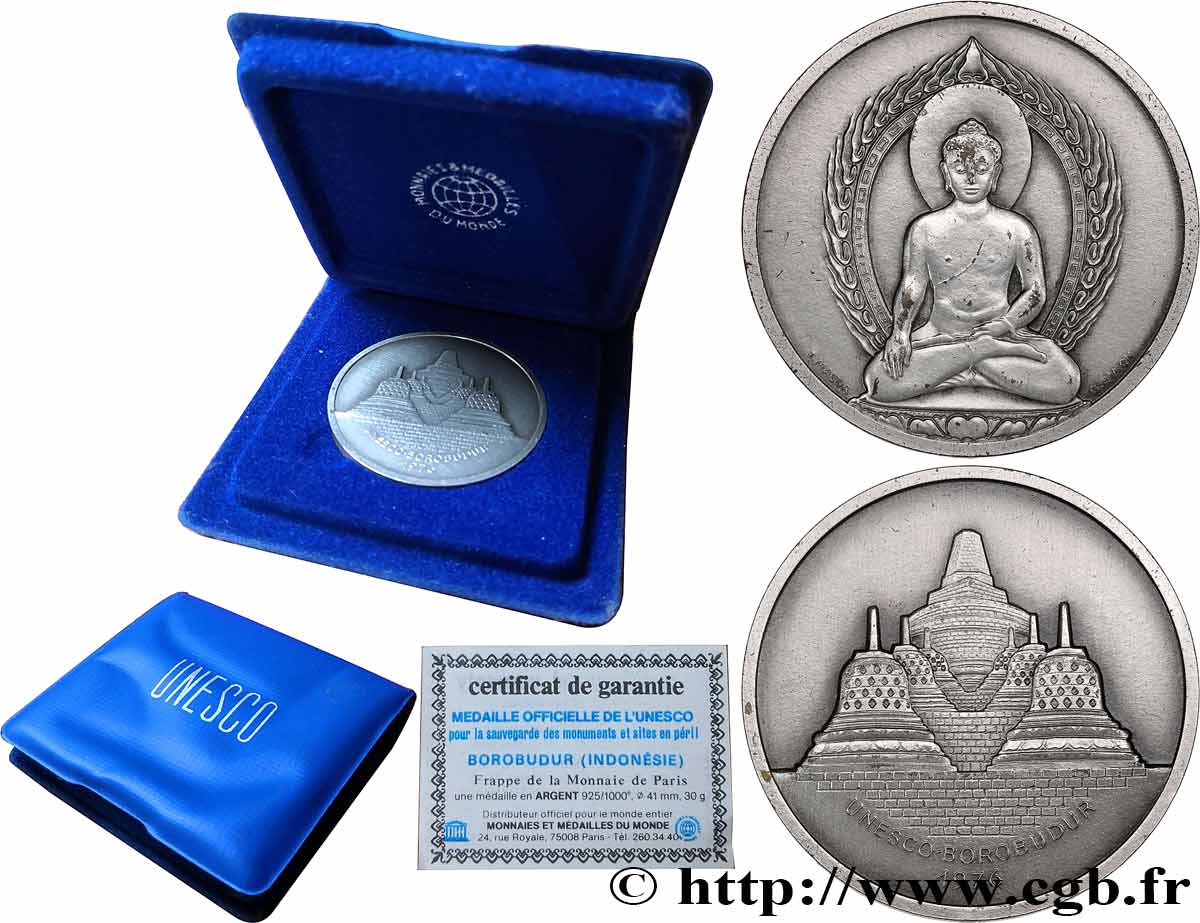
Diritto
Titolatura diritto : ANÉPIGRAPHE.
Descrittivo diritto : Représentation du Bouddha en méditation de Borobudur, signé : J. MAEDA et G. SIMON.
Rovescio
Titolatura rovescio : UNESCO. BOROBUDUR / 1976.
Descrittivo rovescio : Vue sur les terrasses supérieures du temple avec le stupa géant entouré de trois cercles symétriques formés par des stupas plus petits.
Commento
La médaille est conservée dans son étui bleu UNESCO avec son certificat de garantie des Monnaies et Médailles du monde.
Le sanctuaire de Borobudur est l’un des joyaux du patrimoine culturel mondial. Ce vaste monument du bouddhisme mahayana en forme de mandala pyramidal, construit au cœur de Java vers 800 après J.-C. par la dynastie Sailendra, fut abandonné peu de temps après sa construction. Il couvre une surface de près d’un hectare et demi et est surmonté d’un dôme central de 35 mètres de haut. Il a été construit sur trois niveaux: une base pyramidale comprenant cinq terrasses carrées concentriques, surmontée de trois plate-formes circulaires bordées de 72 stupas ajourés, et couronnée d’un stupa monumental. Les murs et les balustrades sont décorés de 1 400 bas-reliefs et 432 statues de Bouddha. Redécouvert en 1814, le site a été débarrassé des décombres et de la végétation. Néanmoins, il a par la suite été endommagé par les tremblements de terre, l’érosion et la jungle envahissante.
En 1972, l’UNESCO a lancé une campagne internationale pour sa restauration. Ce projet, qui s’est terminé en 1983 et auquel ont participé 27 pays, a été le plus important du genre depuis la campagne internationale pour le sauvetage des monuments nubiens. Borobudur a été inscrit sur la Liste du patrimoine mondial en 1991.
Cf. http://www.unesco.org/new/fr/unesco/prizes-medals/commemorative-medals/world-heritage-series/borobudur-indonesia-1976/.
The medal is kept in its blue UNESCO case with its certificate of guarantee from World Coins and Medals.
Borobudur Shrine is one of the jewels of world cultural heritage. This vast monument of Mahayana Buddhism in the form of a pyramidal mandala, built in the heart of Java around 800 AD. -C. by the Sailendra dynasty, was abandoned shortly after its construction. It covers an area of almost one and a half hectares and is topped by a 35-metre-high central dome.. It was built on three levels: a pyramidal base comprising five concentric square terraces, surmounted by three circular platforms lined with 72 openwork stupas, and crowned by a monumental stupa. The walls and balustrades are decorated with 1,400 bas-reliefs and 432 Buddha statues. Rediscovered in 1814, the site was cleared of rubble and vegetation. However, it was subsequently damaged by earthquakes, erosion and encroaching jungle.
In 1972, UNESCO launched an international campaign for its restoration. This project, which ended in 1983 and involved 27 countries, was the largest of its kind since the international campaign to save Nubian monuments.. Borobudur was inscribed on the World Heritage List in 1991.
Cf. http://www. UNESCO. org/new/fr/unesco/prizes-medals/commemorative-medals/world-heritage-series/borobudur-indonesia-1976/
Le sanctuaire de Borobudur est l’un des joyaux du patrimoine culturel mondial. Ce vaste monument du bouddhisme mahayana en forme de mandala pyramidal, construit au cœur de Java vers 800 après J.-C. par la dynastie Sailendra, fut abandonné peu de temps après sa construction. Il couvre une surface de près d’un hectare et demi et est surmonté d’un dôme central de 35 mètres de haut. Il a été construit sur trois niveaux: une base pyramidale comprenant cinq terrasses carrées concentriques, surmontée de trois plate-formes circulaires bordées de 72 stupas ajourés, et couronnée d’un stupa monumental. Les murs et les balustrades sont décorés de 1 400 bas-reliefs et 432 statues de Bouddha. Redécouvert en 1814, le site a été débarrassé des décombres et de la végétation. Néanmoins, il a par la suite été endommagé par les tremblements de terre, l’érosion et la jungle envahissante.
En 1972, l’UNESCO a lancé une campagne internationale pour sa restauration. Ce projet, qui s’est terminé en 1983 et auquel ont participé 27 pays, a été le plus important du genre depuis la campagne internationale pour le sauvetage des monuments nubiens. Borobudur a été inscrit sur la Liste du patrimoine mondial en 1991.
Cf. http://www.unesco.org/new/fr/unesco/prizes-medals/commemorative-medals/world-heritage-series/borobudur-indonesia-1976/.
The medal is kept in its blue UNESCO case with its certificate of guarantee from World Coins and Medals.
Borobudur Shrine is one of the jewels of world cultural heritage. This vast monument of Mahayana Buddhism in the form of a pyramidal mandala, built in the heart of Java around 800 AD. -C. by the Sailendra dynasty, was abandoned shortly after its construction. It covers an area of almost one and a half hectares and is topped by a 35-metre-high central dome.. It was built on three levels: a pyramidal base comprising five concentric square terraces, surmounted by three circular platforms lined with 72 openwork stupas, and crowned by a monumental stupa. The walls and balustrades are decorated with 1,400 bas-reliefs and 432 Buddha statues. Rediscovered in 1814, the site was cleared of rubble and vegetation. However, it was subsequently damaged by earthquakes, erosion and encroaching jungle.
In 1972, UNESCO launched an international campaign for its restoration. This project, which ended in 1983 and involved 27 countries, was the largest of its kind since the international campaign to save Nubian monuments.. Borobudur was inscribed on the World Heritage List in 1991.
Cf. http://www. UNESCO. org/new/fr/unesco/prizes-medals/commemorative-medals/world-heritage-series/borobudur-indonesia-1976/
Cronistoria
INDONESIA
 Segnalare un errore
 Stampate la pagina
 Condividi mia selezione
 Fai una domanda
 Consegnare / vendere
Articoli correlati

 Descrittivo



cgbfr.it numismatica


