


E-auction 112-59640 - bpv_305256 - ADRIANO Tétradrachme syro-phénicien
Devi Sign-in ed essere un offerente approvato fare un'offerta, Login per fare offerte. Conti sono soggetti ad approvazione e di approvazione sono raggiunti entro 48 ore. Non aspettare fino al giorno di una vendita si chiude per registrarti.Confermando la tua offerta su questo oggetto ti impegni ad un contratto legalmente vincolante per l'acquisto di questo prodotto e fare clic su «offerta» costituisce accettazione dei termini di utilizzo de e-auctions cgb.fr.
Offerta deve essere collocato in euro gli importi interi vendita only.The si chiuderà al momento sulla descrizione dell'oggetto, eventuali offerte pervenute al sito dopo l'orario di chiusura non verranno eseguite. Volte transmition possono variare e le offerte potrebbero essere respinto se si attende per gli ultimi secondi. Per ulteriori informazioni ckeck le FAQ.
SENZA COSTI PER GLI ACQUIRENTI.
SENZA COSTI PER GLI ACQUIRENTI.
| Valutazione : | 180 € |
| Prezzo : | 68 € |
| Offerta maxima : | 92 € |
| Data di fine vendita : | 08 giugno 2015 16:08:30 |
| partecipanti : | 10 partecipanti |
Tipo : Tétradrachme syro-phénicien
Data: 119
Nome della officina / città: Antioche, Syrie, Séleucie et Piérie
Metallo : argento
Diametro : 25 mm
Asse di coniazione : 6 h.
Peso : 13,84 g.
N° nelle opere di riferimento :
Pedigree :
Cet exemplaire est le 0157_018, il provient de la trouvaille dite de Banias
Diritto
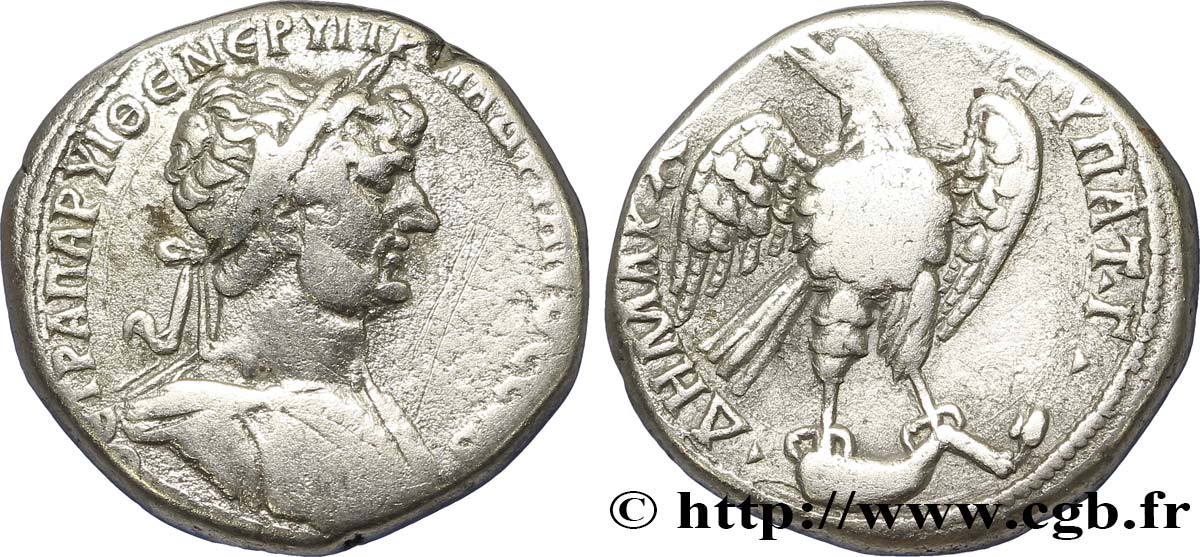
Descrittivo diritto : Buste fin, lauré et cuirassé, d’Hadrien à droite vu de trois-quarts de face, l’un des rubans sur l’épaule, l’autre derrière la tête.
Legenda diritto : AUT KAI QE TRA PAR UI QE NER UI TRAI ADRIANOS SEB
Traduzione diritto : (L'empereur césar fils du divin Trajan le Parthique, fils du divin Nerva, Trajan Hadrien auguste).
Rovescio
Descrittivo rovescio : Aigle élancé debout à droite, tête et queue à gauche, sur un cuissot d’animal sacrificiel, les ailes déployées.
Legenda rovescio : DHMARC EX UPAT . G
Traduzione rovescio : (Tribun du Peuple, Consul pour la troisième fois).
Commento
Une observation plus fine de ce type a permis de détecter deux marqueurs variés, peut-être significatifs : la position des rubans et les détails du haut de la poitrine.
Durant l’an 2, les rubans sont systématiquement derrière la tête et le buste est cuirassé alors que pour l’an 3 on constate deux positions : le Prieur 157, suivant l’illustration du livre, a un ruban derrière la tête et l’autre sur l’épaule ; le 157A, en revanche, a les deux rubans derrière la tête. Cette variante se décompose en deux imagos, la première, 157A, montre un plastron de cuirasse renforcé sous le cou et parfaitement droit. La seconde montre un trait courbe : manifestement un drapé couvrant la cuirasse. Tous les exemplaires 157 donc avec un ruban sur l’épaule ont le cou nu. Logiquement, il y eut trois imagos différentes pendant cette troisième année.
Deuxième année de l’émission d’Antioche sur tous les nouveaux standards récemment établis : légendes à messages politiques, aigle “vivant” en attitude d’envol et non hiératique cuissot sacrificiel dans les serres, disparition de la palme dans le champ, axe à 6 heures.
Le graveur a changé par rapport à l’émission précédente et cette frappe, comme la précédente du deuxième consulat, est la dernière frappe à motivations économiques, donc en quantité importante, avant les frappes des Sévères. Il faut croire que l’afflux de tétradrachmes de Trajan aux types de l’aigle, de la Tyché et du Melqart fut suffisant pour alimenter le marché pendant trois quarts de siècle, aidés en cela par les très importantes frappes de Césarée de Cappadoce.
On note que les sigma sont gravés en C.
Dans la base TSP dix-huit exemplaires sont maintenant répertoriés pour le type 157 “pur”, dont en musées ANS et Berlin.
A closer observation of this type allowed the detection of two varied, perhaps significant, markers: the position of the ribbons and the details of the upper chest..
During year 2, the ribbons are systematically behind the head and the bust is armored, whereas for year 3 we see two positions: Prior 157, following the illustration in the book, has one ribbon behind the head and the other on the shoulder; 157A, on the other hand, has both ribbons behind the head.. This variant is divided into two images, the first, 157A, shows a breastplate reinforced under the neck and perfectly straight. The second shows a curved line: clearly a drape covering the breastplate. All examples 157 therefore with a ribbon on the shoulder have a bare neck. Logically, there were three different imagos during this third year.
Second year of the Antioch issue on all the new standards recently established: legends with political messages, “living” eagle in a flight attitude and not hieratic, sacrificial haunch in the talons, disappearance of the palm in the field, axis at 6 o’clock.
The engraver has changed compared to the previous issue and this strike, like the previous one from the second consulate, is the last strike with economic motives, therefore in significant quantity, before the strikes of the Severans. It must be believed that the influx of Trajan's tetradrachms with the eagle, Tyche and Melqart types was sufficient to supply the market for three-quarters of a century, helped in this by the very important strikes of Caesarea in Cappadocia..
Note that the sigmas are engraved in C.
In the TSP database eighteen examples are now listed for the “pure” type 157, including in ANS and Berlin museums
Durant l’an 2, les rubans sont systématiquement derrière la tête et le buste est cuirassé alors que pour l’an 3 on constate deux positions : le Prieur 157, suivant l’illustration du livre, a un ruban derrière la tête et l’autre sur l’épaule ; le 157A, en revanche, a les deux rubans derrière la tête. Cette variante se décompose en deux imagos, la première, 157A, montre un plastron de cuirasse renforcé sous le cou et parfaitement droit. La seconde montre un trait courbe : manifestement un drapé couvrant la cuirasse. Tous les exemplaires 157 donc avec un ruban sur l’épaule ont le cou nu. Logiquement, il y eut trois imagos différentes pendant cette troisième année.
Deuxième année de l’émission d’Antioche sur tous les nouveaux standards récemment établis : légendes à messages politiques, aigle “vivant” en attitude d’envol et non hiératique cuissot sacrificiel dans les serres, disparition de la palme dans le champ, axe à 6 heures.
Le graveur a changé par rapport à l’émission précédente et cette frappe, comme la précédente du deuxième consulat, est la dernière frappe à motivations économiques, donc en quantité importante, avant les frappes des Sévères. Il faut croire que l’afflux de tétradrachmes de Trajan aux types de l’aigle, de la Tyché et du Melqart fut suffisant pour alimenter le marché pendant trois quarts de siècle, aidés en cela par les très importantes frappes de Césarée de Cappadoce.
On note que les sigma sont gravés en C.
Dans la base TSP dix-huit exemplaires sont maintenant répertoriés pour le type 157 “pur”, dont en musées ANS et Berlin.
A closer observation of this type allowed the detection of two varied, perhaps significant, markers: the position of the ribbons and the details of the upper chest..
During year 2, the ribbons are systematically behind the head and the bust is armored, whereas for year 3 we see two positions: Prior 157, following the illustration in the book, has one ribbon behind the head and the other on the shoulder; 157A, on the other hand, has both ribbons behind the head.. This variant is divided into two images, the first, 157A, shows a breastplate reinforced under the neck and perfectly straight. The second shows a curved line: clearly a drape covering the breastplate. All examples 157 therefore with a ribbon on the shoulder have a bare neck. Logically, there were three different imagos during this third year.
Second year of the Antioch issue on all the new standards recently established: legends with political messages, “living” eagle in a flight attitude and not hieratic, sacrificial haunch in the talons, disappearance of the palm in the field, axis at 6 o’clock.
The engraver has changed compared to the previous issue and this strike, like the previous one from the second consulate, is the last strike with economic motives, therefore in significant quantity, before the strikes of the Severans. It must be believed that the influx of Trajan's tetradrachms with the eagle, Tyche and Melqart types was sufficient to supply the market for three-quarters of a century, helped in this by the very important strikes of Caesarea in Cappadocia..
Note that the sigmas are engraved in C.
In the TSP database eighteen examples are now listed for the “pure” type 157, including in ANS and Berlin museums
Cronistoria
ADRIANO
(08/11/117-07/10/138)
Adriano nacque nel 76 in Italica. Allievo di Traiano, sposò nel 100 Sabine, pronipote dell'imperatore, e fece carriera nel personale di quest'ultimo, in particolare durante la campagna dei Daci. Nel 117 succedette a Traiano e viaggiò per vent'anni visitando l'intero impero, unico imperatore che si fosse prestato a questo esercizio. Nel 122 Adriano andò in Spagna. Senza figli, scelse per la prima volta Elio come successore nel 136, ma quest'ultimo morì il 1 gennaio 138. Adriano adottò poi Antonino il 25 febbraio e lui stesso scelse Marco Aurelio e Lucio Vero come eredi di Antonino. Morì il 10 luglio 138.
 Segnalare un errore
 Stampate la pagina
 Condividi mia selezione
 Fai una domanda
 Consegnare / vendere
 Descrittivo



cgbfr.it numismatica


