


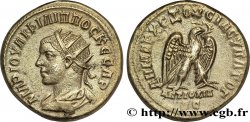
bpv_154056 - FILIPPO II FIGLIO Tétradrachme syro-phénicien
non disponibile.
Articolo venduto sul nostro negozio (2017)
Prezzo : 190.00 €
Articolo venduto sul nostro negozio (2017)
Prezzo : 190.00 €
Tipo : Tétradrachme syro-phénicien
Data: 248
Nome della officina / città: Antioche, Syrie, Séleucie et Piérie
Metallo : billone
Diametro : 28,00 mm
Asse di coniazione : 12 h.
Peso : 11,25 g.
Grado di rarità : R2
Commenti sullo stato di conservazione:
Pas de franches traces d’usure, bonne frappe et bon centrage sur un flan régulier mais surface très légèrement piquée
N° nelle opere di riferimento :
Pedigree :
Cet exemplaire, provenant de la trouvaille dite de Syrie 1930, est le 0398_004 de la base TSP
Diritto
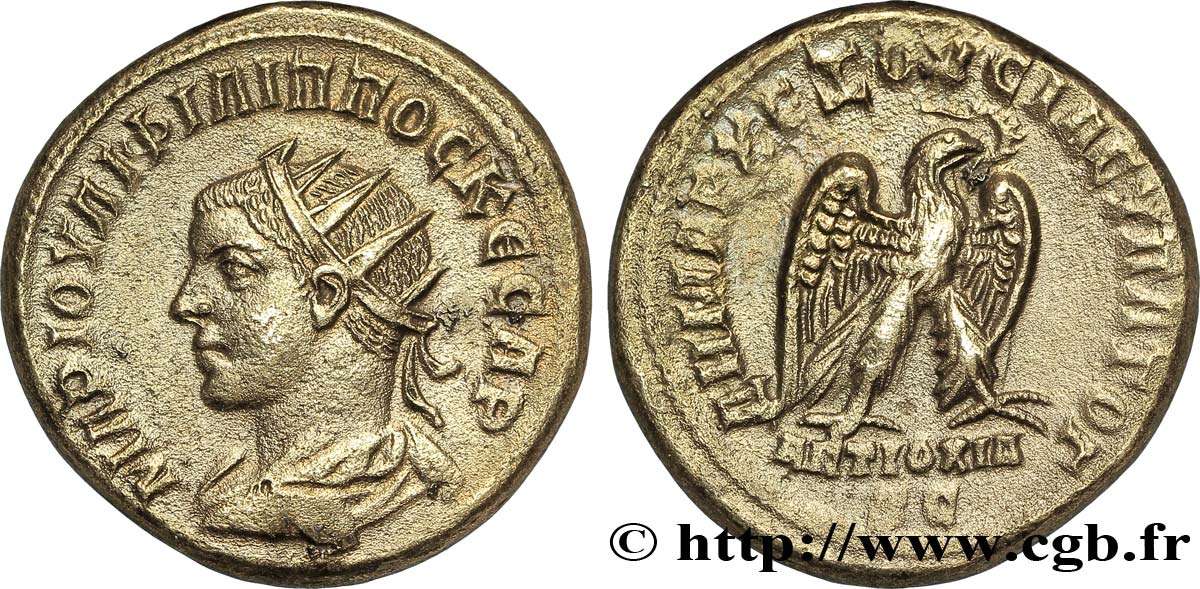
Descrittivo diritto : Buste radié et drapé de Philippe II césar à gauche, vu de trois quarts en arrière (A31).
Legenda diritto : MAR IOULI FILIPPOS KESAR
Traduzione diritto : (Marcus Julius Philippus césar).
Rovescio
Titolatura rovescio : ANTIOXIA / S|C À L’EXERGUE.
Descrittivo rovescio : Aigle debout à droite, les ailes déployées, aile gauche derrière la patte gauche, tête à droite et queue à gauche, tenant une couronne feuillée dans son bec.
Legenda rovescio : DHMARC - EX OUSIAS UPATOG
Traduzione rovescio : (Revêtu de la puissance tribunitienne / Consul pour la troisième fois / avec l’accord du Sénat d’Antioche).
Commento
Les frappes de Philippe II datées du troisième consulat, comme celles d’Otacilie Sévère d’ailleurs, portent les titres de Philippe Père. Elles se distinguent entre elles par différents aigles de revers et un portrait à droite ou à gauche.
L’évolution des portraits de Philippe II au 3e consulat va du césar tête nue, à droite ou à gauche, à toute la gamme des bustes militaires, laurés ou radiés, avec la titulature d’auguste.
Il faut noter qu’aucun buste lauré n’est connu avec la titulature de césar, alors que radiés et laurés sont également répartis avec la titulature d’auguste. On peut en déduire que la tête laurée est indiscutablement liée aux augustes, et la tête nue aux césars, alors que la couronne radiée n’a pas de spécificité politique.
En abordant les frappes du 3e consulat, on remarque l’absence complète de frappes datées du deuxième consulat, bien que le deuxième consulat de Philippe et de sa famille existe indubitablement à Rome, y compris sur les émissions monétaires. Interruption des frappes ou comput différent à Antioche qu’à Rome ? Nous penchons pour la deuxième solution, pour deux raisons.
Tout d’abord la continuité stylistique : tant pour les revers que pour les droits, il n’y a pas de rupture, alors que l’on aurait pu présumer une certaine normalisation après une interruption des frappes. De plus, celle-ci se produira effectivement pour les frappes datées du quatrième consulat avec un style d’aigle unique, suivie à la fin par une nouveauté encore plus marquante, l’introduction d’officines indiquées sur les monnaies.
Ensuite, il existe à Antioche de très nombreuses frappes datées d’un quatrième consulat de Philippe l’Arabe dont nous ne trouvons pas trace à Rome. Il est extrêmement regrettable que les quelques informations dont nous disposons sur le Sénat d’Antioche soient largement plus tardives (4e et 5e siècle) car les émissions de tétradrachmes laissent à penser que non seulement le Sénat d’Antioche manifestait son indépendance envers Rome en frappant de l’argent avec la titulature “SC / ANTIOXIA” mais encore qu’il avait son propre comput impérial sous Philippe.
L’apparition de cette exergue et la disparition de la palme sont caractéristiques des 3e et 4e consulat mais les styles des aigles ne se normaliseront qu’au 4e.
On note que les sigma sont gravés en C.
Dans la base TSP maintenue par Michel Prieur, seize exemplaires sont maintenant répertoriés pour ce type. Un seul est en musée, à Paris, ex Poindessault, vente décembre 1983, 93 = Poindessault, vente janvier 1986, 219.
The coins of Philip II dated from the third consulate, like those of Otacilia Severus, bear the titles of Philip the Father. They are distinguished from each other by different reverse eagles and a portrait on the right or left..
The evolution of the portraits of Philip II during the 3rd consulate goes from the bareheaded Caesar, on the right or on the left, to the whole range of military busts, laureates or radiates, with the title of Augustus.
It should be noted that no laureate bust is known with the title of Caesar, while radiates and laureates are also distributed with the title of Augustus.. We can deduce that the laureate head is indisputably linked to the Augusti, and the bare head to the Caesars, while the radiate crown has no political specificity..
When approaching the strikes of the 3rd consulate, we notice the complete absence of strikes dated from the second consulate, although the second consulate of Philip and his family undoubtedly existed in Rome, including on monetary issues.. Was the minting interrupted or was the calculation different in Antioch than in Rome? We are leaning towards the second solution, for two reasons..
First of all, stylistic continuity: for both the backhands and the forehands, there is no break, whereas one could have assumed a certain standardization after an interruption in the strokes. Furthermore, this will actually occur for the strikes dated from the fourth consulate with a unique eagle style, followed at the end by an even more striking novelty, the introduction of offices indicated on the coins..
Then, in Antioch there are many dated strikes from a fourth consulate of Philip the Arab, of which we find no trace in Rome.. It is extremely regrettable that the little information we have on the Senate of Antioch is much later (4th and 5th century) because the issues of tetradrachms suggest that not only did the Senate of Antioch demonstrate its independence from Rome by minting money with the title “SC / ANTIOXIA” but also that it had its own imperial computus under Philip..
The appearance of this exergue and the disappearance of the palm are characteristic of the 3rd and 4th consulate but the styles of the eagles will not become standardized until the 4th..
Note that the sigmas are engraved in C.
In the TSP database maintained by Michel Prieur, sixteen examples are now listed for this type. Only one is in a museum, in Paris, ex Poindessault, sale December 1983, 93 = Poindessault, sale January 1986, 219
L’évolution des portraits de Philippe II au 3e consulat va du césar tête nue, à droite ou à gauche, à toute la gamme des bustes militaires, laurés ou radiés, avec la titulature d’auguste.
Il faut noter qu’aucun buste lauré n’est connu avec la titulature de césar, alors que radiés et laurés sont également répartis avec la titulature d’auguste. On peut en déduire que la tête laurée est indiscutablement liée aux augustes, et la tête nue aux césars, alors que la couronne radiée n’a pas de spécificité politique.
En abordant les frappes du 3e consulat, on remarque l’absence complète de frappes datées du deuxième consulat, bien que le deuxième consulat de Philippe et de sa famille existe indubitablement à Rome, y compris sur les émissions monétaires. Interruption des frappes ou comput différent à Antioche qu’à Rome ? Nous penchons pour la deuxième solution, pour deux raisons.
Tout d’abord la continuité stylistique : tant pour les revers que pour les droits, il n’y a pas de rupture, alors que l’on aurait pu présumer une certaine normalisation après une interruption des frappes. De plus, celle-ci se produira effectivement pour les frappes datées du quatrième consulat avec un style d’aigle unique, suivie à la fin par une nouveauté encore plus marquante, l’introduction d’officines indiquées sur les monnaies.
Ensuite, il existe à Antioche de très nombreuses frappes datées d’un quatrième consulat de Philippe l’Arabe dont nous ne trouvons pas trace à Rome. Il est extrêmement regrettable que les quelques informations dont nous disposons sur le Sénat d’Antioche soient largement plus tardives (4e et 5e siècle) car les émissions de tétradrachmes laissent à penser que non seulement le Sénat d’Antioche manifestait son indépendance envers Rome en frappant de l’argent avec la titulature “SC / ANTIOXIA” mais encore qu’il avait son propre comput impérial sous Philippe.
L’apparition de cette exergue et la disparition de la palme sont caractéristiques des 3e et 4e consulat mais les styles des aigles ne se normaliseront qu’au 4e.
On note que les sigma sont gravés en C.
Dans la base TSP maintenue par Michel Prieur, seize exemplaires sont maintenant répertoriés pour ce type. Un seul est en musée, à Paris, ex Poindessault, vente décembre 1983, 93 = Poindessault, vente janvier 1986, 219.
The coins of Philip II dated from the third consulate, like those of Otacilia Severus, bear the titles of Philip the Father. They are distinguished from each other by different reverse eagles and a portrait on the right or left..
The evolution of the portraits of Philip II during the 3rd consulate goes from the bareheaded Caesar, on the right or on the left, to the whole range of military busts, laureates or radiates, with the title of Augustus.
It should be noted that no laureate bust is known with the title of Caesar, while radiates and laureates are also distributed with the title of Augustus.. We can deduce that the laureate head is indisputably linked to the Augusti, and the bare head to the Caesars, while the radiate crown has no political specificity..
When approaching the strikes of the 3rd consulate, we notice the complete absence of strikes dated from the second consulate, although the second consulate of Philip and his family undoubtedly existed in Rome, including on monetary issues.. Was the minting interrupted or was the calculation different in Antioch than in Rome? We are leaning towards the second solution, for two reasons..
First of all, stylistic continuity: for both the backhands and the forehands, there is no break, whereas one could have assumed a certain standardization after an interruption in the strokes. Furthermore, this will actually occur for the strikes dated from the fourth consulate with a unique eagle style, followed at the end by an even more striking novelty, the introduction of offices indicated on the coins..
Then, in Antioch there are many dated strikes from a fourth consulate of Philip the Arab, of which we find no trace in Rome.. It is extremely regrettable that the little information we have on the Senate of Antioch is much later (4th and 5th century) because the issues of tetradrachms suggest that not only did the Senate of Antioch demonstrate its independence from Rome by minting money with the title “SC / ANTIOXIA” but also that it had its own imperial computus under Philip..
The appearance of this exergue and the disappearance of the palm are characteristic of the 3rd and 4th consulate but the styles of the eagles will not become standardized until the 4th..
Note that the sigmas are engraved in C.
In the TSP database maintained by Michel Prieur, sixteen examples are now listed for this type. Only one is in a museum, in Paris, ex Poindessault, sale December 1983, 93 = Poindessault, sale January 1986, 219
Cronistoria
FILIPPO II FIGLIO
(05/244-09/249)
Cesare
Figlio di Filippo l'Arabo e di Otacilia Sévéra, Filippo II fu nominato Cesare poco dopo l'ascesa al trono del padre, che gli conferì il titolo di principe della giovinezza..
 Segnalare un errore
 Stampate la pagina
 Condividi mia selezione
 Fai una domanda
 Consegnare / vendere
Articoli correlati
 Descrittivo



Articoli visualizzati di recente

100 Francs DAKAR FRENCH WEST AFRICA Dakar 1926 P.11Bb q.SPL
180.00 €

20 Shillings - 1 Pound AFRICA DI L'EST BRITANNICA 1941 P.30a q.MB
100.00 €

50 Francs FRENCH WEST AFRICA 1956 P.45 SPL
50.00 €

1 au 500 Kip Spécimen LAOS 1979 P.25s au P.31s AU+
70.00 €

10 Francs MINERVE modifié FRANCIA 1939 F.07.12 SPL
25.00 €
FILIPPO II FIGLIO Tétradrachme syro-phénicien BB
190.00 €
cgbfr.it numismatica


