


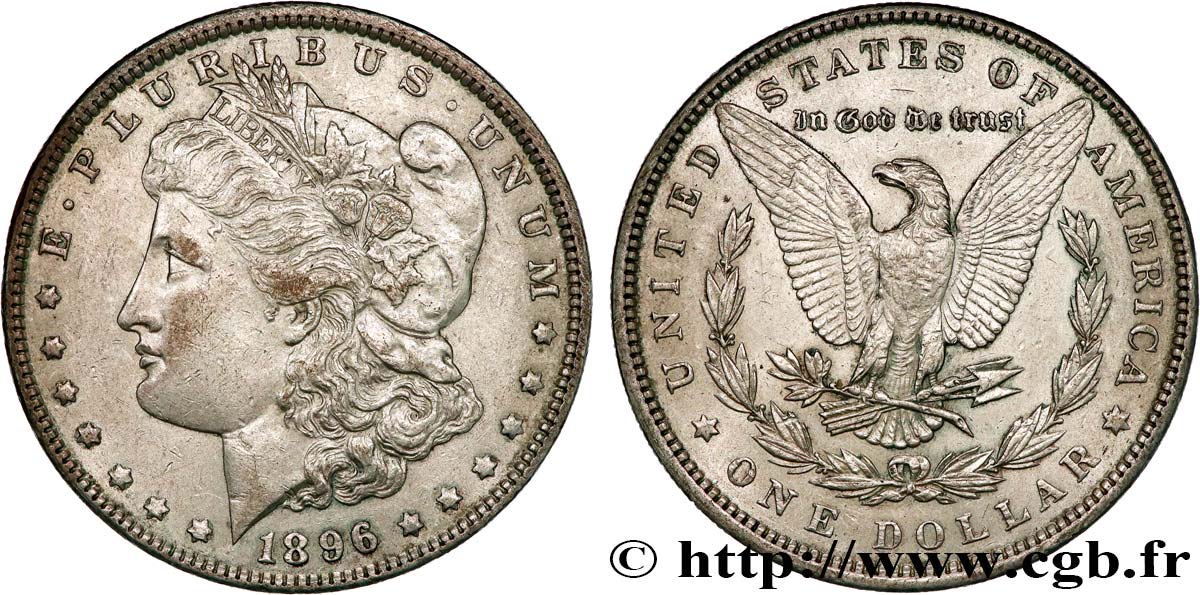
fwo_721571 - STATI UNITI D'AMERICA 1 Dollar Morgan 1896 Philadelphie
non disponibile.
Articolo venduto sul nostro negozio (2022)
Prezzo : 50.00 €
Articolo venduto sul nostro negozio (2022)
Prezzo : 50.00 €
Tipo : 1 Dollar Morgan
Data: 1896
Nome della officina / città: Philadelphie
Quantità coniata : 9976000
Metallo : argento
Titolo in millesimi : 900 ‰
Diametro : 38, mm
Asse di coniazione : 6 h.
Peso : 26,81 g.
Orlo : cannelée
Diritto
Titolatura diritto : E . PLURIBUS . UNUM // 1896.
Descrittivo diritto : Tête à gauche de femme symbolisant la Liberté.
Rovescio
Titolatura rovescio : UNITED - STATES OF - AMERICA // * ONE DOLLAR *.
Descrittivo rovescio : Aigle aux ailles déployées tenant une branche d’olivier et deux flèches ; couronne de laurier et motto “In God we trust”.
Commento
En 1873, le « Fourth Coinage act » met fin au bimétallisme et les monnaies en argent sont démonétisées. Cependant dès 1876, de nombreux projets de lois sont proposés afin de réintroduire des dollars en argent. En 1878, Rutherford B. Hayes tente en vain de faire véto au «Bland-Allison Act » au Congrès. Dans cette optique, dès 1876, Henry Linderman, directeur de l'US Mint demande alors à C.W. Fremantle, deputy master de la Royal Mint de Londres, de lui trouver un graveur de coin de premier rang. Ce sera Georges T. Morgan (1845-1925) qui devient assistant graveur auprès du graveur en chef William Barber. Dès 1877, Morgan travaille sur des essais monétaires et prépare son projet de dollar argent. Ainsi en 1878, seulement une semaine après le passage de la loi, l'atelier de Philadelphie frappe des dollars dits « Morgan ». Georges T. Morgan Morgan succèdera à Charles E. Barber (fils de William Barber) en 1917.
In 1873, the Fourth Coinage Act ended bimetallism, and silver coins were demonetized. However, as early as 1876, numerous bills were proposed to reintroduce silver dollars. In 1878, Rutherford B. Hayes unsuccessfully attempted to veto the Bland-Allison Act in Congress. With this in mind, Henry Linderman, director of the U.S. Mint, asked C.W. Fremantle, deputy master of the Royal Mint in London, to find him a top-tier coin engraver. This turned out to be George T. Morgan (1845–1925), who became assistant engraver to chief engraver William Barber. Starting in 1877, Morgan worked on coin trials and prepared his design for a silver dollar. Thus, in 1878, just one week after the passage of the Act, the Philadelphia Mint struck dollars known as \\\"Morgan dollars.\\\" Georges T. Morgan Morgan succeeded Charles E. Barber (son of William Barber) in 1917
In 1873, the Fourth Coinage Act ended bimetallism, and silver coins were demonetized. However, as early as 1876, numerous bills were proposed to reintroduce silver dollars. In 1878, Rutherford B. Hayes unsuccessfully attempted to veto the Bland-Allison Act in Congress. With this in mind, Henry Linderman, director of the U.S. Mint, asked C.W. Fremantle, deputy master of the Royal Mint in London, to find him a top-tier coin engraver. This turned out to be George T. Morgan (1845–1925), who became assistant engraver to chief engraver William Barber. Starting in 1877, Morgan worked on coin trials and prepared his design for a silver dollar. Thus, in 1878, just one week after the passage of the Act, the Philadelphia Mint struck dollars known as \\\"Morgan dollars.\\\" Georges T. Morgan Morgan succeeded Charles E. Barber (son of William Barber) in 1917
Cronistoria
STATI UNITI D'AMERICA
 Segnalare un errore
 Stampate la pagina
 Condividi mia selezione
 Fai una domanda
 Consegnare / vendere
Articoli correlati
 Descrittivo

cgbfr.it numismatica


