


E-auction 549-477300 - fme_867415 - CONQUÊTE DE L'ESPACE - EXPLORATION SPATIALE Médaille d’Apollo 11 - Landing on the Moon

Devi Sign-in ed essere un offerente approvato fare un'offerta, Login per fare offerte. Conti sono soggetti ad approvazione e di approvazione sono raggiunti entro 48 ore. Non aspettare fino al giorno di una vendita si chiude per registrarti.Confermando la tua offerta su questo oggetto ti impegni ad un contratto legalmente vincolante per l'acquisto di questo prodotto e fare clic su «offerta» costituisce accettazione dei termini di utilizzo de e-auctions cgb.fr.
Offerta deve essere collocato in euro gli importi interi vendita only.The si chiuderà al momento sulla descrizione dell'oggetto, eventuali offerte pervenute al sito dopo l'orario di chiusura non verranno eseguite. Volte transmition possono variare e le offerte potrebbero essere respinto se si attende per gli ultimi secondi. Per ulteriori informazioni ckeck le FAQ.
SENZA COSTI PER GLI ACQUIRENTI.
SENZA COSTI PER GLI ACQUIRENTI.
| Valutazione : | 50 € |
| Prezzo : | 24 € |
| Offerta maxima : | 29 € |
| Data di fine vendita : | 23 ottobre 2023 19:59:20 |
| partecipanti : | 7 partecipanti |
Tipo : Médaille d’Apollo 11 - Landing on the Moon
Data: 1969
Metallo : argento
Titolo in millesimi : 950 ‰
Diametro : 34 mm
Asse di coniazione : 12 h.
Peso : 15,45 g.
Orlo : cannelée
Marchio : Corne 1 (1880 -)
Commenti sullo stato di conservazione:
Médaille sous sachet scellé
Diritto
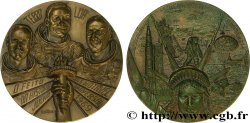
Titolatura diritto : LANDING ON THE MOON - E. ALDRIN N. ARMSTRONG M. COLLINS // 21.7.1969-3:56:20 .
Descrittivo diritto : Bustes des trois astronautes accolés.
Rovescio
Titolatura rovescio : ANÉPIGRAPHE.
Descrittivo rovescio : Vue de l’exploration lunaire ; Mention : HH. Corne d’abondance 1.
Commento
Apollo 11 est une mission du programme spatial américain Apollo au cours de laquelle, pour la première fois, des hommes se sont posés sur la Lune, le 20 juillet 1969. Apollo 11 est la troisième mission habitée à s'approcher de la Lune, après Apollo 8 et Apollo 10, et la cinquième mission habitée du programme Apollo. Par cet exploit, l'agence spatiale américaine, la NASA, remplit l'objectif fixé par le président John F. Kennedy en 1961 de poser un équipage sain et sauf sur la Lune avant la fin des années 1960 et démontre sans contestation possible la supériorité des États-Unis sur l'Union soviétique dans le domaine des vols spatiaux habités. Apollo 11 est l'aboutissement d'un projet qui a mobilisé des moyens humains et financiers considérables permettant à l'agence spatiale de rattraper son retard sur l'astronautique soviétique puis de dépasser celle-ci.
La mission est lancée depuis le centre spatial Kennedy le 16 juillet 1969 par la fusée géante Saturn V développée pour ce programme. Elle emporte un équipage composé de Neil Armstrong, commandant de la mission et pilote du module lunaire, Edwin « Buzz » Aldrin, qui accompagne Armstrong sur le sol lunaire, et Michael Collins, pilote du module de commande qui restera en orbite lunaire. Armstrong et Aldrin, après un alunissage comportant quelques péripéties, séjournent 21 heures et 30 minutes à la surface de la Lune et effectuent une sortie extravéhiculaire unique d'une durée de 2 heures et demie. Après avoir redécollé et réalisé un rendez-vous en orbite lunaire avec le module de commande, le vaisseau Apollo reprend le chemin de la Terre et amerrit sans incident dans l'océan Pacifique à l'issue d'un vol qui aura duré en tout 195 heures.
Au cours de la mission Apollo 11, 21,7 kilogrammes de roche et de sol lunaires sont collectés et plusieurs instruments scientifiques sont installés sur la surface de notre satellite. Bien que l'objectif scientifique d'Apollo 11 ait été limité par la durée du séjour sur la Lune et la capacité d'emport réduite des vaisseaux spatiaux utilisés, la mission fournit des résultats substantiels. Son déroulement, en particulier les premiers pas sur la Lune filmés par une caméra vidéo et retransmis en direct, constituent un événement suivi sur toute la planète par des centaines de millions de personnes..
Apollo 11 was a mission of the American Apollo space program during which, for the first time, men landed on the Moon, on July 20, 1969.. Apollo 11 was the third manned mission to approach the Moon, after Apollo 8 and Apollo 10, and the fifth manned mission of the Apollo program.. With this feat, the American space agency, NASA, fulfilled the goal set by President John F.. Kennedy in 1961 to land a safe crew on the Moon before the end of the 1960s and demonstrates beyond any doubt the superiority of the United States over the Soviet Union in the field of human spaceflight.. Apollo 11 was the culmination of a project that mobilized considerable human and financial resources, enabling the space agency to catch up with Soviet astronautics and then surpass it..
The mission was launched from the Kennedy Space Center on July 16, 1969, by the giant Saturn V rocket developed for this program.. It carried a crew consisting of Neil Armstrong, mission commander and lunar module pilot, Edwin \\\"Buzz\\\" Aldrin, who accompanied Armstrong to the lunar surface, and Michael Collins, command module pilot who remained in lunar orbit.. Armstrong and Aldrin, after a lunar landing with some adventures, spent 21 hours and 30 minutes on the surface of the Moon and carried out a single spacewalk lasting 2 and a half hours.. After taking off again and completing a rendezvous in lunar orbit with the command module, the Apollo spacecraft returned to Earth and landed without incident in the Pacific Ocean after a flight that lasted a total of 195 hours..
During the Apollo 11 mission, 21.7 kilograms of lunar rock and soil were collected and several scientific instruments were installed on the surface of our satellite.. Although the scientific objective of Apollo 11 was limited by the duration of the stay on the Moon and the reduced payload capacity of the spacecraft used, the mission provided substantial results.. Its unfolding, in particular the first steps on the Moon filmed by a video camera and broadcast live, constitutes an event followed all over the planet by hundreds of millions of people.
La mission est lancée depuis le centre spatial Kennedy le 16 juillet 1969 par la fusée géante Saturn V développée pour ce programme. Elle emporte un équipage composé de Neil Armstrong, commandant de la mission et pilote du module lunaire, Edwin « Buzz » Aldrin, qui accompagne Armstrong sur le sol lunaire, et Michael Collins, pilote du module de commande qui restera en orbite lunaire. Armstrong et Aldrin, après un alunissage comportant quelques péripéties, séjournent 21 heures et 30 minutes à la surface de la Lune et effectuent une sortie extravéhiculaire unique d'une durée de 2 heures et demie. Après avoir redécollé et réalisé un rendez-vous en orbite lunaire avec le module de commande, le vaisseau Apollo reprend le chemin de la Terre et amerrit sans incident dans l'océan Pacifique à l'issue d'un vol qui aura duré en tout 195 heures.
Au cours de la mission Apollo 11, 21,7 kilogrammes de roche et de sol lunaires sont collectés et plusieurs instruments scientifiques sont installés sur la surface de notre satellite. Bien que l'objectif scientifique d'Apollo 11 ait été limité par la durée du séjour sur la Lune et la capacité d'emport réduite des vaisseaux spatiaux utilisés, la mission fournit des résultats substantiels. Son déroulement, en particulier les premiers pas sur la Lune filmés par une caméra vidéo et retransmis en direct, constituent un événement suivi sur toute la planète par des centaines de millions de personnes..
Apollo 11 was a mission of the American Apollo space program during which, for the first time, men landed on the Moon, on July 20, 1969.. Apollo 11 was the third manned mission to approach the Moon, after Apollo 8 and Apollo 10, and the fifth manned mission of the Apollo program.. With this feat, the American space agency, NASA, fulfilled the goal set by President John F.. Kennedy in 1961 to land a safe crew on the Moon before the end of the 1960s and demonstrates beyond any doubt the superiority of the United States over the Soviet Union in the field of human spaceflight.. Apollo 11 was the culmination of a project that mobilized considerable human and financial resources, enabling the space agency to catch up with Soviet astronautics and then surpass it..
The mission was launched from the Kennedy Space Center on July 16, 1969, by the giant Saturn V rocket developed for this program.. It carried a crew consisting of Neil Armstrong, mission commander and lunar module pilot, Edwin \\\"Buzz\\\" Aldrin, who accompanied Armstrong to the lunar surface, and Michael Collins, command module pilot who remained in lunar orbit.. Armstrong and Aldrin, after a lunar landing with some adventures, spent 21 hours and 30 minutes on the surface of the Moon and carried out a single spacewalk lasting 2 and a half hours.. After taking off again and completing a rendezvous in lunar orbit with the command module, the Apollo spacecraft returned to Earth and landed without incident in the Pacific Ocean after a flight that lasted a total of 195 hours..
During the Apollo 11 mission, 21.7 kilograms of lunar rock and soil were collected and several scientific instruments were installed on the surface of our satellite.. Although the scientific objective of Apollo 11 was limited by the duration of the stay on the Moon and the reduced payload capacity of the spacecraft used, the mission provided substantial results.. Its unfolding, in particular the first steps on the Moon filmed by a video camera and broadcast live, constitutes an event followed all over the planet by hundreds of millions of people.
Cronistoria
CONQUÊTE DE L'ESPACE - EXPLORATION SPATIALE
dal 1944
L'esplorazione dello spazio, talvolta chiamata conquista dello spazio, consiste nell'esplorazione fisica dello spazio, vale a dire di tutti gli oggetti al di fuori della Terra. L'esplorazione del sistema solare costituisce la prima tappa, uno dei maggiori eventi della seconda metà del XX secolo sul piano scientifico, ma anche più in generale per le nostre società, della prodigiosa espansione di questa nuova frontiera..
 Segnalare un errore
 Stampate la pagina
 Condividi mia selezione
 Fai una domanda
 Consegnare / vendere
Articoli correlati

 Descrittivo

Articoli visualizzati di recente

20 Zlotych POLONIA 1948 P.137 q.MB
1.00 €

20 Bolivares Spécimen VENEZUELA 1972 P.052s q.FDC
57.00 €
CARACALLA Tétradrachme syro-phénicien BB
125.00 €

10 francs Turin 1934 F.360/7 SPL
30.00 €

1 franc Morlon 1934 Paris F.219/5 SPL55
9.00 €

TERZA REPUBBLICA FRANCESE Médaille, Conseil des Prud’hommes q.SPL
185.00 €
cgbfr.it numismatica


