


bga_959319 - CELTI DEL DANUVIO Tétradrachme

non disponibile.
Articolo venduto sul nostro negozio (2025)
Prezzo : 250.00 €
Articolo venduto sul nostro negozio (2025)
Prezzo : 250.00 €
Tipo : Tétradrachme
Data: (IIe-Ier siècles avant J.-C.)
Metallo : argento
Diametro : 24 mm
Asse di coniazione : 2 h.
Peso : 12,58 g.
Grado di rarità : R2
Commenti sullo stato di conservazione:
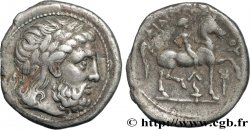
Monnaie idéalement centrée. Joli portrait de Zeus, bien venu à la frappe. Revers agréable. Patine grise
N° nelle opere di riferimento :
Diritto
Titolatura diritto : ANÉPIGRAPHE.
Descrittivo diritto : Tête laurée de Zeus à droite ; grènetis.
Rovescio
Descrittivo rovescio : Cavalier au pas à droite, tenant une palme de la main droite ; le cheval lève l'antérieur à droite ; entre les jambes du cheval, une torche.
Legenda rovescio : FILIP - POU
Commento
Si le statère d’or de Philippe II de Macédoine a servi de prototype à de nombreuses imitations gauloises, le tétradrachme n’a pas été imité en Gaule, mais reste principal sujet d’inspiration des monnaies pour les Celtes du Danube (LT. 9697-9767, 9768-9832, 9618-9630, 9870-9886). Les premières imitations furent frappées dans le premier quart du IIIe siècle avant J.-C. La fabrication des copies serviles, puis des imitations, enfin des frappes celtiques continuèrent pendant plus de deux siècles.
Cet exemplaire est d’un très bon style, encore très proche du prototype.
If the gold stater of Philip II of Macedonia served as a prototype for numerous Gallic imitations, the tetradrachm was not imitated in Gaul, but remained the main subject of inspiration for the coins of the Danube Celts (LT. 9697 -9767, 9768-9832, 9618-9630, 9870-9886). The first imitations were struck in the first quarter of the 3rd century BC. The manufacture of servile copies, then imitations, and finally Celtic mintings continued for more than two centuries. This example is of a very good style, still very close to the prototype
Cet exemplaire est d’un très bon style, encore très proche du prototype.
If the gold stater of Philip II of Macedonia served as a prototype for numerous Gallic imitations, the tetradrachm was not imitated in Gaul, but remained the main subject of inspiration for the coins of the Danube Celts (LT. 9697 -9767, 9768-9832, 9618-9630, 9870-9886). The first imitations were struck in the first quarter of the 3rd century BC. The manufacture of servile copies, then imitations, and finally Celtic mintings continued for more than two centuries. This example is of a very good style, still very close to the prototype
Cronistoria
CELTI DEL DANUVIO
(III-I secolo a.C.)
Sotto questo titolo vengono generalmente raggruppate tutte le monete che non hanno una precisa attribuzione. A volte viene offerto il termine "Celti orientali". Dopo che i Celti saccheggiarono Delfi e si diffusero attraverso la Grecia e l'Asia Minore, sequestrarono una notevole quantità di bottino, grazie al loro saccheggio. I re ellenistici, Diadoques o Epigones, li usavano come mercenari nei loro eserciti dove il salario medio era normalmente uno statere d'oro corrispondente a cinque tetradramme di standard attico o venti dramme. I prototipi che rappresentavano la testa di Zeus con un cavaliere furono ampiamente copiati e imitati nei Balcani, nella Macedonia settentrionale e in Tracia. La fase finale della monetazione avviene alla fine del II secolo o all'inizio del I secolo a.C. dove non ci sono tracce del dritto e del rovescio così come leggende più di una faccia bombata di una moneta praticamente liscia su entrambi lati.
 Segnalare un errore
 Stampate la pagina
 Condividi mia selezione
 Fai una domanda
 Consegnare / vendere
Articoli correlati

 Descrittivo

Articoli visualizzati di recente
ITALIA 2 Euro GIUSEPPE VERDI 2013 MS
4.00 €
cgbfr.it numismatica


