


bpv_173676 - CARACALLA Tétradrachme syro-phénicien
non disponibile.
Articolo venduto sul nostro negozio (2017)
Prezzo : 280.00 €
Articolo venduto sul nostro negozio (2017)
Prezzo : 280.00 €
Tipo : Tétradrachme syro-phénicien
Data: 215-217
Nome della officina / città: Cyrrhus, Syrie, Cyrrhestica
Metallo : billone
Diametro : 23 mm
Asse di coniazione : 12 h.
Peso : 11,87 g.
Grado di rarità : R3
Commenti sullo stato di conservazione:
Flan court et usure raisonnable
N° nelle opere di riferimento :
Diritto
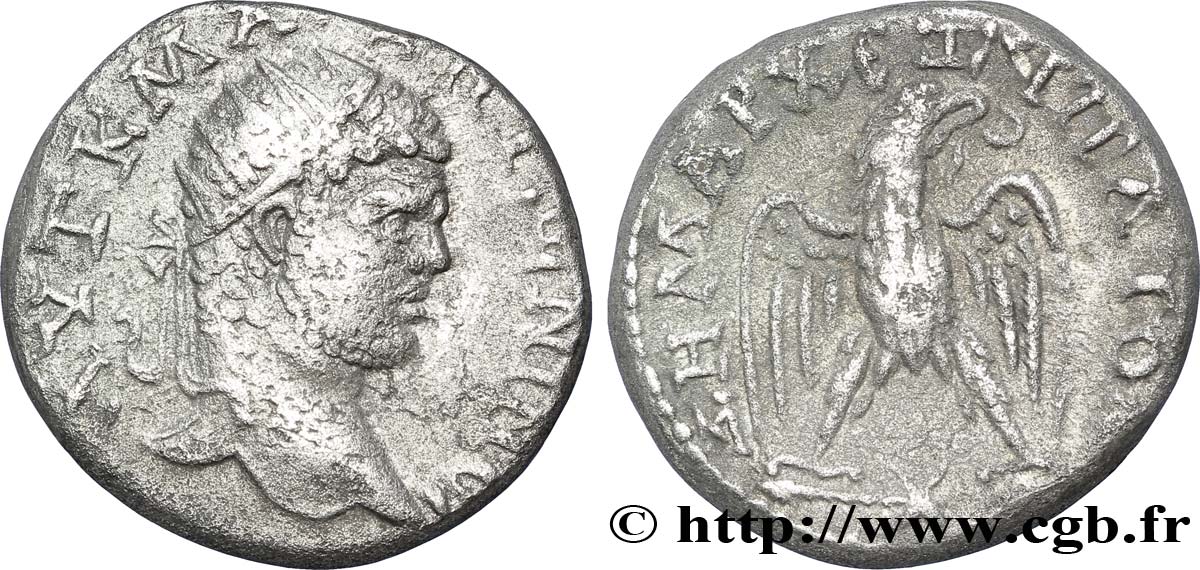
Descrittivo diritto : Tête radiée de Caracalla à droite, vue de trois-quarts en arrière, l’un des deux rubans de la couronne radiée descendant sur l’épaule (O).
Legenda diritto : AUT. K.M. AU .ANTWNEINOS (Autokrator Kaisar Markos Aurhlios Antwneinos)
Traduzione diritto : (L’empereur césar Marc Aurèle Antonin auguste).
Rovescio
Descrittivo rovescio : Aigle debout à gauche, les ailes déployées, la tête et la queue tournées à droite, tenant dans son bec une couronne feuillée ; les pattes de l’aigle sont posées sur un thyrse ou un foudre.
Legenda rovescio : DHMARC. EX. UPATOS TO. D., (Dhmarcikhs Ex Ousias Upatos D)
Traduzione rovescio : (Revêtu de la puissance tribunitienne consul pour la quatrième fois).
Commento
Autant certaines des frappes attribuées à Cyrrhus en proviennent à coup sûr (identité de graveur avec les frappes de présentation qui portent la statue de Zeus Kataibates, la grande divinité locale), autant c’est plus douteux pour d’autres. En effet, la lecture du symbole comme un thyrse par Bellinger semble peut-être recouvrir autre chose, probablement, à notre avis, une représentation locale d’un foudre. On doit noter que la représentation du foudre dans la main du Zeus des émissions de présentation de Cyrrhus (Prieur 900 et 901) est exactement identique à celle que l’on retrouve à Séleucie et au symbole sous les pattes de l’aigle à Séleucie sous Caracalla. Cela n’a rien d’étonnant car les deux villes adoraient des Baals maitres de la foudre et n’étaient guère éloignées l’une de l’autre.
Mais si une partie des émissions attribuées à Cyrrhus en proviennent effectivement avec comme symbole un foudre stylisé, à quelles villes attribuer en réalité les frappes d’autres graveurs, aux symboles mal lisibles ? Tant dans le Prieur que dans le Bellinger, l’atelier semble avoir servi de dépotoir pour pièces à problèmes dont le symbole pouvait laisser penser à un thyrse ou à un foudre et que l’auteur était bien en peine d’attribuer à un autre atelier (sans remonter au Bellinger, les Prieur 905, 906, 912 sont d’une attribution douteuse).
Notre exemplaire est indiscutablement de Cyrrhus.
On note que les sigma sont gravés en C.
Dans la base TSP maintenue par Michel Prieur, six exemplaires sont maintenant répertoriés dont trois en musées : Paris ex collection Seyrig, British Museum et Jérusalem ex trouvaille de Capharnaum. Notre exemplaire est le 0908_004.
While some of the strikes attributed to Cyrrhus certainly come from there (identity of engraver with the presentation strikes which bear the statue of Zeus Kataibates, the great local divinity), it is more doubtful for others.. Indeed, Bellinger's reading of the symbol as a thyrsus perhaps seems to cover something else, probably, in our opinion, a local representation of a thunderbolt. It should be noted that the representation of the thunderbolt in the hand of Zeus in the presentation issues of Cyrrhus (Prior 900 and 901) is exactly identical to that found at Seleucia and to the symbol under the eagle's feet at Seleucia under Caracalla.. This is not surprising because both cities worshipped Baals who were masters of lightning and were not far from each other..
But if some of the issues attributed to Cyrrhus actually come from there with a stylized thunderbolt as their symbol, to which cities should we actually attribute the strikes of other engravers, with poorly legible symbols? In both the Prieur and the Bellinger, the workshop seems to have served as a dumping ground for problem coins whose symbol could suggest a thyrsus or a thunderbolt and which the author was at pains to attribute to another workshop (without going back to the Bellinger, the Prieur 905, 906, 912 are of dubious attribution)..
Our example is indisputably by Cyrrhus.
Note that the sigmas are engraved in C.
In the TSP database maintained by Michel Prieur, six examples are now listed, including three in museums: Paris ex Seyrig collection, British Museum and Jerusalem ex Capharnaum find. Our example is 0908_004
Mais si une partie des émissions attribuées à Cyrrhus en proviennent effectivement avec comme symbole un foudre stylisé, à quelles villes attribuer en réalité les frappes d’autres graveurs, aux symboles mal lisibles ? Tant dans le Prieur que dans le Bellinger, l’atelier semble avoir servi de dépotoir pour pièces à problèmes dont le symbole pouvait laisser penser à un thyrse ou à un foudre et que l’auteur était bien en peine d’attribuer à un autre atelier (sans remonter au Bellinger, les Prieur 905, 906, 912 sont d’une attribution douteuse).
Notre exemplaire est indiscutablement de Cyrrhus.
On note que les sigma sont gravés en C.
Dans la base TSP maintenue par Michel Prieur, six exemplaires sont maintenant répertoriés dont trois en musées : Paris ex collection Seyrig, British Museum et Jérusalem ex trouvaille de Capharnaum. Notre exemplaire est le 0908_004.
While some of the strikes attributed to Cyrrhus certainly come from there (identity of engraver with the presentation strikes which bear the statue of Zeus Kataibates, the great local divinity), it is more doubtful for others.. Indeed, Bellinger's reading of the symbol as a thyrsus perhaps seems to cover something else, probably, in our opinion, a local representation of a thunderbolt. It should be noted that the representation of the thunderbolt in the hand of Zeus in the presentation issues of Cyrrhus (Prior 900 and 901) is exactly identical to that found at Seleucia and to the symbol under the eagle's feet at Seleucia under Caracalla.. This is not surprising because both cities worshipped Baals who were masters of lightning and were not far from each other..
But if some of the issues attributed to Cyrrhus actually come from there with a stylized thunderbolt as their symbol, to which cities should we actually attribute the strikes of other engravers, with poorly legible symbols? In both the Prieur and the Bellinger, the workshop seems to have served as a dumping ground for problem coins whose symbol could suggest a thyrsus or a thunderbolt and which the author was at pains to attribute to another workshop (without going back to the Bellinger, the Prieur 905, 906, 912 are of dubious attribution)..
Our example is indisputably by Cyrrhus.
Note that the sigmas are engraved in C.
In the TSP database maintained by Michel Prieur, six examples are now listed, including three in museums: Paris ex Seyrig collection, British Museum and Jerusalem ex Capharnaum find. Our example is 0908_004
Cronistoria
CARACALLA
(27/05/196-8/04/217)
Augusto
Dopo l'assassinio di Geta, Caracalla decretò la "damnatio memoriæ" del fratello. La "Costituzione Antoniniana" fu promulgata nel 212. Tutti gli abitanti dell'Impero divennero cittadini romani. L'anno successivo intraprese una campagna in Germania e ottenne molte vittorie su Germani, Iapigi e Goti. Ha ricevuto il titolo di "Germanico". La fine del regno fu segnata nel 215 dalla Riforma Monetaria e dalla creazione dell'Antoniniano. Caracalla inizia un'ultima campagna contro i Parti. Viene assassinato dopo aver celebrato i suoi vicennalia.
 Segnalare un errore
 Stampate la pagina
 Condividi mia selezione
 Fai una domanda
 Consegnare / vendere
Articoli correlati

 Descrittivo



Articoli visualizzati di recente
CARACALLA Tétradrachme syro-phénicien SPL
450.00 €

LOUIS XVI Écu aux branches d'olivier 1787 Bayonne BB/q.SPL
120.00 €
cgbfr.it numismatica


