


bpv_295681 - AUGUSTO Tétradrachme syro-phénicien
non disponibile.
Articolo venduto sul nostro negozio (2017)
Prezzo : 290.00 €
Articolo venduto sul nostro negozio (2017)
Prezzo : 290.00 €
Tipo : Tétradrachme syro-phénicien
Data: 30-29 AC.
Nome della officina / città: Antioche, Syrie, Séleucie et Piérie
Metallo : argento
Diametro : 26 mm
Asse di coniazione : 12 h.
Peso : 14,24 g.
Grado di rarità : R1
N° nelle opere di riferimento :
Pedigree :
Cet exemplaire est le 0014_005 de la base TSP, il provient de la trouvaille de Livia et de la collection de Richard McAlee. C’est cet exemplaire qui illustre le type dans l’ouvrage de Richard McAlee The coins of Roman Antioch, page 69, n°13
Diritto
Titolatura diritto : ANÉPIGRAPHE.
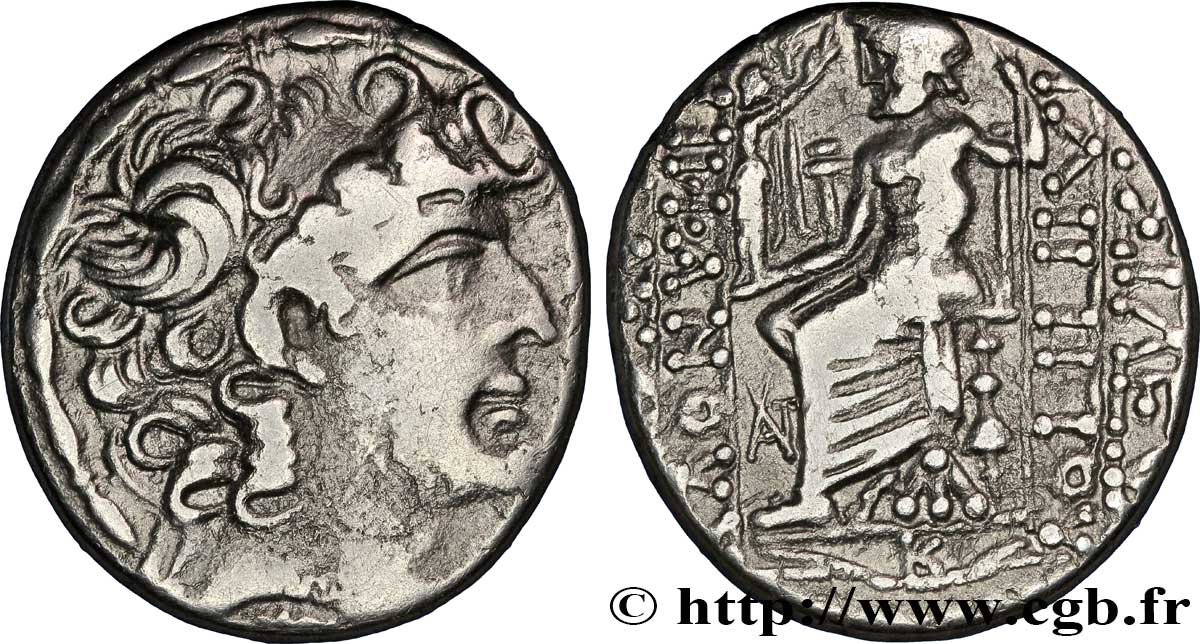
Descrittivo diritto : Tête diadémée de Philippe Philadelphe à droite, entouré de la stemma (O’).
Rovescio
Descrittivo rovescio : Zeus assis à gauche sur un trône avec dossier, tenant de la main droite une Niké qui le couronne et un sceptre long de la main gauche ; au-dessus de Zeus, le foudre ; monogramme dans le champ à gauche ; date à l’exergue.
Legenda rovescio : BASILEWS/ FILIPPOU/ EPIFANOUS/ FILADELFOU, K(Basilews Filippou Epifanous Filadelfou)
Traduzione rovescio : (Roi Philippe Epiphane Philadelphe/ monogramme d’Antioche et millésime 20).
Commento
An 20 de l’ère césarienne, deuxième année de frappe sous Auguste de la série intermédiaire entre les frappes séleucides et les frappes impériales syriennes.
La colonisation romaine se conforte et la Syrie devient une province impériale gérée par un Legatus Augusti. La monnaie, bien que contrôlée par Rome, reste toujours au type séleucide et seul le petit monogramme marque le changement.
Les émissions au type immobilisé de Philippe Philadelphe sont très importantes car elles illustrent parfaitement la logique impériale de la colonisation romaine. Autant une conquête de revendication territoriale d'expansion de l'espace vital autour d'un pouvoir central de type national va chercher à éliminer toutes les symboliques locales dans les pays conquis pour imposer celles du conquérant (selon le principe de un peuple, un roi, une foi, une loi), autant un empire va laisser cohabiter des symboliques différentes. C'est ce qui se passe en Syrie, Palestine et Phénicie dans les premiers temps de l'expansion. Loin d'imposer le denier ou la typologie romaine, les Latins vont respecter la métrologie et même le type. Il faudra attendre les rares émissions d'Auguste au revers du Zeus, presque cinquante ans, pour voir apparaître le portrait du Prince sur les monnaies locales en argent.
Style classique pour l’émission avec les mèches traitées en “serpents”. On remarquera le style du plissé de l’himation de Zeus que nous retrouverons exactement dans la première émission au portrait d’Auguste.
Dans la base TSP maintenue par Michel Prieur, vingt et un exemplaires sont maintenant répertoriés mais il faut noter que sur ce total, onze sont en musées ou collections publiques.
Year 20 of the Caesarian era, second year of minting under Augustus in the intermediate series between the Seleucid minting and the Syrian imperial minting.
Roman colonization was consolidated and Syria became an imperial province managed by a Legatus Augusti. The coin, although controlled by Rome, still remains of the Seleucid type and only the small monogram marks the change.
The immobilized type emissions of Philippe Philadelphe are very important because they perfectly illustrate the imperial logic of Roman colonization.. Just as a conquest of territorial claim of expansion of the living space around a central power of national type will seek to eliminate all local symbols in the conquered countries to impose those of the conqueror (according to the principle of one people, one king, one faith, one law), so an empire will allow different symbols to coexist. This is what happened in Syria, Palestine and Phoenicia in the early days of expansion.. Far from imposing the denarius or Roman typology, the Latins will respect metrology and even the type. It was not until the rare issues of Augustus on the reverse of the Zeus, almost fifty years later, that the portrait of the Prince appeared on local silver coins..
Classic style for the show with the strands treated in “snakes”. We will notice the style of the pleating of the himation of Zeus that we will find exactly in the first emission with the portrait of Augustus.
In the TSP database maintained by Michel Prieur, twenty-one examples are now listed, but it should be noted that of this total, eleven are in museums or public collections.
La colonisation romaine se conforte et la Syrie devient une province impériale gérée par un Legatus Augusti. La monnaie, bien que contrôlée par Rome, reste toujours au type séleucide et seul le petit monogramme marque le changement.
Les émissions au type immobilisé de Philippe Philadelphe sont très importantes car elles illustrent parfaitement la logique impériale de la colonisation romaine. Autant une conquête de revendication territoriale d'expansion de l'espace vital autour d'un pouvoir central de type national va chercher à éliminer toutes les symboliques locales dans les pays conquis pour imposer celles du conquérant (selon le principe de un peuple, un roi, une foi, une loi), autant un empire va laisser cohabiter des symboliques différentes. C'est ce qui se passe en Syrie, Palestine et Phénicie dans les premiers temps de l'expansion. Loin d'imposer le denier ou la typologie romaine, les Latins vont respecter la métrologie et même le type. Il faudra attendre les rares émissions d'Auguste au revers du Zeus, presque cinquante ans, pour voir apparaître le portrait du Prince sur les monnaies locales en argent.
Style classique pour l’émission avec les mèches traitées en “serpents”. On remarquera le style du plissé de l’himation de Zeus que nous retrouverons exactement dans la première émission au portrait d’Auguste.
Dans la base TSP maintenue par Michel Prieur, vingt et un exemplaires sont maintenant répertoriés mais il faut noter que sur ce total, onze sont en musées ou collections publiques.
Year 20 of the Caesarian era, second year of minting under Augustus in the intermediate series between the Seleucid minting and the Syrian imperial minting.
Roman colonization was consolidated and Syria became an imperial province managed by a Legatus Augusti. The coin, although controlled by Rome, still remains of the Seleucid type and only the small monogram marks the change.
The immobilized type emissions of Philippe Philadelphe are very important because they perfectly illustrate the imperial logic of Roman colonization.. Just as a conquest of territorial claim of expansion of the living space around a central power of national type will seek to eliminate all local symbols in the conquered countries to impose those of the conqueror (according to the principle of one people, one king, one faith, one law), so an empire will allow different symbols to coexist. This is what happened in Syria, Palestine and Phoenicia in the early days of expansion.. Far from imposing the denarius or Roman typology, the Latins will respect metrology and even the type. It was not until the rare issues of Augustus on the reverse of the Zeus, almost fifty years later, that the portrait of the Prince appeared on local silver coins..
Classic style for the show with the strands treated in “snakes”. We will notice the style of the pleating of the himation of Zeus that we will find exactly in the first emission with the portrait of Augustus.
In the TSP database maintained by Michel Prieur, twenty-one examples are now listed, but it should be noted that of this total, eleven are in museums or public collections.
Cronistoria
AUGUSTO
(16/01/27 a.C. - 19/08/14 d.C.)
Augusto, dopo Azio e la presa di Alessandria, rimane l'unico padrone dell'Impero Romano. Cedette i suoi poteri al senato nel 27 e fu insignito del titolo di augusto, dando vita a un nuovo regime politico: il principato.. I prossimi quarant'anni saranno dedicati alla strutturazione e al consolidamento del sistema messo in atto da Augusto sul piano politico, economico e culturale.. È assistito da Agrippa, che diventa suo genero sposando la figlia Giulia nel 21 a.C.. -VS. e gli dà due nipoti, Caio e Lucio. Purtroppo Agrippa, amico e sosia, morì nel 12 a.C.. -VS. Sul piano militare è affiancato prima da Druso poi da Tiberio, i due figli della sua terza moglie, Livia. A livello culturale, l'arbitro delle mode è Patron. Con il suo poema epico l'Eneide, la nuova Iliade e l'Odissea, Virgilio rievoca la mitica nascita di Roma ed esalta le virtù romane.. Con abile attività diplomatica e militare, e nonostante il disastro di Varo nel 9 d.C., Augusto fissò il limes sul fronte renano-danubiano, beneficiando delle ripetute campagne di Druso, poi di Tiberio, e della fine del regno di Germanico, figlio di Druso. La relativa pace con i Parti si materializza con il ritorno degli alfieri e dei prigionieri di Carre (53 a.C.. -VS. ) nel 20 a.C. -VS. Questo evento ha un impatto notevole. Augusto riorganizza anche le province senatorie e imperiali. Si riserva l'amministrazione dell'Egitto. Gli ultimi vent'anni del suo regno sono dedicati alla preparazione della sua successione. Uno dopo l'altro, Agrippa morì nel 12 a.C.. -VS. , Druso nel 9 a.C. -VS. , poi i suoi due nipoti, Lucio in 2 e Caio in 4. Augusto morì a Nola il 19 e 14 agosto a 77 anni, lasciando il trono a Tiberio, nuovo marito di Giulia, già due volte vedova.. Le sue speranze riposano anche su Germanico mentre Agrippa Posthumus è stato messo da parte. Dopo la sua morte, Augusto viene divinizzato e i romani danno il suo nome all'ottavo mese dell'anno, agosto (augustus).
 Segnalare un errore
 Stampate la pagina
 Condividi mia selezione
 Fai una domanda
 Consegnare / vendere
 Descrittivo

cgbfr.it numismatica


